



SPOILER ALERT: This story contains spoilers for “Coven Academy,” now streaming on Disney+.
“Coven Academy” was supposed to be the first true young adult drama in the history of Disney Channel. The series, set at a New Orleans boarding school for witches and warlocks, is bloodier and darker than the network ever got with other magical fare like “Wizards of Waverly Place.”
Ultimately, those qualities drove Disney to decide “Coven Academy” would be more at home on Freeform. “I think this shares more DNA with a classic CW show like ‘Vampire Diaries,’ or even the ‘Sabrina’ revival on on Netflix,” says series creator Tim Federle, best known as the mind behind “High School Musical: The Musical: The Series.” “When we went to Vancouver to shoot this, I feel like I hired half the ‘Riverdale’ team and was like, ‘Let’s bring that aesthetic to this show.’ Optically and message-wise, this sits in a different space than Disney Channel. As more and more of the higher ups at the company watched the show and got excited, there was a decision made, which was that this doesn’t belong there; it’s the wrong signal.”
“And yet,” he adds, “because of the sisterhood and magic, I feel this is still classically Disney. If you’ve watched ‘Zombies’ and ‘Descendants’ and ‘Vampirina,’ and maybe you’re also dipping a toe into older genre shows, I think this is a bridge.”
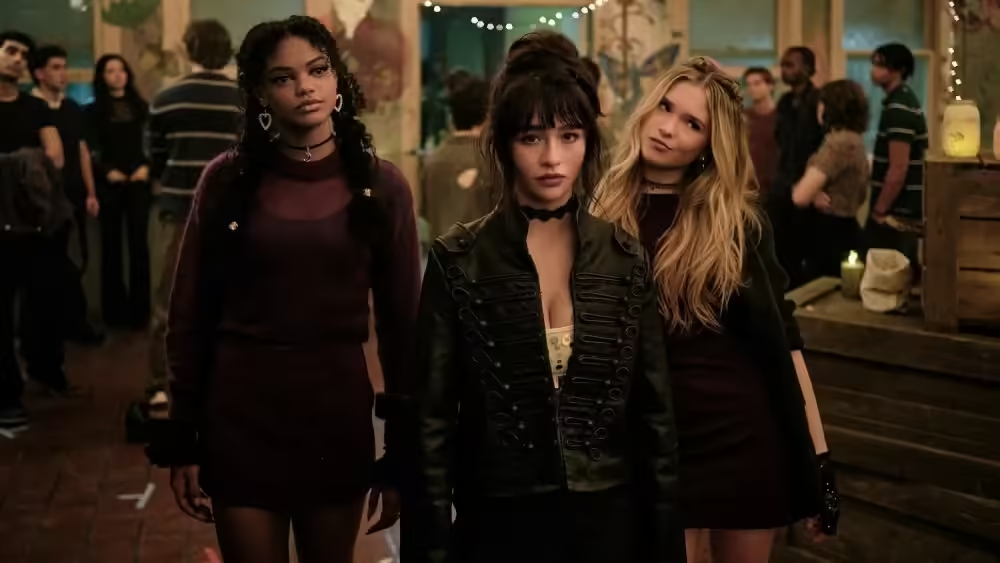
“Coven Academy” stars Malina Weissman as Briar, whose grief and anger about the unsolved murder of her mother, Mary, end up revealing a part of her identity she’d never known: She’s a witch. After reluctantly starting school in New Orleans, she befriends two fellow witches, Sasha (Jordan Leftwich) and Tegan (Ora Duplass), who teach her the ways of the magical world and help her search for answers about Mary (Cecilia Grace Deacon).
That process requires the young witches to break some rules, attracting the watchful eye of the school’s headmaster, Miss Graves (Tiffani Thiessen), who they realize was close friends with Briar’s mother. Miss Graves’ secrecy, and some information shared by one of their teachers, Mr. Cole (Devon Sawa), lead them to believe that she’s the murderer. But it’s later revealed that the real Mr. Cole is locked in a basement. A shapeshifting Warlock named William — who turns out to be the father of the girls’ friend Jake (Malachi Barton) — has taken Mr. Cole’s place as part of a decades-long evil scheme. He had been friends with Mary back in school until she, Graves and their coven sister Tamora (Keegan Connor Tracy) thwarted his plan to pollute the ley lines, the mystical source of all witches’ and warlocks’ powers. The coven interrupted a spell he was casting that would have made it so that they could all use only dark magic, which would lead to the eradication of monsters like the werewolves that killed his family. Decades later, he had come out of hiding to try again, and didn’t hesitate to kill anyone in his way — including Mary.
Briar, Sasha, Tegan and Graves — with an assist from Jake — manage to stop William and save the magical world. But as everyone processes their whirlwind semester at school, Briar can’t stop thinking about the connection she felt when Graves grabbed her hand to cast the spell on William. At the same time, Graves is shown speaking to Mary’s ghost in the woods. “I wanna tell her, Mary. She needs to know why I gave her up,” Graves says. “She needs to know what happened. No more secrets.” Mary replies, “No one can ever know you’re Briar’s birth mother. If the truth ever got out, you wouldn’t be able to protect her.” As a storm rolls in and Season 1 ends, Graves says, “She deserves to know.”
Federle spoke to Variety about family secrets, the meaning behind dark magic and what’s to come for “Coven Academy.”
“Coven Academy” isn’t based on IP, but you’re pulling from preexisting lore about witches, vampires and other mystical beings. What was your research process like? Did you create a rulebook about how magic operates in the world of the show?
Todd Slavkin and Darren Swimmer, my co-showrunners, ran “Shadowhunters” and “Smallville.” They really understand genre. And we staffed up the writers’ room primarily with women, and some of the younger women were on, like, their second viewing of “Vampire Diaries.”
In the room, we got pretty granular about the rules, like with warlocks and teleporting. I really wanted everything to be governed by character and emotion and what their perceived faults might be. For me, everything that got me picked on in middle school gets me paid now. I just needed to get with the right group, and then they would accept it. And for Briar, she gets labeled as angry or hot-headed, but it’s actually her source of power if she can channel it. For Tegan, it’s about having ADHD. It’s her ability to morph time, though other people might call her hyperactive. For Sasha, she is so empathic and has the ability to read other people, but she is not totally in touch with her own feelings.
All of those felt like metaphors for the teenage experience that could somehow be explored in magic. I wanted the magic to be driven by character.
This show was originally intended to be Disney Channel’s first YA drama. It ended up moving to Freeform, but since you were writing with a Disney Channel audience in mind, how did you approach the level of violence, romance and darkness in the show?
So many young people, for better or for worse, are exposed to [mature themes]. When I was in high school myself, I was not reading the assigned reading; I was reading “The Shining.” There’s a curiosity about the darker, deeper experience of growing up. I think I have a pretty good internal barometer of what makes something Disney and appropriate for a younger audience, even if it toes the line. And when you look back, you’re like, “OK, Simba’s dad dying is traumatic.” The best Disney stories go to really genuine places, even if you’re not always seeing all the blood.
But there is some blood and some making out in “Coven Academy.” I am very excited about a white space that I think exists at Disney. Disney has done the most incredible job of keeping an audience engaged through the [tween] era, but there’s this white space where I want to capture the audience — I don’t want them to go away. I’d like to see Disney really have a piece of that pie.
Devon Sawa as Mr. Cole
Let’s get into the plot now. Did you always know that the villain would be Jake’s dad, who Briar’s mom had a history with? Or were Graves or Cole ever real candidates?
Cole was never going to be the murderer. Devon Sawa is such a chameleon, so it was a joy to see him play multiple roles in one season. There was some discussion about Graves, but I liked the commonality and parallelism between Jake and Briar both having this giant parental question mark around them. And I kept bringing up, “What if Ms. Graves is actually her mom?” And the more I was watching Tiffani and Malina — their physical resemblance, and how maternal Tiffani is, as someone who grew up a teen icon — the more I felt like there was a really powerful story there. The idea that if a witch is related to another witch and they are in close proximity, there’s something very dangerous and powerful about that. That became the secret of the season, which I really hope we’re able to explore.
Tell me more about William, the actual villain, and what his character represents.
The best villains think they’re heroes and that the thing they want is noble. He feels this very anti-monster stance. And in Jake’s awakening as a young warlock, he’s able to ultimately summon his father. “Coven Academy” is so much about: “Who are you if your family expects something? Who are you if you’re in the shadow of a sibling? Or if your family experiences trauma or loss? How do you make something out of that?” William is what happens if you go to the dark place. Genre is a blast, because you get to experiment with so much metaphor, whether it’s substance abuse or family shame.
The characters discuss the addictive nature of dark magic multiple times. Was it meant to stand in for substance abuse?
I hope the audience recognizes the idea that almost anything in moderation is OK, but be careful how deep you go. In my extended family, there’s some deep substance abuse, and I saw how it tore people apart and became a real emotional lightning rod. Dark magic is about that thing that you may be drawn to, whether it’s drinking or internet doomscrolling, that can be a perfectly benign habit, but if you go deep, it can take over.
The tension between humans and “monsters” also seems to represent something bigger. It feels wrong when the witches and warlocks talk about vampires and werewolves like they aren’t equals, but it’s based on real fears about their safety. What were you trying to say with that conflict?
It’s definitely a commentary on othering. With McKenna [Sway Bhatia] getting bitten, we’re trying to figure out what that means for her story with Tegan. It’s a classic “Romeo and Juliet,” or any story about a group that feels different from you. Now more than ever, we’re so divided in so many ways, and it’s easy to write off a group of people. One of the reasons I wanted Ollie [Louis Thresher] to be a newly turned vampire was because it was truly thrust upon him. He did not walk out the door that morning and say, “I want to be a vampire.” Whereas Jake, the powerful warlock who’s got so much going for him, has darker qualities, in some ways, than Ollie, who is a genuinely great guy and is now trying to make the best of [his circumstances]. That’s the story of anybody growing up and deciding what kind of person they want to be. I don’t even think of the vampires as monsters. I keep using that word, but I think of them as just different — and aren’t we all different? I don’t like black-and-white stories. I like the gray.
By the way, when Jake and Briar almost kiss in the final chapter, we also shot a version where they did kiss, and we were like, “We have to save this. This is a slow burn. We’re yearning. Don’t rush everything.” The gray is how you get 100 stories and not just 10.

Malachi Barton as Jake, Malina Weissman as Briar
There are also interesting gender politics going on. William warns Jake about witches getting together and being judgmental, and Jake has a line about how witches work together with their coven sisters, but warlocks deal with their problems on their own.
I made a decision really early on to separate the witches and the warlocks. With the women, it’s about girlhood and sisterhood. They lean on each other and gossip and come back together. The guys are on this very solitary journey. In my mind — not addressed yet in the series — they all used to learn together. And then around ’98, when William made this decision that fractured the community forever, the well-meaning adults separated the genders. We are fully owning this idea that boys and men are just not as comfortable expressing themselves, and when they do, these days in particular, they’re listening to some potentially questionable sources. The young ladies in the show are calling each other out and keeping each other accountable.
At the beginning of the season, Briar doesn’t think of herself as a girl’s girl, and by the end, these are her sisters. Jake was being, if not brainwashed, certainly influenced by a male figure with some misogyny here. But Jake made a better decision than I think a lot of people do in real life.
Thinking about a potential second season, how do you see Jake dealing the fact that he finally gained the father he’d been missing his whole life just to lose him again?
He has some major things to face when it comes to nature vs. nurture. “Am I always going to be drawn to dark magic? Is that my genetics?” It’s the addiction metaphor. But I would like to explore Mr. Cole being a genuine mentor to Jake moving forward. Jake is somebody who has to throw himself into something, because with idle time, he gets into trouble.
What about Briar and Miss Graves? Thematically, what are you exploring by revealing they’re mother and daughter?
I’m childless, and I never wanted kids, but [in my work] I can’t graduate from high school, it seems. So I was interested in telling the story of a woman who absolutely knew her life would be complete without the experience of being a capital-M “Mother.”
Maybe it’s because I grew up a black sheep that I’m always drawn to stories of making your parents proud vs. following your own destiny. I liked the idea of suddenly looking at somebody anew and going, “Hold on a second. Like, if I’ve inherited X, Y and Z from you, what does that mean? Did you have anger issues too?” Secrets are a big thing in families. What you keep from your family to protect them ultimately creates bigger issues later. I don’t want to tell another straight-up mom mystery again, but I think there is something fun to explore in what makes a mother and daughter so dangerous when they’re together. And who would be most threatened by that?

Tiffani Thiessen as Miss Graves
What’s on your mind with the other characters as you contemplate a second season?
Ollie goes away because he doesn’t want to hurt Briar, yet he’s so drawn to her, and he recognizes the inherent unfairness of that. I think he’s going to work on if there’s a way back. Sasha’s desperately sad about her brother [Nathaniel Logan McIntyre] being a vampire and diving into this idea of, “Is there something I could do to turn him back? And if I could, would he even want that?” And Tegan’s got feelings developing for McKenna, who could very much be under threat.
I’m a selfish, greedy, ambitious showrunner. I don’t want to say seven seasons — I said that in every interview for “High School Musical: The Musical: The Series” and we got four, the longest running show on Disney+, I’ll humbly point out — but I’ve got similar ambitions for this. I’d love to create a world, and I hope the audience shows up.
This interview has been edited and condensed.
Source: variety.com