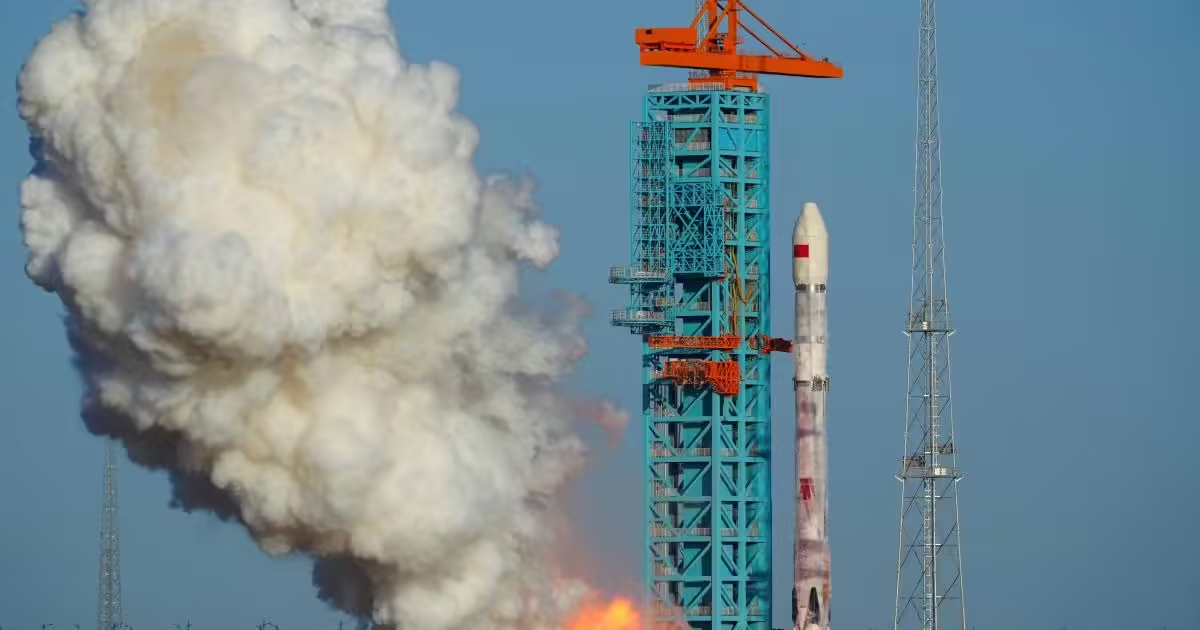

On the morning of August 19, China’s space industry crossed a major threshold. Shortly after the Chinese aerospace company LandSpace launched a rocket in northwestern China, its booster—the part needed to thrust the rocket into orbit—successfully detached and landed back on earth. It was the first time a Chinese firm recovered a rocket on land, and it came six weeks after the country’s first-ever rocket recovery, carried out in the South China Sea by China’s premier state-owned space contractor. These events mark the dawn of China’s reusable rocket launch—a capability that will unlock enormous potential in the country’s booming space industry.
Washington’s response to these developments has been muted. The United States still conducts more than twice as many launches and has more satellites in orbit than any other country. But China is catching up. Between 2020 and 2025, the number of rockets launched annually by Chinese companies more than doubled, from 39 to 92. Chinese entities have applied for licenses for hundreds of thousands of communications satellites, and Chinese space companies are proliferating. Many of them, such as LandSpace, are relatively new but already innovative.
This progress has both economic and military implications. Chinese companies could soon compete with U.S. firms to provide vast swaths of the globe with space-based services such as satellite Internet. Meanwhile, the People’s Liberation Army (PLA), which sees space superiority as essential to winning future wars, is developing a range of space capabilities as well as a suite of weapons that can attack satellites. This poses a serious risk to the U.S. military, which depends on space for communications, situational awareness, and navigation, as well as for conducting precision strikes and receiving missile warnings.
China’s development as a space power should be a wake-up call for the United States. After the end of the Cold War, Washington began to take its dominance in space for granted. It can no longer afford to do so. As Beijing’s space industry advances, its cost advantages will make it much harder for U.S. companies to compete, and China’s military capabilities will increase the risk that space becomes a battlefield in future conflicts. The era of unassailable U.S. space power is ending, and Washington has no choice but to adapt.
BLASTOFF!
China’s space program dates to the 1950s, when Chinese leader Mao Zedong initiated efforts to modernize the PLA and boost technological innovation. In 1970, China launched its first satellite, and in the 1980s, it made space technology research a national priority. But the watershed moment for China’s space program occurred during the 1990–91 Gulf War, when the U.S. military’s adept use of space-based assets allowed a relatively small but technologically advanced coalition to defeat Iraq’s army in just a few days. Satellites allowed U.S. forces to navigate difficult desert terrain, gave commanders information about the battlefield with greater speed and accuracy, and enabled soldiers to coordinate seamlessly across long distances. Beijing, which had not realized just how far behind it was, leaped into action to catch up.
In the years that followed, PLA doctrine emphasized the growing importance of advanced technology, especially satellites, for warfighting. In 2000, the Chinese military began developing its own satellite-powered navigation service, called BeiDou, so that it would not have to rely on U.S.-operated GPS. In 2015, the PLA created the Strategic Support Force, a now defunct organization that consolidated China’s space, cyber, and electronic warfare missions, with the aim of accelerating the country’s space progress. That same year, a Chinese government white paper identified outer space as a critical national security domain. China has since created spacecraft for communications; navigation; and intelligence, surveillance, and reconnaissance that would have been unimaginable to PLA officials who observed Desert Storm.
Encouraging commercial space activity has become one of China’s main tools for expanding its space program. In 2014, Beijing opened parts of the space sector to private investment, and more than 400 Chinese commercial space companies have since sprouted. Beijing and provincial governments have provided commercial space firms with financing through state-backed investment funds, subsidized factory upgrades and rocket launches, and given private companies access to government test facilities and technologies. In 2025, commercial space missions accounted for 54 percent of China’s national total, and commercial satellites made up 84 percent of Chinese spacecraft placed in orbit. China’s broad space-industrial ecosystem, composed of commercial companies, state-owned enterprises, research institutes, and universities, has allowed the country to eliminate its dependence on GPS and paved the way for the development of new domestic remote sensing and satellite communications companies.
In reusable rocket technology, the U.S. company SpaceX has enjoyed an enormous advantage, conducting five out of every six launches in the United States. But China’s two controlled recoveries of rocket boosters in July and August suggest that it could be a real competitor to the United States within a decade. Reusable rockets drive down the cost and increase the speed of space launches significantly; should China master the technology, it could develop large satellite constellations much more easily.
Reusable launches will also allow China to develop space-based Internet capabilities to compete with SpaceX’s dominant Starlink network, an extensive satellite Internet system with connectivity that rivals many land-based networks and which has been crucial for Ukraine in its defense against Russia. Although Chinese companies are still in the early stages of developing this technology, they are scaling fast. The entities operating the Guowang and Qianfan satellite constellations, which intend to compete with Starlink, plan to launch nearly 30,000 communications satellites over the next decade or so. These systems are currently much smaller than Starlink, which has more than 11,000 satellites in orbit, but they could eventually become legitimate alternatives. Qianfan already has trial agreements with Brazil, Kazakhstan, Malaysia, and Turkey for the use of its satellite network.
ROCKET SCIENCE
China’s commercial space development has gone hand in hand with a growing ability to use space to support its military modernization. Beijing has spent decades studying the U.S. military’s use of satellites, and it is now developing its own national security–related space capabilities. According to the Pentagon, China operates more than 500 satellites that can conduct intelligence, surveillance, and reconnaissance missions, in addition to its satellite-enabled positioning system, allowing the PLA to locate and track U.S. and allied forces around the world. PLA strategists have identified Defense Department space assets as valuable targets because the U.S. military depends on them for nearly every step of what it calls the “kill chain”: finding, aiming at, and striking targets, and then assessing the results.
To exploit U.S. dependence on satellites, Beijing is investing in antisatellite weapons. Since 2007, when it conducted its first successful test of an antisatellite missile, China has developed other tools, including electronic warfare and directed-energy weapons, which can interfere with satellite signals or damage sensors without physically destroying satellites. Chinese spacecraft can also execute increasingly sophisticated maneuvers: in 2022, a Chinese satellite called Shijian-21 attached itself to a defunct Chinese satellite and moved it into a different orbit. Such an action could be benign—it could be used to repair and refuel satellites or remove debris—but it could also enable Chinese platforms to manipulate other spacecraft, including U.S. military satellites. Beijing’s ability to take down U.S. satellites could pose an especially serious challenge for the U.S. military in East Asia, where, in the case of conflict, China would be much less dependent on space-based assets than the United States.
China’s space rise is already influencing broader international security dynamics. During Russia’s full-scale invasion of Ukraine, in 2022, Chinese firms provided satellite imagery of the battlefield that helped Russian forces conduct military operations. Throughout the war in Iran, Chinese entities have also supplied Tehran with satellite imagery, including images of a base in Jordan that Iran struck in July, resulting in the deaths of three American service members. As China’s commercial space sector expands, so could these relationships, giving more countries and nonstate actors without advanced space programs access to their benefits. Such expanded access could be used during natural disasters or other emergencies to save lives. But it could also provide adversaries with the ability to more effectively target U.S. and allied forces across the globe.
MISSION CRITICAL
As China’s space power grows, Washington has moved to protect some of its satellite networks. The U.S. Space Force has diversified the placement of some of its most sensitive assets and increased procurement of new satellites. Such investments are useful but insufficient to address the United States’ vulnerabilities. Given the capabilities that China already has or will develop soon, there are now many possible scenarios in which the U.S. military would have to operate when satellite communications are denied or degraded, GPS signals are jammed, and intelligence from orbit is restricted.
The U.S. military should invest in nascent technologies, such as inertial navigation systems and quantum sensors, which could one day help its forces move with precision without GPS. It should also invest in emerging alternatives to satellites, such as high-altitude relays, which include drones or balloons that operate closer to Earth and can link communications networks; laser-enabled communications, which use light to transmit information and are difficult to disrupt; and mesh networks, which automatically reroute signals around nodes that have been destroyed, making communications more resilient. Mechanisms for delegating decision-making will be even more essential than in the past, as the danger of disconnection increases.
Washington should also increase its efforts to foster a more competitive domestic launch industry. The United States leads the world in space launches largely because of SpaceX. Although the company is an enormous asset, its near monopoly is a risk. If technical failures or damage to launch infrastructure were to interrupt SpaceX’s operations, the United States’ ability to launch satellites would be severely curtailed. This year, SpaceX announced plans to retire the Falcon 9, its main reusable rocket. The Falcon 9 will eventually be replaced by Starship, a new high-capacity rocket that will carry more satellites into orbit with each launch. But the beginning of the phase-out has already created a launch shortage that threatens the continued development of the U.S. space economy. To mitigate this risk, Washington should continue awarding government contracts to more companies.
SpaceX is an enormous asset to the United States, but its near monopoly is a risk.
In addition to investing in launch capacity, the United States should provide support to companies building emerging space technologies that have important national security applications but which struggle to attract sufficient commercial demand in their early years—an approach it took with SpaceX starting in the first decade of this century. Federal agencies could be anchor customers for technologies that Washington identifies as crucial for national security purposes, providing companies that make them with stable revenue and legitimacy that will allow them to grow.
Identifying important emerging technologies and consistently funding them is essential to maintaining a lead in space. Unfortunately, U.S. priorities in the sector have been susceptible to changes across presidential administrations and in Congress. When the Soviet Union collapsed, so did Washington’s willingness to invest heavily in space. The United States did not, of course, completely abandon space, as evidenced by projects such as the space shuttle program, the Artemis moon missions, and the founding of the U.S. Space Force. But the government’s interest in the domain has waxed and waned. Beijing, on the other hand, has pursued its space objectives consistently since the early 1990s, revising programs as technology evolves without losing sight of its end goal. If Washington is to continue competing with China, it should sustain its commitments, too.
Finally, the United States would benefit from working with its allies. NATO is already experimenting with ways to share members’ space expertise and integrate it into allied operations. In July, eight U.S. allies launched the HALO initiative, which aims to connect sovereign military satellites into a network that streamlines communications, intelligence, and missile tracking. NATO’s STARLIFT project, established in 2024, is exploring how launch sites across allied territory could speed up access to orbit during a crisis. The United States, which has deprioritized international security cooperation in recent years, should recommit to allied space security. Having access to allies’ space resources will be essential in future conflicts that stretch across vast distances, especially if the United States’ own space-based assets are taken down.
Even the most effective modernization and resilience measures will not be enough to protect U.S. assets in space from determined adversaries. For decades, the United States was able to depend on space dominance in fighting wars. Now, overdependence on satellites and on SpaceX are major liabilities. Washington must protect itself in a world in which it is no longer the sole space power. Staying ahead in the new space race will require both investing in space architecture and establishing backup plans to offset the dangers of the emerging multipolar space age.
Loading…
Source: www.foreignaffairs.com