




Illustration: Chen Xia/GT
China is steadily moving toward becoming an agricultural and food powerhouse, and it has become a practical example of how a country can feed its people.
The country’s grain output has held steady at 700 million tons for two consecutive years, fully meeting the food demand of its 1.4 billion people, and in recent years production has gone beyond basic sufficiency. China feeds nearly 20 percent of the world’s population with 9 percent of the world’s arable land.
The shift is not only in volume. China has moved from producing enough food for 1.4 billion people to producing enough nutritious food. Feeding the population, and feeding it well, is a policy priority, as better diets help reduce disease and micronutrient deficiency.
Chinese research institutes are sharpening agricultural technologies and breeding for a changing climate, drought included. For example, heavy investment in genetics allows scientists to select traits for higher yields, disease resistance and nutrient uptake. These are different lines of work, but they serve one goal: stable, nutritious supply.
I saw what that looks like on the ground in a village near Shijiazhuang, North China’s Hebei Province. The community ran a full chain from production to processing and sales. It felt less like a scattering of small plots than a place organized for farming. This Chinese model of rural revitalization is useful for Africa. If farmers are organized into cooperatives, they learn from one another.
One household adopts a better variety, and neighbors see the result, take it up, and productivity rises. For the African continent, getting out of food poverty, and then out of income poverty, starts with agricultural production. When farming works, a community has taken the first step from poverty toward prosperity. That is what China has done.
I want to see similar cooperatives in Africa, using technologies developed jointly by Chinese and African researchers and tested in China and a number of African countries.
Africa holds about 60 percent of the world’s available arable land, yet many countries still cannot produce enough food and rely on imports. The most common reason is the lack of technology. Machinery is limited, and farmers there plant long-season local varieties with very low yields. Also behind that is a lack of investment in agricultural research. In contrast, China invests heavily in research and development.
In this context, China’s drive to become an agricultural powerhouse matters beyond its own borders, and it carries great significance for Africa.
It is reported that the output of China’s homegrown super hybrid rice at a demonstration base in Sichuan Province has reached a world record of almost 18.8 metric tons per hectare, surpassing the target set by Chinese scientists. `
That is why I am here in Hainan: to deepen China-Africa agricultural cooperation. Hainan, in South China, is tropical, and most of Africa is tropical as well. Crops can be tested in both places and exchanged. Work done on China’s agricultural priorities can bring a direct benefit to African farmers. At a time when geopolitical uncertainties are spreading hunger and malnutrition, a Chinese policy that raises real production is beneficial for Africa and the rest of the world.
An old Chinese saying puts the method well: give a man a fish and you feed him for a day; teach a man to fish and you feed him for a lifetime. China-Africa agricultural cooperation must extend beyond the training of a limited number of scientists or the designation of priority crops and livestock.
The prospects are better if bilateral cooperation extends from shipments to local capacity. Seeds, fertilizers, farm machinery and irrigation are the fields where this can go deepest. Chinese seed companies can test drought-tolerant and higher-yield varieties with African partners, then produce and sell them to local farmers. Joint training of mechanics and irrigation technicians keeps equipment in use after the project team leaves.
China has always put people’s need for food first and worked to support Africa’s agricultural development. China has a clear understanding of what food-sovereignty means: no matter what shock a country faces, it can still ensure a sufficient food supply for its people. That is a development goal China has long pursued at home. In its agricultural cooperation with Africa, China focuses on making sure that improved crop varieties, farm machinery, and agricultural skills truly stay in local hands. After the project team leaves, the related agricultural capacity remains rooted in Africa and continues to support the continent’s independent development.
Felix Dapare Dakora is a senior advisor to the National Nanfan Research Institute (Sanya) under the Chinese Academy of Agricultural Sciences, foreign member of the Chinese Academy of Engineering and former president of the African Academy of Sciences
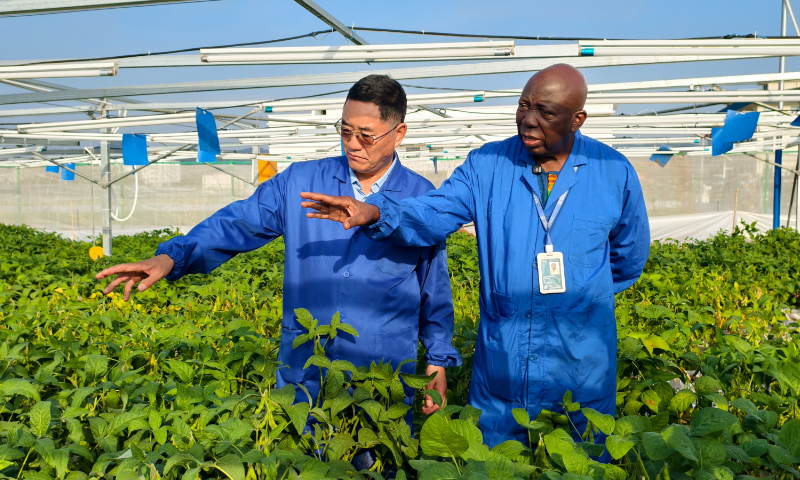
Felix Dapare Dako (right) works at a farmland in Sanya, South China’s Hainan Province in 2026. Photo: Courtesy of the National Nanfan Research Institute (Sanya) under the Chinese Academy of Agricultural Sciences
Source: www.globaltimes.cn