



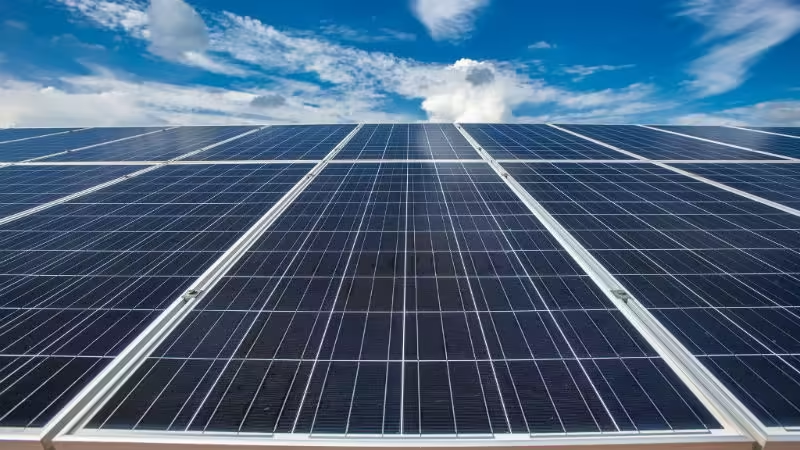

China’s solar export controls proposal would bring 12 photovoltaic technologies under new restrictions, while an immediate registration requirement is already placing certain overseas technology transfers under government scrutiny. The plan, announced October 16 and examined in fresh reporting by Reuters on Sunday, reaches manufacturing processes and some equipment carrying those technologies. The proposed additions to the export catalogue remain subject to public consultation through November 15.
The measures cover parts of the industrial chain that turns raw material into electricity-producing cells: polysilicon, wafers and cell manufacturing. They arrive in an industry whose production capacity remains concentrated in China, even as other countries develop factories and research programs of their own.
Beijing’s announcement combines two different timetables. The catalogue changes are proposed, but the temporary registration system took effect when the notice was published. Treating the whole announcement as either an immediate export ban or a future-only proposal would miss part of the policy.
A proposal with an immediate requirement
The Commerce Ministry and Ministry of Science and Technology jointly issued the official notice. It encompasses 40 technologies across artificial intelligence, biotechnology and photovoltaics, with solar accounting for 12 of them.
Until the revised catalogue formally takes effect, exporters must register covered transfers through the ministry’s technology-trade platform. Transactions already begun but not completed are included. The notice identifies transfers of technology ownership, licensing domestic technology for use overseas and changes that place a domestic technology’s owner or actual controller under a foreign entity among the situations requiring registration.
The requested information includes the parties involved, destination, technology, intended use and expected transaction value. That gives the interim requirement a reach beyond a shipment of physical goods: a licensing arrangement or ownership change can also bring a transaction within its terms.
In an accompanying explanation, the ministry said the revision was not directed at any particular country, region or entity. It cited expanding applications of photovoltaic technology in aerospace, national defense, unmanned equipment and other sensitive infrastructure as its security rationale.
The explanation also said products made using the technologies would fall outside the proposed technology controls. Certain listed critical equipment carrying controlled know-how would be included, while other unlisted photovoltaic equipment would generally fall outside the notice’s requirements.
Reuters reported that the proposed prohibited category includes perovskite and tandem-cell production technologies. Other advanced solar-cell manufacturing technologies would be restricted rather than prohibited. The two categories therefore should not be read as interchangeable, and the announcement does not establish a blanket ban on exports of finished solar panels.
The factories behind the panels
The manufacturing base gives the policy international relevance. In its Energy Technology Perspectives 2026 report, the International Energy Agency put China’s share of solar supply-chain production capacity at about 85%, rising to about 95% for photovoltaic wafers. Those figures describe capacity, rather than the value of panel exports or a country’s electricity generation.
The agency’s supply-chain assessment also examines concentration beyond national borders. Chinese companies account for a substantial portion of solar manufacturing capacity located outside China, it says. A factory’s location alone therefore does not describe all of the industry’s corporate connections.
A separate stress test in the same report illustrates the exposure. The agency estimated that a one-month halt in Chinese solar supply-chain exports would reduce output at module factories outside China by about $1 billion. Southeast Asia and India accounted for more than 40% of the affected output in that scenario.
That calculation assumes an export disruption; it does not predict losses from Beijing’s proposed technology rules. The distinction between a broad supply interruption and controls on selected manufacturing know-how limits what the estimate can establish about this announcement.
Why tandem technology draws attention
Some of the technologies named in the proposal concern the next generation of solar cells. Perovskites are a family of materials with potential for efficient light absorption and comparatively inexpensive production, according to the U.S. Department of Energy. In photovoltaic applications, a thin active layer absorbs light and generates excited electrons that can be extracted as electric power.
A perovskite absorber can be paired with silicon in a tandem cell. The materials capture different parts of the light spectrum, offering the prospect of converting more sunlight into electricity than either material alone. The term describes the cell’s layered design, rather than a separate source of energy.
DOE describes possible manufacturing advantages that include low-temperature processing and printing active layers from inks. Those approaches offer the potential for fewer or less expensive production steps. They remain possibilities dependent on successful development, rather than evidence that every tandem manufacturing process is commercially competitive.
The department’s research guidance identifies durability and scaling as major challenges. Perovskites can deteriorate under moisture, oxygen, heat, light and electrical stress. Researchers must also produce uniform material across larger areas while retaining the performance achieved in small laboratory devices.
Manufacturing methods under study include depositing layers on a rigid sheet or on a flexible base in a roll-to-roll process. The department says reliably producing durable, high-efficiency modules with scalable methods is a requirement for translating laboratory advances into wider manufacturing.
Testing creates another obstacle. Different test conditions make results difficult to compare, and laboratory measurements require validation against behavior outdoors. DOE describes standardized testing, independent replication and field data as part of building confidence in the technology’s long-term operation.
A U.S. project still in development
The American effort predates the Chinese announcement. DOE selected projects for its $44 million Advancing U.S. Thin-Film Solar Photovoltaics program in May 2024, supporting both perovskite tandems and cadmium-telluride technology. The department listed a proposed $6 million award for Cubic PV’s work on durable perovskite-silicon modules and $7 million for Swift Solar’s prototype-to-production project. Its published award figures were rounded and subject to negotiations.
The projects address different manufacturing problems. Cubic PV’s plan allows optimization of the perovskite layer without changing the silicon layer. Swift Solar’s work uses vapor deposition for the perovskite layer, with measurements during production to improve control and reproducibility. DOE describes both as development efforts, including tests of durability, rather than finished answers to the industry’s manufacturing challenges.
American research is pursuing that same combination of performance and manufacturability. A September 25 DOE document describes support for Tandem PV’s TANDEM project, which is developing mechanically stacked perovskite-silicon modules manufactured in the United States.
The work outlined in the document proceeds through coating development, testing of the module-production process, prototype design and field trials. Results from field testing are to inform scaled prototype production, followed by further testing of durability, stability and manufacturing performance.
DOE says the project, if successful, aims to reduce installation costs and the levelized cost of energy by as much as 20%. That is a conditional project objective, not a reported commercial saving. The document describes a development and validation program; it does not establish that the Chinese proposal has affected the project.
FAQ
Have China’s proposed solar-technology bans taken effect?
The catalogue revision is still proposed, with consultation running through November 15. The separate temporary registration requirement began with the October 16 notice.
Does the announcement ban all solar-panel exports?
No. The ministry describes controls on selected technologies and certain equipment carrying them, and says products manufactured using the technologies are outside that scope.
Has the U.S. tandem project achieved its projected savings?
The DOE document presents the savings as an objective conditional on successful development and testing, rather than an achieved result.
Source: finchannel.com