



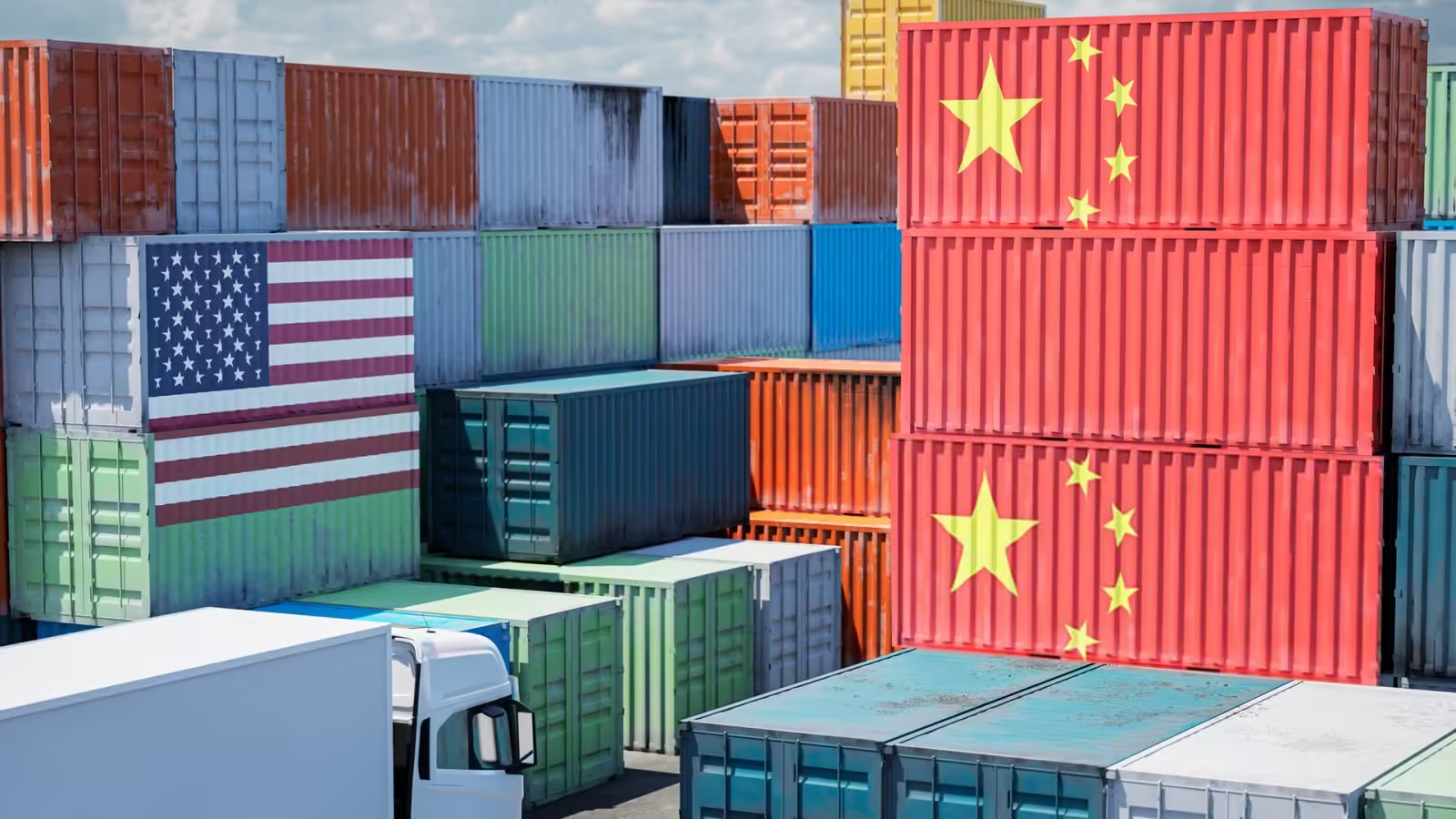

While China is engaged in a fierce struggle with the U.S. for AI supremacy, it is accelerating its development of other future technologies. In 2024, Chinese investors put nearly $1 trillion in clean-energy capex for renewables, electricity grids, and energy storage. As a result, China now makes 70% of the world’s EVs, its companies are responsible for 80%–85% of global solar photovoltaic manufacturing, and they oversee more than 75% of global battery production. Writes Columbia University scholar Tim Wu, “If we set AI aside for a moment and assume that these technologies represent the future, it is clear who is ahead.”
Other benchmarks reach a similar conclusion. Take, for example, the Australian Strategic Policy Institute’s “Critical Technology Tracker,” which analyzes China and the United States’ research capacity across 74 current and emerging technologies. The latest data from December 2025 indicated that China led research in nearly 90% of crucial technologies, including nuclear energy, synthetic biology, and small satellites. The results revealed a “drastic reversal,” writes Xiaoying You in Nature. At the beginning of the century, American scientists held an enduring advantage in more than 90% of assessed technologies, with China leading in less than 5% of them; but in the intervening 25 years, Chinese researchers flipped the balance.
The days of China as an “imitator” are long gone.
While the findings are striking, some caveats are in order. Most importantly, the authors measured cited pieces of research as opposed to deployable or applied technology. It is one thing to publish theoretical concepts. It is quite another to come up with a manufacturing process and actually produce specific items. When it comes to innovations like jet engines (a task that remains stubbornly elusive for Chinese engineers), whether research translates to manufacturing is a key question. As the authors acknowledge, “If you’re good at origami but don’t yet excel at making decent paper, are you really good at origami?” Nonetheless, the conclusions are sobering and signify how swiftly China has narrowed the scientific gap with the U.S.
China’s success in the consumer drone industry underscores its growing technological power. Da Jiang Innovations (DJI), which is based in Shenzhen, holds more than 70% of the global consumer drone market. In 2022, the size of that market was about $30.6 billion; it is expected to grow to $55.8 billion by 2030. While studying at Hong Kong University of Science and Technology, founder and CEO Frank Wang started DJI in 2006. Rather than work out of a dorm room, Wang and two of his classmates rented a small office across the border in Shenzhen. He started selling drone control systems for hobbyists making their own DIY units. By 2013, DJI released its first preassembled “ready-to-fly” drone, the Phantom 1, which sold for less than $700. The product was a hit — the cost was reasonable, and the unit came with “serious hardware,” making it stand out from the cheap toy versions being sold at similar price points.
Today, DJI is a behemoth: it has over 14,000 employees and no close competitors. Its drones are ubiquitous, including in the U.S. They are used by first responders to respond to emergencies and by hobbyists to take panoramic photos. They have also become an important fixture on the battlefield, particularly in Ukraine. Both sides rely heavily on DJI drones to surveil troop movements, guide artillery, and identify enemy emplacements. China has reportedly shipped millions of dollars’ worth of DJI units to Russia during the conflict.
China’s success in the consumer drone industry underscores its growing technological power.
But it is not just Wang’s resourcefulness and tenacity that is responsible for DJI’s market dominance. U.S. tech executives confided to me that there was no way a U.S. company could replicate DJI’s success. The industry’s understanding was that DJI scaled due to massive subsidies from the Chinese government, affording it major cost advantages. Reporting from The Washington Post confirmed these claims, despite DJI’s assertions that it had not accepted any funding from the Chinese government. Reporters reviewed company documents and other sensitive information showing that four investment entities “owned or administered by Beijing” invested in DJI, including a government asset manager who played a key role in “promoting partnerships between private enterprises and the Chinese military.”
Not only did state subsidies play an important role in propping up the company, but DJI also benefited from being part of China’s competitive drone ecosystem, which spawned an array of service providers producing advanced components at cut-rate prices. Few other countries could compete. When a Taiwanese drone manufacturer tried to replace its Chinese-made engines, it searched far and wide for alternatives, even going to Australia, where it found that an equivalent engine “would cost 20 times more.” The company eventually inked a deal with a local supplier, but only after convincing the bidder to lower its prices “as an act of virtue” to support Taiwan’s defense.
Like other Chinese firms and products (such as TikTok), geopolitics have caught up to DJI. In December 2025, the Federal Communications Commission blacklisted all new foreign-made drones and components from the U.S. market over concerns that they posed “an unacceptable risk” to national security. While the directive didn’t directly name DJI, given the company’s 80% share of America’s consumer drone market, the implication was clear: DJI drones were no longer welcome in the U.S. (For now, the FCC’s rule doesn’t impact DJI’s unmanned aircraft already in use; it only applies to new drone sales.) In short, today’s geopolitics has made DJI’s position increasingly untenable for America’s interests.
China’s ambitions are large, and it has built up an enviable R&D and manufacturing capacity.
Experts remain divided about how the U.S. and China stack up on science and technology. In certain sectors, American research continues to lead; in other areas, China appears to be supplanting the U.S. What is clear is that the days of China as an “imitator” are long gone. Some analysts argue that the West retains a “creative advantage” relative to China, but scholars like Georgetown University’s William Hannas and Huey-Meei Chang contend that this mischaracterizes China’s advancements. They argue that focusing on how China achieved its innovation, whether through forced tech transfers or collaboration, “is largely irrelevant.” Instead, what matters is the degree to which China’s scientists have achieved technological breakthroughs, and on that score “China’s progress is clear.”
Looking at the trend lines, their logic is sensible. China’s ambitions are large, and it has built up an enviable R&D and manufacturing capacity. Despite its current economic struggles, it has vast resources for Xi to turn loose in the growing tech war against the U.S.
Xi projects confidence that China is on the right track. Ahead of the CCP’s approval of the Fourteenth Five-Year Plan, which outlines development priorities for the country, the party released a 2018 speech by Xi that served as a “powerful reminder” about China’s modernization push. In his remarks, Xi declared, “We are closer than any time in history to the objective of the great rejuvenation of the Chinese nation, and we need more than any time in history to build [China into] a world S&T superpower!” Those are not the words of a leader who believes China’s innovation is faltering.
Adapted from “Bytes and Bullets: Global Rivalries, Big Tech, and the New Shape of Modern Warfare” by Steve Feldstein published by St. Martin’s Press © 2026 by Steven Feldstein, and reprinted with permission.
Source: restofworld.org