




by Lillian Avedian, Nashville Banner
October 9, 2026
Tennessee charter schools want more support from the state when it comes to facilities and financing.
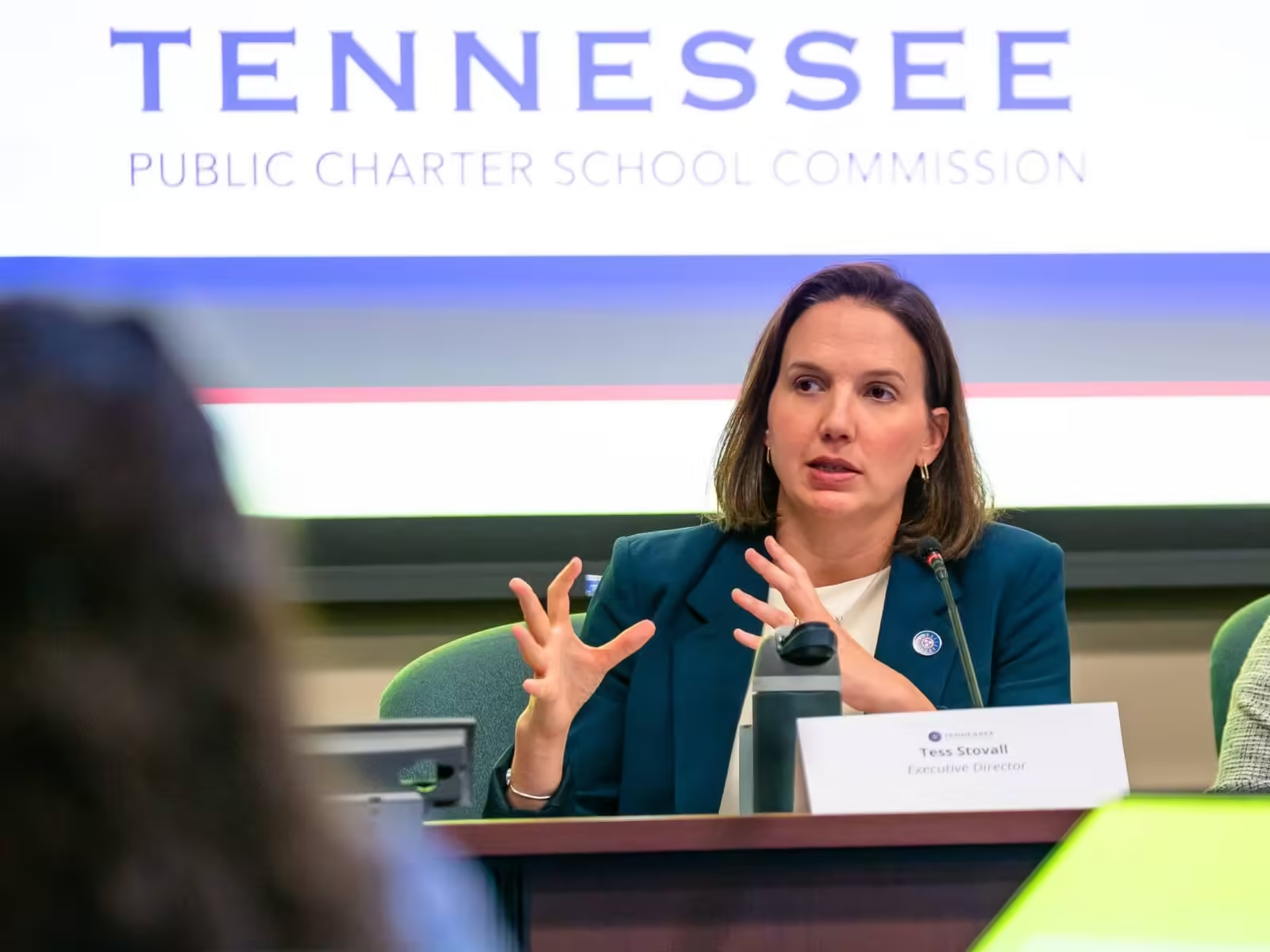
The Tennessee Public Charter School Commission, a state body that oversees a portfolio of charter schools across the state, hosted a panel on Thursday to discuss the challenges of securing resources and facilities. Charter schools, which are privately run and publicly funded, are responsible for managing their own operations and finances. Chris Richards, chair of the commission, said that finding facilities is “the single biggest thing that we consistently hear about with our new schools.”
The Commission approved two new charter schools last year that intended to open for the 2026-27 school year in Middle Tennessee. The Rock Academy is an opportunity charter school that plans to serve at-risk students in Nashville, and Rocketship Public Schools was approved to open a fourth campus in Rutherford County. Both have delayed their opening dates because they did not find facilities.
Dr. Eric Dailey, executive director of Rocketship Tennessee, said that the network has faced two main obstacles to opening on time. The first is finding an appropriate building, options for which, he said, “continue to be few and far between.” Since construction from the ground up is expensive, charter operators often look for existing buildings that they can renovate to meet the educational needs of students, he said. The second obstacle is finding lenders with the confidence in a new charter school’s ability to finance multimillion dollar projects.
“The last thing you want to do is make promises, particularly to new families, that you can’t meet,” he said.
Dailey added that the Commission’s portfolio of charter schools has grown over the past decade, making the search for facilities and finances increasingly competitive. There are 30 schools in Nashville, Memphis, Rutherford County and Jackson in the Commission’s portfolio, including 16 in Davidson County.
“Operators are ideally experts in educating young people,” Dailey said. “We are not necessarily finance experts or renovators by any stretch of the imagination.”
Emily Lilley, a vice president at the nonprofit advocacy group Tennessee Charter School Center, added that the state can do a better job of providing clearer information to charter school leaders as they decide what neighborhoods to open in as well as resources to ask the right questions.
“Real estate in Nashville is difficult,” she said, “no matter what you’re trying to do with the building.”
Jana Lavin, a charter school facility consultant, said that enrollment is one key reason charter school openings are delayed. New charter schools in Tennessee often do not meet their projected enrollment numbers. For example, Jackson Museum School opened in the 2026-27 school year with 118 students, fewer than its budgeted enrollment of 160 students. Lavin argued that charter schools should rely on “evidence-based enrollment” rather than “simple math” to calculate their enrollment projections.
“When enrollment is declining nationally everywhere, we are seeing letters of intent, conversions to enrollment at 20-25 percent drops,” Lavin said. “You’re not going to be able to get financing if you can’t prove that your kids — who actually are the dollars in the door — demonstrate that you can bring that forward.”
The Tennessee Charter School Center launched a fund last month to help charters acquire and expand facilities. The fund was created with a $5 million allocation from the state, matched by philanthropy. Based on a survey, the center estimated that charter schools statewide will face $72 million in facilities costs over the next five years.
The state has allocated more than $100 million to help charter schools find and improve facilities since 2017, including a one time allocation of $20 million for all charter schools in 2025.
Lilley proposed that in addition to state support, charter schools should be able to access local government funding allocated for traditional public schools. Metro Nashville Public Schools officials have lamented that the state share of funding for Nashville’s public schools has been in decline, forcing the city to take on a greater share of local education funding. District officials have pointed to the expansion of voucher programs and new state-authorized charter schools as two sources diverting state funds from MNPS.
The Commission will meet for a second day on Friday to vote on new start applications from four proposed charter schools in Nashville.
This <a target=”_blank” href=”https://nashvillebanner.com/2026/10/09/tennessee-charter-schools-facilities-financing-issues/”>article</a> first appeared on <a target=”_blank” href=”https://nashvillebanner.com”>Nashville Banner</a> and is republished here under a <a target=”_blank” href=”https://creativecommons.org/licenses/by-nd/4.0/”>Creative Commons Attribution-NoDerivatives 4.0 International License</a>.<img src=”https://i0.wp.com/nashvillebanner.com/wp-content/uploads/2023/05/favicon-300×300-1.png?resize=150%2C150&ssl=1″ style=”width:1em;height:1em;margin-left:10px;”>
<img id=”republication-tracker-tool-source” src=”https://nashvillebanner.com/?republication-pixel=true&post=35491&ga4=G-7M2L6EHPYT” style=”width:1px;height:1px;”><script> PARSELY = { autotrack: false, onload: function() { PARSELY.beacon.trackPageView({ url: “https://nashvillebanner.com/2026/10/09/tennessee-charter-schools-facilities-financing-issues/”, urlref: window.location.href }); } } </script> <script id=”parsely-cfg” src=”//cdn.parsely.com/keys/nashvillebanner.com/p.js”></script>
Source: nashvillebanner.com