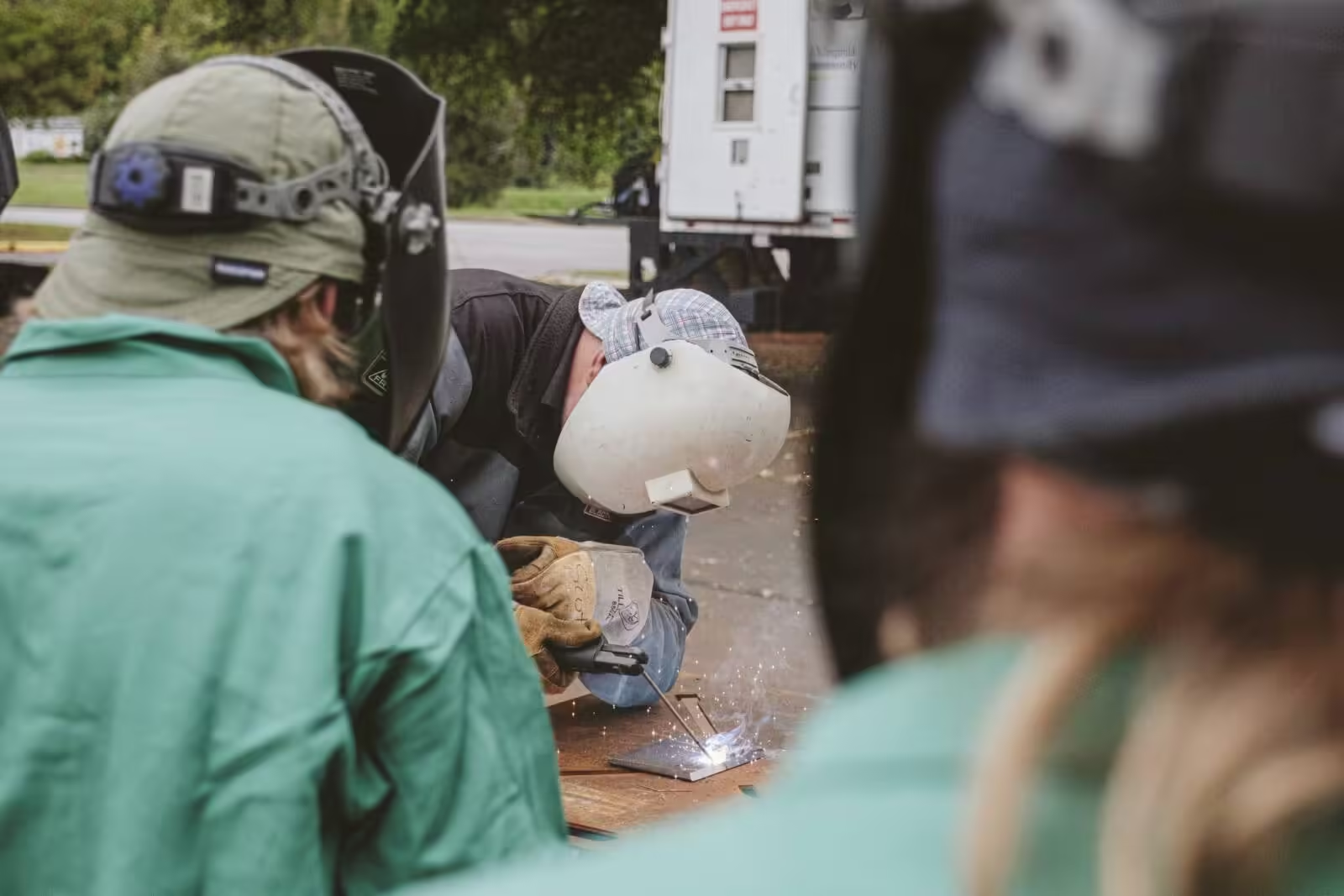

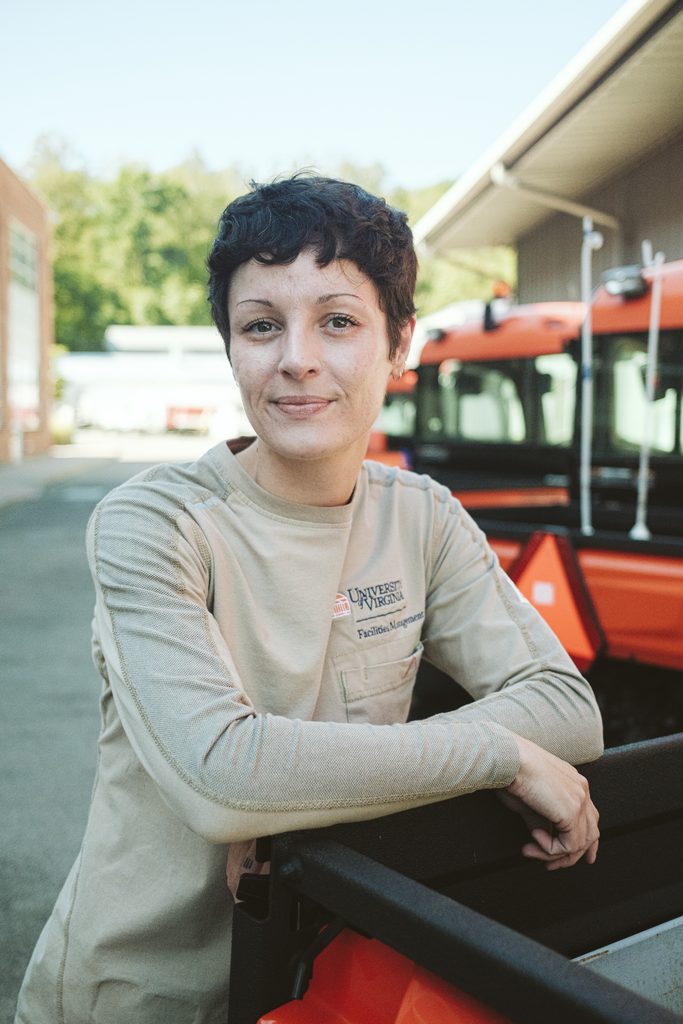
Alex Funk’s job comes with a big bag of tricks. “Wire nuts, locknut wrenches, electrician-specific things, like wire strippers and cutting pliers,” says Funk, burrowing through her backpack of tools. “This is my 11-in-one, there’s two sizes of Phillips and flatheads, a hawkbill knife, different types of connectors, and a lot of random pieces of hardware.” She also uses plenty of stuff that doesn’t fit in the backpack: eight-, 10-, and 12-foot ladders, assorted power tools and battery banks, zippy Kubota RTVs, and, with each skilled trade rotation—Funk’s already done four-month stints in HVAC and plumbing—a large, official-looking set of keys. Funk, 32, who earned an undergraduate degree in art, is in year two of UVA’s four-year apprenticeship program. She used to fix fighter jets for the U.S. Air Force. Now she’s on track to become an electrical journeyman in another couple of years and secure a $70,000 to $80,000-a-year job.
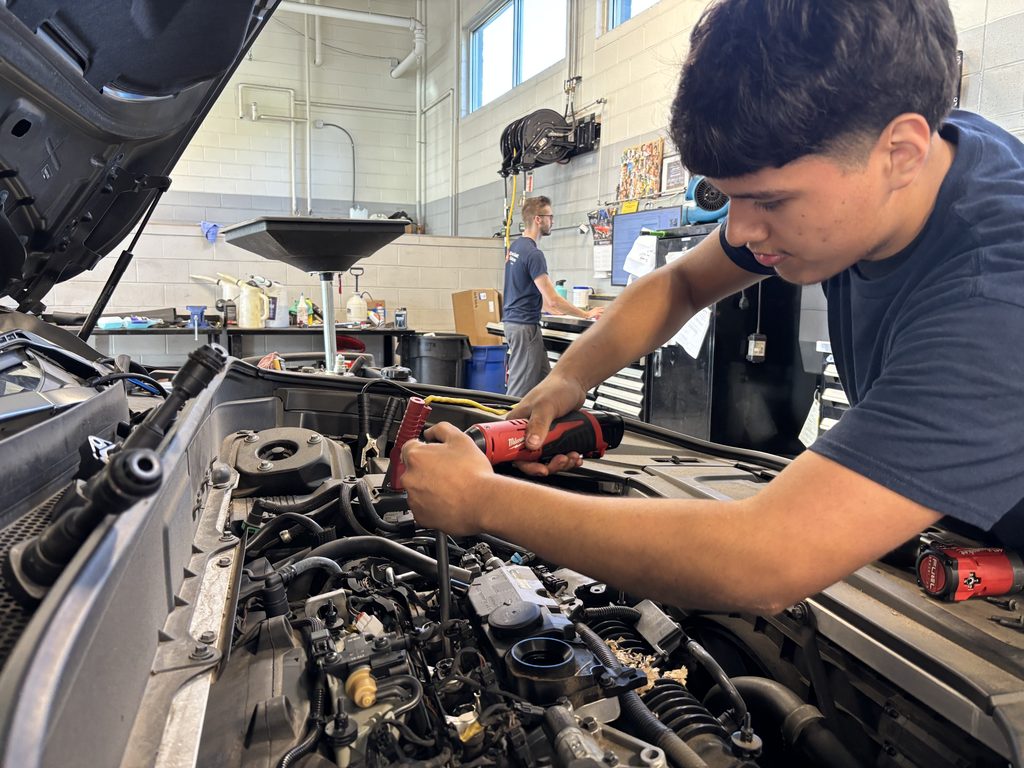
Across town, 17-year-old automotive tech apprentice Chris Serrato is giving a graphite-colored Volvo its 60,000-mile tune-up.
“So, that’s the spark plugs, tire rotation, transmission service, oil change, and then checking the car over to see what else it needs,” says Serrato, who’ll graduate from Albemarle High School next spring with a year of experience, a job, and shot at a six-figure salary.
It was a love of fast cars that drove Serrato’s interest in Carter Myers Automotive’s apprenticeship program, where he works part-time while in school. Since last summer, CMA mentors have brought him up to speed on the intricacies of European car maintenance, as well as how to use diagnostic equipment and a fantastical variety of tools.
“Getting to fix something is just really satisfying,” says Serrato, a slow smile spreading on his face. “I basically built my foundation here, and learned a lot from all the techs. They’re really good teachers.”
One garage over is Jeremy Hill, 20, who’s using a computer to align tires on a khaki-colored Nissan Rogue. Hill, a 2025 Western Albemarle High School graduate who attended CATEC junior year, once considered going to a four-year college.
But “I was always very fidgety, and needed to do something with my hands,” he says. “Once I really started gathering stuff in the automotive world, I was like, ‘This is really something I could do for the rest of my life.’”
The glue
Ask 18-year-old Landon Wiseman the hardest part of his job, and he’ll quip, “Heights!” Ask him about his five-year goal, and his answer is dead serious: “To be the best employee I can be, and to make my boss money.”
A year ago, Wiseman started as a landscaper for Chance+Da Company, a Central Virginia builder. It wasn’t long, though, before he got noticed—and promoted. Now Wiseman helps staff and company owners doing whatever’s needed, from buying and delivering materials to cleanup and client relations. He calls the work “fulfilling and very fun.”
“I get to make things go together,” says Wiseman. “You have to be hardworking, and respectful, and respectable, and open to learning. That’s a recipe for success in any field you’re working in, but especially construction. Relationships and communication are key”—and not just in construction.
“From digging ditches to building skyscrapers, the things you’ll learn from this field can translate so easy into other fields, just like that,” adds Wiseman. “Plus, people will always be building houses, so if you’re in construction, and you’re good at it, you’ll always have jobs.”
Trade up (you’re hired!)
Funk, Serrato, and Hill are among the country’s 728,000 registered apprentices, 15,000 of whom live in Virginia. Others, like Wiseman, get on-the-job experience in less formal but equally powerful ways.
Long a staple in European countries like Switzerland and Germany, where more than half of young people become apprentices, area educators and industry professionals say there’s a continuing surge of interest in the skilled trades from high schoolers, recent graduates, and career-switchers, especially in the last five years. In 2025, Trump officials announced plans to grow apprenticeships to more than a million to feed manufacturing, defense, and shipbuilding jobs. While that goal hasn’t been met, Virginia apprenticeships have grown six-fold under the last two presidencies. The shift is showing up in local enrollments, too.
Piedmont Virginia Community College’s fall electrical and HVAC courses are at capacity, with waitlists stretching to spring. CATEC’s electrical courses are also full, and most other programs “mostly full,” says Katharine Dulaney, who manages the school’s apprenticeship and adult education programs. UVA’s apprenticeship program routinely receives north of 100 applications for roughly a half-dozen spots each year, according to Julie Thomas, assistant director of occupational training for UVA Facilities Management. Five years ago, Carter Myers Automotive hired Beth Lucchesi to visit schools and attend career fairs to recruit 20 to 30 automotive technician apprentices a year, like Serrato and Hill, who work with seasoned mechanics for one to two years to become certified.
Interest is heating up the search for trades instructors, too.
“We help tradespeople understand the teaching aspect is also another way to keep that work going, and add longevity,” says Dulaney. “There’s the manual work, and there’s also helping educate the next generation, and there can be creative ways to piece that together, to kind of get the best of both worlds. Teaching is a totally different muscle use and way to spend your time with students who truly want to learn this work and are interested in it.”
By contrast, Virginia’s undergraduate student population declined 1.4 percent since last year, according to the State Council of Higher Education for Virginia’s estimates. On average, graduate enrollment is off by 2 percent, but in some places, like Virginia Tech, it’s declined by 7 percent in a single year.
“We like to say college is all about the pursuit of learning and truth and all that, but I think students and their families recognize that when they graduate, whether that’s from a skilled trade program, an associate’s degree, or bachelor’s degree, there needs to be a job at the end of that,” says Todd Parks, PVCC’s senior director of admissions. “The skilled trades are in-demand jobs, they pay well, they’re available in our community, and they often require short- term training, not necessarily a two- or four-year degree.”
Money talks (earn while you learn)
Virginia isn’t the only state with a teeming supply of construction projects and a voracious appetite for energy. Someone’s got to build all those data centers, says Dulaney, which has the potential to earn wages that are as much as 43 percent above the standard rate.
“There is some legitimate concern of where a lot of these people will come from to build the buildings that’ve been committed to,” she says, “so in an indirect way, AI is giving more security. Those projects will be short-term, at least for the construction, but because there’s such a need, so the wage increases . . . are really exorbitant.”
Bureau of Labor Statistics 2025 estimates show median pay for construction laborers (expected to add 109,000 jobs a year through 2035) was about $23 an hour. HVAC technicians (expected to add 48,000 jobs a year through 2035) earned just under $30 an hour, while electricians’ (expected to add 73,000 jobs a year through 2035) and plumbers’ (expected to add 34,500 jobs a year through 2035) median rate was above $30 an hour. PVCC Program Manager Scott Ishler says data center builders earn about $50 an hour and electricians at the North Anna Nuclear Plant earn more than $52 an hour to start. Side hustles and contract work can plump earnings, too, says Ishler. Community relations specialist Lucchesi says CMA’s automotive techs “easily earn six figures.”
“The trades are becoming more and more recognized,” she says, “not only to make a living, but to build a very high wage-earning career with advancement and respect. Twenty years ago, we thought, ‘Gosh, they’re going to be changing oil for $20 an hour for their whole career,’ and that’s just not the case.”
Leigh Keniston, PVCC’s vice president of academic affairs and workforce development, calls them “family-sustaining wages.”
“Here are fields where they’re going to be making as much money, if not more, as somebody with a traditional bachelor’s degree,” says Keniston. “What we see with the skilled trades, when students come out, they’re doing better than just living. They’re thriving.”
Passion (learning new things)
But money isn’t everything. For those with a yen for creativity, Ishler says the work scratches that itch, too.
“We could put all [our students’] welds in a pile, and everyone’s looks a little different,” he says. “So much of it is problem solving. Let’s take conduit, a large amount of wires, and figure out the best way to [install electrical lines] so it doesn’t get in the way of anything else. For plumbing and HVAC, you have to figure out and accommodate all the slopes and angles. All that problem solving leads to creativity.”
CATEC Principal Stacy Heltz surveys students each year about what motivates them in a job.
“And wage is not the number one,” says Heltz. “It tends to be passion for the work. And helping students connect with that is key to long-term happiness.”
She pushes students to consider everything.
“We’re shifting our mindset from, ’It’s this or that,’ and talk to students about ‘And,’” says Heltz. “You can do a skilled trade and go to college. If college doesn’t work, you have this thing to lean back on. It can also be a hobby, something that helps you pay your way through school. You can be a mechanic, and then do the engineering aspect of it, too. You can pair both aspects together. It really is about the opportunities and possibilities.”
After a series of administrative and tech jobs in his 20s and 30s, Greg Weaver became interested in green energy and started imagining himself installing solar arrays and “working toward something that’ll make a difference in the community and ultimately the world.” He’s now more than halfway through his apprenticeship at UVA.
Weaver, who majored in music and East Asian studies at the university, likes working with his hands, being active, and roving around campus with mentors like Cody Borrelli, a lead electrician who’s worked in the field for 16 years.
But the biggest net positive?
“It’s being interested in learning,” says Weaver. “I’m a curious person, so while this is different work than I did before, it’s still like I’m learning things I have zero clue about. That’s exciting. I think people should tap into that. I think we all have the capacity for that and can get excited about learning new things.”
Trades secrets
Interested in a career in the skilled trades? High school students, families, educators, and other curious community members can explore career paths at the 2026 NextGen Skilled Trades Day. The event is free and open to the public.
Saturday, October 17
10am–1pm
Piedmont Virginia Community College
501 College Dr.
Source: c-ville.com