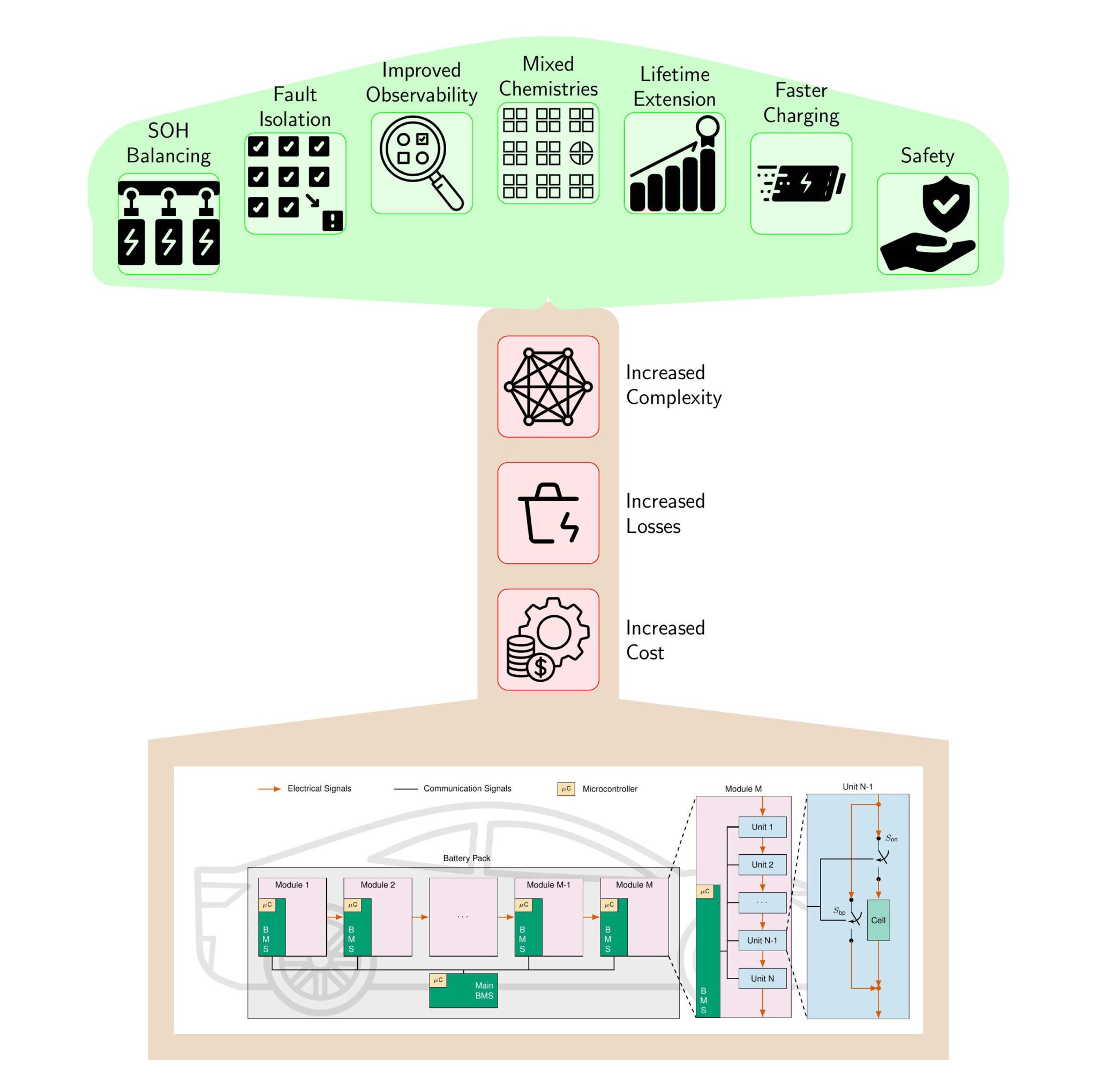





Reconfigurable battery packs shift EV durability from cell chemistry to control electronics, opening a new lever for automakers
Reconfigurable battery packs that route around weak cells could extend electric vehicle (EV) battery life by more than 20% in some high-voltage models, a Chalmers University of Technology study involving Phinia and Scania has found. That figure assumes each cell is switched individually, so it marks a theoretical ceiling.
Cells in a pack age unevenly, and in current designs the weakest sets the limit for all of them. Switches and control software let a reconfigurable pack skip that cell and keep drawing on the rest, with electric trucks and long-range cars gaining most.
In a modelled 80 kW/h car battery covering 12,000 km a year, the reconfigurable pack hit the replacement threshold after about 11 years, roughly 14 months later than a conventional pack retired at 10. Added electronics raise upfront cost, though longer life and stronger residual value offset it in many realistic cases, the study found.
Production may change too. Tolerating wider variation between cells could cut the testing and matching work done during manufacturing, and more packs could reach a second life as stationary storage, though the approach exists only in research and industrial prototypes.
In a statement, Changfu Zou, Professor at the Department of Electrical Engineering at Chalmers and study co-author, said: “Reconfiguration is not a question of ‘on or off’. It is a spectrum, and where a manufacturer chooses to sit on that spectrum determines how much of the potential benefit can be realised.”
Source: www.automotiveworld.com