
Here’s the thing about “Chad Powers”: It’s an acquired taste.
“It’s a deep, and deeply stupid, show,” co-creator Michael Waldron says, laughing knowingly from his corner of the Zoom window. “And I’m very proud of it.”
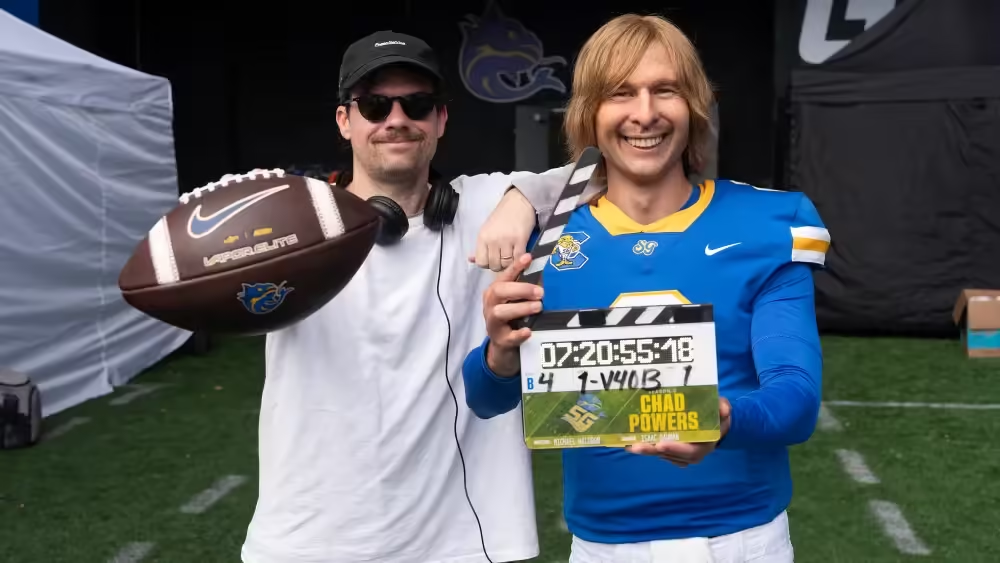
From the jump, Waldron and co-creator/star Glen Powell knew they were taking a leap of faith in asking audiences to embrace the Hulu show’s zany premise: Russ Holloway (Powell), a disgraced former star quarterback, dons a prosthetic mask, mustache and wig and assumes an absurdly quirky alias to try out for a struggling football team and reclaim his gridiron glory. But the stats show that, in its sophomore season, “Chad Powers” has found his people.
All six new episodes launched on Sept. 3, and according to Nielsen, the Season 2 premiere episode “7th Quarter,” ranks third among scripted series returns on Hulu, with 2.86 million viewers in the U.S. “Chad Powers” follows the second season debuts of FX’s “The Bear” (8.96 million viewers in the U.S.) and “Paradise” (6.72 million) and tops “Nine Perfect Strangers” (2.06 million), FX’s “Adults” (2.04 million) and “How I Met Your Father” (2.01 million). (Those are the only returning Hulu shows to cross that threshold in their second time out.)
Beyond that, the episode marked one of Hulu’s strongest returning scripted launches since the start of 2023, ranking No. 14 behind new seasons of “Only Murders in the Building,” FX’s “The Bear,” “Paradise,” “King of the Hill,” “Futurama” and “The Handmaid’s Tale.”
In the first 28 days of Season 2’s release, the show has demonstrated what Hulu calls “strong audience stickiness,” averaging 2.75 million viewers per episode in the U.S. (Those numbers are relatively comparable to Season 1, which averaged 2.96 million viewers per episode.)
“Making this show is the great joy of my career,” Waldron says. “I can’t believe how specific it is, and yet, the audience keeps finding it. It just makes me happy that people are digging it.”
The industry has responded, too: Rotten Tomatoes’ critics score surged from 60% in Season 1 to 93% for Season 2. (The audience popcorn meter rates Season 2 at 93%, compared to 85% for Season 1). Many of those reviews credited the series’ shift to a darker tone, which Waldron, who directed four of the season’s six episodes, crafted to evoke “Point Break” and films from Tony Scott, Jonathan Demme and Sam Raimi.
“We shoot six-day episodes, but our level of ambition is to look like we’re a big movie,” Waldron says, explaining that he and cinematographer Isaac Bauman were determined to create a “cinematic experience.”
Waldron made his directorial debut with the Season 1 finale, where he took on the challenge of filming during halftime of a game at the University of Georgia (his alma mater).
“Almost every day on set felt like it was recreating that experience at UGA, where it was like, ‘Holy crap, the clock is ticking!’ So, that led to a lot of what you see in this season,” Waldron adds. “We adopted a real handheld approach. It’s a lot of moving masters [a continuous, unbroken camera shot] — sort of that ‘Point Break,’ ‘Uncut Gems’ vibe — and it enhanced the propulsion and the tension of the season.”
Michael Waldron directs on the set of “Chad Powers.”
Disney
The drama centers on Russ’ efforts to keep his identity secret, with help from his friend Danny (Frankie A. Rodriguez), the Catfish’s costumed mascot, and assistant coach Ricky Hudson (Perry Mattfeld), whom he’s falling in love with. The trio’s biggest threat is backup quarterback Gerry (Colton Ryan), who’d grown increasingly suspicious of “Chad.” Tensions ratchet even higher when Gerry learns the truth and, now fully unhinged, blackmails Russ into throwing the game against Texas for a $200,000 bet.
The finale ends on a cliffhanger: Ricky and Russ find a way around Gerry’s rules to win the game. But they soon learn that Danny, attempting to protect them from Gerry, has exposed Russ’ identity to booster Tricia Yeager (Wynn Everett). And Tricia has her own demands: Russ and Danny will live on her ranch to keep Russ playing as Chad — and serving as her cash cow.
There’s also a major development in the “RickyRuss” romance department. (“There’s a nice little fandom out there for them online that I keep my eye on, and hopefully all those folks, as they would say, feel like they’re getting ‘fed’ this season,” Waldron cracks.)
After the game, Ricky admits that he loves her and they finally kiss. But then, Coach Jake Hudson (Steve Zahn), the Catfish’s head coach and Ricky’s father, catches them. And the camera cuts to black before showing whether he noticed Ricky had peeled off Russ’ Chad prosthetic.
With Season 2 now streaming, Waldron is turning his attention to a potential third season. He and Powell designed the story to evolve in three parts, following the fictional South Georgia Catfish over the course of one football season.
“A story like this certainly doesn’t want to overstay its welcome,” Waldron says, explaining that the first season began with Russ’ fall from grace and focused on the first half of Chad’s football season, while the second set of episodes tracked the Catfish’s run up to the playoffs.
So, if, and seemingly when, Hulu renews the show for Season 3, audiences will watch the Catfish compete to win the Natty (the national championship game) — which could signal a rematch with Waldron’s Georgia Bulldogs or the Texas Longhorns (Powell’s college team).
“If they want us to make more, I guess Chad can join the basketball team or something,” Waldron says, laughing again.
“Nothing’s guaranteed,” he continues. “But in the same way that, this season, we tried to subvert the audience’s expectations of telling a sports story — which has these predictable conventions: the rise and fall and rise again — we’ll try and keep doing that.”
Of course, Waldron’s quite busy. He’s a Marvel Studios stalwart, having created the hit Disney+ series “Loki” and writing Raimi’s 2022 film “Doctor Strange in the Multiverse of Madness.” He’s also co-writer of “Avengers: Doomsday,” out in December, and in the early stages of developing a “Nova” movie. Next, he and Adam Fasullo’s Anomaly Pictures will follow up “Chad Powers” with “Spaceship Earth,” the new Disney+ pilot inspired by the Disney World Epcot attraction of the same name. Co-written by Jason Fuchs (“It: Welcome to Derry”) and Waldron, the show will star Catherine Laga’aia (Disney’s live-action “Moana”) and Deacon Phillippe (“Brother Save Us”).
But that’s the future — in this interview, Waldron answers some of our burning questions about “Chad Powers” Season 2 and what audiences can expect in the (presumably) final chapter.
Ricky’s last line of Season 1 is “I hate you.” How did you and the writers craft the arc to Russ saying “I love you” at the end of Season 2?
I’d like to say that was some grand plan to go from “I hate you” to “I love you,” but as always happens, it’s something that we found more organically. I remember working on that last scene and realizing we’d gotten to the point where that was earned. It felt like an honest moment.
There’s so much debate in the writers’ room over, “Are we ruining the show if they kiss?” When you have a “will they, won’t they,” when they kiss, it’s like, “What happens to the tension of the show?” So, we talked a lot about the kiss, but Russ expressing that he loves her was kind of a surprise to me. It was one of those amazing things that came over the course of working on the finale script, and even as we were shooting the show. It felt like we’d watched the characters earn that on this journey, so it became a really nice mirror to the very tragic end of season one.
Going back a bit: season one marked your directing debut, and now you’re directing two-thirds of the episodes. Was there a scene that was as difficult as shooting at Georgia at halftime?
One of the trickiest sequences was the opening of episode five, where Gerry poses as whiskers. You have Chad watching Ricky talk to Jay in the end zone; Danny coming out in the stands; and Gerry walking out to Chad. With the geography of the football field, everything becomes technical. You’re really relying on your DP, your script supervisor, and everybody just to keep your head on straight, but it was all fun.
The scene with Ricky and Russ at golden hour was the result of an accident. We had to switch those locations during the day. The location we had didn’t work, but we wanted a sense of scope and feel like they’re driving out in the country, so we pivoted and found this field. When Ricky’s driving and slams to a stop, I’m in the back seat behind them directing, and we just happened to burn enough of the first part of our day that we were able to shoot that great dialogue scene outside the car in golden hour. That was already one of my favorite scenes in the season because it’s when she says to him, “If you like who Chad is, then maybe you should rethink your idea of Russ.”
This season, there’s a lot of visual references to unmasking and peeling back the layers of the face Chad put on in Season 1. How did you look at this second part of his arc?
Season one was about Russ taking accountability: him being able to admit why he liked being Chad in the first place. At first, it was just, “Well, the world screwed me, and I take no accountability for it.” And at the end of the season, he’s able to say, at least to his dad, “I messed up, and I’m sorry, and I like being Chad because I’m not so sad all the time.”
Season two, me, the writers and Glen, we wanted to evolve his arc to the point where he’s a little more of a hero than an antihero, and start getting him to a place where people are pointing out to him that you can’t be Chad forever. And is Russ as bad as you think he is? If you’re able to do things as Chad that are good, and if Chad is a good person, and a way for you to be a good person, as Ricky says, they’re the same guy. So that’s what this season is about: Can Russ forgive Russ?
That’s why, in the final football sequence, he runs the play like Russ, because of Ricky, Danny, Coach Hudson and all these amazing people that have come into his life. Not because of winning, not because of the football, but he is able to forgive himself a little bit. At least for that one play, he’s finally Russ again because he’s kind of OK with himself.
We wanted him to score in an epic way, and we looked at a lot of different versions of that, like Cam Newton diving at the pylon, and as we were shooting, Fernando Mendoza just had his amazing score in the national championship game. But we landed on Russ locking horns with that Texas player, and the guy trying everything he can to knock the ball out of his hands. This time, Russ does the opposite of his original sin and holds onto the ball.

A scene from the “Chad Powers” Season 2 finale, “12th Quarter,” where Chad and the Catfish must beat Texas to make the College Football Playoff.
Disney
I imagine that was also the only way that Glen would allow Texas to lose on screen.
It had to be in a way that made him look so cool. That’s what I said [to him], I was like, “Texas is gonna lose. Georgia’s gonna lose too. It’s gonna be off-screen. We’re gonna totally ignore it. It basically didn’t happen.”
I’m so glad you mentioned that because, if something happens off-screen, it didn’t happen. So, the Catfish fans can say “Dawgs Pounded” all they want …
There was a lot of debate in the writers’ room. Me saying, “Well, they have to lose, but how could they win?” At some point, somebody in the writers room said, “Do you want what’s best for the show? Or do you want what’s best for the fictional University of Georgia football team?” And I was like, “Fair enough.” So, apologies to Kirby [Smart] and the Dawgs for them taking the regular season L here.
They lose to a team that lost to Vandy at home. Who does that?
I know! And Arkansas! [Laughs.] It’s tough, but I’d like to think that loss to the Catfish probably gave Kirby motivation. Who knows? We don’t know what’s going to happen in Season 3. Maybe they meet again.
Speaking of things that don’t happen on camera, Gerry does not get killed on camera, so what are the chances that he lives? He has seen all the mask-making technology. Does Trisha just keep him around in case she needs a foil if Chad gets out of line?
We have really got to figure that out. We talked about “Breaking Bad” all the time, and I need to talk to Vince Gilligan about writing yourself into corners. But the thing that Vince Gilligan could do was kill people. And in this show we were like, “I don’t think we can kill this guy, but if he finds this out, he has to die.”
I think Gerry’s story is far from over. Trisha has temporarily taken him off the board, but who knows where he goes from here? But certainly, Season 3, if we get to make it, would have to pick up right after this episode.
Tell me about crafting Gerry’s arc and how unhinged you let him get.
It’s all Colton Ryan, man. The antagonist of the show was meant to be Evil Rudy; it’s like, well, as dumb as Chad is, what if the backup quarterback is in some ways an even bigger idiot?
I saw Colton in “Poker Face” and was blown away by his performance, and his audition was so good, so we cast him. His first day in season one was the pool party scene, and he came and did a flip in the pool that was just so funny, so unhinged, but also had this real humanity to him. And as I’ve said to Colton, he bent the show toward him.
I don’t know that I knew that Gerry was gonna become the Joker, but thank God. I’m like, “How could the show ever have been about anything else?” That’s just the case of a tremendous actor giving you no choice but to drive the story toward them. He’s a comedic foil. He’s pathetic. But he plays it all straight, and I think that’s why it works. And also, is he even the bad guy? If you look at the story from Gerry’s perspective, he’s kind of right, and that’s the mark of a good villain.
That’s true: Chad comes in, lies to everyone and takes Gerry’s job. Gerry gets assaulted by the costumed mascot. Then they plant a gun on him. But let’s talk about the sequence set to “Don’t Laugh at Me,” which I did not know was a real song.
That’s a ’90s country deep cut. I love Mark Wills. I like that song unironically, and was always like, “Man, that would be fun to use that somewhere.” It’s just so perfect over Gerry in that sequence. The trick with Gerry is you want to be laughing at him and crying at how sad he is. That’s the sign of a good foil to our hero.
[For that sequence,] I was like, “Colton, you’re going to be in a jockstrap,” and Colton was like, “Put me in, Coach.” Colton was cutting weight, getting jacked and talking to Glen about how to get ripped on camera on the day. And he looks amazing. There’s plenty of amazing footage on the cutting room floor.
What is the origin of those Chad masks?
We wanted to show that Chad’s legend is growing. In the writers room, we talked a lot about the LeBron James Witness posters that would be up in Cleveland, so, as we were breaking episode one, [we came up with] the idea that Trisha would have made merch as a marketing tool. And it’s a great MacGuffin in episode one, where Russ and Ricky can hide and get around the stadium in [the masks], and then it becomes a very spooky element for Gerry to creep around in.
We worked with Vincent Van Dyke, who designed the Chad prosthetic. We wanted it to feel like something you’d get at the grocery store. Kind of like the President masks in “Point Break,” but more plasticky.
A scene from “Chad Powers.”
Disney
Speaking of “Point Break,” you wore a Val Kilmer hat to the Season 2 premiere party. Why was that one of your references this season?
When I told Isaac I was going to direct four of the six episodes, I was like, “Let’s keep trying to evolve the look.” Isaac immediately put together a 100-page PowerPoint deck on Tony Scott, like, “We’ve got to have 45-degree shafts of light coming through blinds,” and stuff. In the field house, when Chad and Coach Hudson are playing catch, we were talking about “Days of Thunder.”
Then, in terms of the way we moved the camera, I wanted to feel like it was on the run. Our characters are in a pressurized situation, so how can we make the audience feel that, and how can it feel cinematic? It’s Glen Powell on TV. You’re stealing something. Episode five was the genre episode, where we got really into the Jonathan Demme close-ups, where we’re looking down the barrel at everything.
There are a few deliberate homages. When Chad is in the training room, and we’re popping around in those close-ups, and then he takes off, Isaac and I looked at “Tombstone,” right before the gunfight at the O.K. Corral. Val Kilmer winks at the camera, and then Kurt Russell goes, “Oh my god,” and then they start shooting. Our actor who plays the doctor delivers that [same] line so well.
Also, in the premiere, we did the exact camera move from “Indiana Jones and the Last Crusade,” when Indy is talking about Marcus: “He’ll blend right in. Disappear. You’ll never see him again. With any luck, he’s got the Grail already,” and then, in that movie, you hard cut to Marcus [standing there] totally lost. Our version is Chad looking like such an idiot with the mask and poncho on.
You set the meeting where Gerry blackmails Chad in a movie theater, with “Edward Scissorhands” playing. What was the thought process behind that?
We shot that at the Plaza Theater in Atlanta, which is an amazing, iconic independent theater. I just wanted a cool setting for their tête-à-tête. I’m fascinated by the lore of Lee Harvey Oswald, and as Gerry says, Lee Oswald was caught in a movie theater and had a bunch of aliases, so there was something apt about that. It’s a very visually striking location, and it felt like the kind of place Gerry would be able to hide out. Like “Taxi Driver,” just hanging out in this theater.
“Edward Scissorhands” is certainly apropos: a story of a simple man falling for a beautiful woman and causing a lot of pain to the community around them. We’re lucky to have those clips and that bit of Danny Elfman’s score, and the way that interacts with Natalie Holt’s score.
I love the millennial nostalgia references too, like a “Remember the Titans” reference in episode 201.
I keep seeing people say this show’s very millennial coded, which secretly makes me feel old.
Since we’re talking about directing, your next directing break might be making “Nova” for Marvel. What would it mean for that long-held goal to come true?
I don’t even know what I can say as an answer to this question without my computer just catching on fire. But I love the character of Nova. I love Rich Ryder, and I’ve gotten to work at Marvel with a bunch of great filmmakers. I worked so closely with Sam Raimi and learned so much from him.
He is the biggest influence for me as a filmmaker; everything on “Chad Powers” is filtered through Sam, because watching how he did it was my film school. So, to get to write and direct a movie for Marvel would be a dream come true. I hope it gets to happen.
Have you thought about a way to get Glen cast in the film?
These are the questions to be hypothetically asking someone who was hypothetically directing the movie. But that person, if they wanted to hold on to that job, should not answer those questions.
Let’s circle back to Val Kilmer. We’ve talked about “Point Break” and “Tombstone” as references — do you see a parallel between these two actors?
Val Kilmer was a brilliant character actor who looked like an absolutely gorgeous, dynamic leading man; to me, that is Glen. He can do it all. Of course he can just be your square-jawed, all-American hero — which we ask him to do in this show, and he crushes it. But I like seeing him do the weird shit, the Doc Holliday [in “Tombstone”] type stuff, and he wants to do the voices. He wants to disappear, and he can.
In this show, you take it for granted, because there’s a real magic trick happening where he’s under these prosthetics — big fake nose, fake teeth, ridiculous wig. He’s having this emotional, cathartic argument with Toby Huss — whose prosthetic makes him look like Jon Voight in “Heat.” It’s this great piece of drama and Glen’s just anchoring it, and you forget how stupid he looks. I just can’t say enough about him as an actor, as a collaborator and just as my pal. I’m so proud of the work he did this season. He’s an absolute genius.
Source: variety.com