



Milene de Farias
Today, October 5, communities around the globe are celebrating World Teachers’ Day, a moment to recognize the teachers who show up every day to spark curiosity, build confidence and help young people imagine what they can become.
Educators do far more than deliver lessons. They notice the quiet student with a big question, bring to their attention opportunities students didn’t know existed, and stay late to help an experiment finally work.
At Society for Science, educators are at the heart of so much of what we do. Behind nearly every young researcher who steps up to a science fair board, enters a competition or presents their findings to a judge, there is a teacher or mentor who encouraged them. Anna Pawlow, the Society’s Director of STEM Literacy & Curriculum says, “Our STEM Outreach programs recognize that teachers are the experts in effective STEM education and student research. That is why the peer-to-peer learning model is at the core of our teacher professional development programming. We celebrate educators’ immeasurable impact by creating meaningful opportunities for them to learn from one another, build community and inspire new possibilities for their students.”
This World Teachers’ Day, we asked three educators who work closely with Society for Science to share their thoughts on STEM education.
Allyson McFalls
ELA & Science Teacher, Blowing Rock School
Blowing Rock, North Carolina
Allyson has participated in the Society’s Advocate Program as an Advocate and a Lead Advocate. She is also a former Western North Carolina STEM Research Ambassador, leading the Society’s NC STEM Research Fellow Program. Allyson participates in the Science News Learning program and has mentored students who competed in science fairs affiliated with Regeneron ISEF.
Why do independent research experiences matter for kids right now?
For many students, especially adolescents, time in the classroom can feel like an obligation, not a joy. My goal with implementing independent research experiences is to provide students the opportunity to explore in depth a subject that matters deeply to them, and in the process discover that there is joy in deep learning. Helping students discover the project that fits them is key to helping them engage with the rest of our science content and helps them see that I care about them as more than a data point—as an individual with unique interests and passions.
Can you tell us about a time when a student’s confidence or trajectory changed because of a research experience?
I’ve had the joy of teaching students in both 6th and 8th grade in a small rural school. There are a few girls who entered 6th grade very hesitant about their science skills and aptitude, worried about whether they could “do it” when it came to science fair projects. Watching them discover their passion through science fair has been incredible, and now, as 8th-grade students, they are not only confident in their own research, but are actively seeking out opportunities and connections to build their science education. I can’t wait to see how their lives unfold!
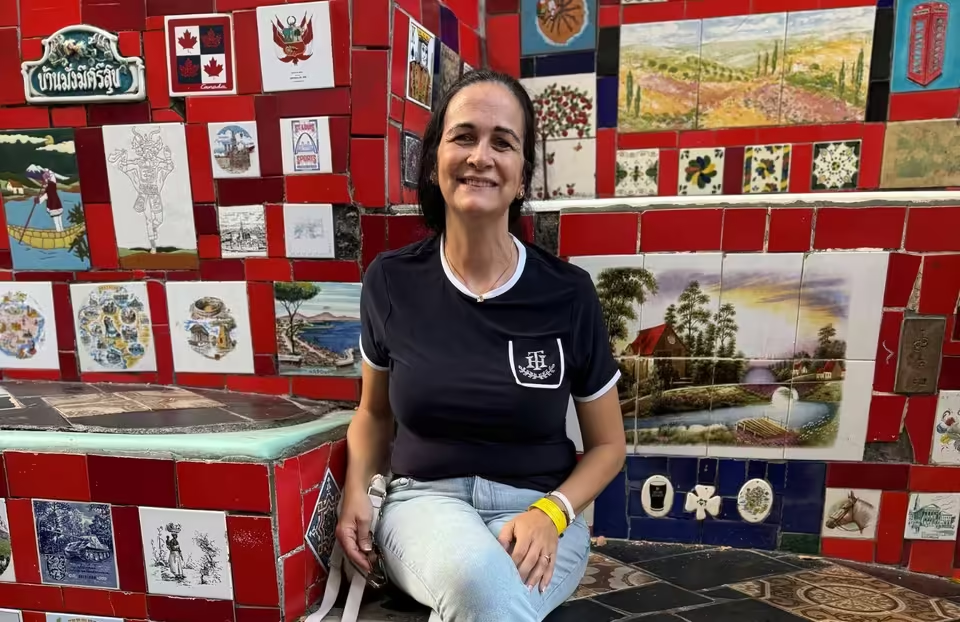
Milene de Farias
Teacher, Southcrest Christian School
Lubbock, Texas
Milene has participated in the Society’s Research Teachers Conference, received a STEM Action Grant, served as an Invention Fellow and participates in the Science News Learning program. She has also mentored students who competed in science fairs affiliated with Regeneron ISEF, as well as in Thermo Fisher JIC, Regeneron ISEF and Regeneron STS.
What drew you to teaching, and specifically to teaching a STEM subject? Was there a teacher or mentor in your own life who shaped how you teach today?
In 6th grade, I moved to a traditional public school, where my science teacher introduced me to a real lab for the first time and I took part in a science fair. I was shy, but when it came to my projects, I could talk with anybody who asked about them, and I couldn’t wait to start researching for my 7th-grade project.
The science fair changed my plans of becoming a model, a surfer or a crime novel writer, and I chose to attend a technical STEM high school. There, my math teacher, Armando, made a lasting impact on how I teach. He taught with empathy and always used projects. I still remember learning trigonometry by going outside to measure the height of our four-story school building, which is why I love hands-on activities today.
Why do independent research experiences matter for kids right now?
Information is everywhere today, and students can find an answer in seconds, but personal experiences are what truly shape them. When students choose a problem they care about and work to solve it, they build critical thinking, curiosity and grit, because real research does not always go as planned. They learn to ask better questions and keep going when the results surprise them. Independent research also connects students to the needs of their community, which teaches them to think beyond themselves and see that science can make a difference.
Oktay Ince
Director of Teaching and Learning, Concept Schools
Columbus, Ohio
Oktay has participated in the Society’s Advocate Program as an Advocate and a Lead Advocate. He has also attended the Research Teachers Conference as an attendee and a Captain, participated in the Science News Learning program and mentored students who competed in science fairs affiliated with Regeneron ISEF.
What drew you to teaching, and specifically to teaching a STEM subject? Was there a teacher or mentor in your own life who shaped how you teach today?
I believe teaching is rewarding both personally and professionally. I think it is especially rewarding when you are teaching in a STEM field. You know that you are making a difference in the lives of students—their life trajectories, their families and the communities around them.
Witnessing this makes my heart full of joy. It makes me think that I am leaving a legacy in this world, even after I am gone. That is what makes teaching so meaningful to me. This servant mindset was instilled in me by my parents, teachers and coaches. They taught me that our purpose is not only to be successful ourselves, but also to help others become successful. That is the mindset I try to bring to my students every day.
Why do independent research experiences matter for kids right now?
I believe acquiring skills through the experience of conducting independent research is one of the highest forms of education we can give to students.
Students do not have to choose a career in STEM, but the skills they develop through the research process can set them up for success in almost anything they choose to do. They learn how to ask questions, solve problems, think critically, communicate, persevere when things do not work and defend their ideas.
Independent research experiences are both transformative and transferable.
If we want our students to be prepared for a constantly changing world and to be competitive in that world, I believe students from all backgrounds need opportunities to experience independent research. We are not just preparing them for a science fair or a STEM career. We are preparing them to become thinkers, problem-solvers, and people who believe they can make a difference.
Source: www.societyforscience.org