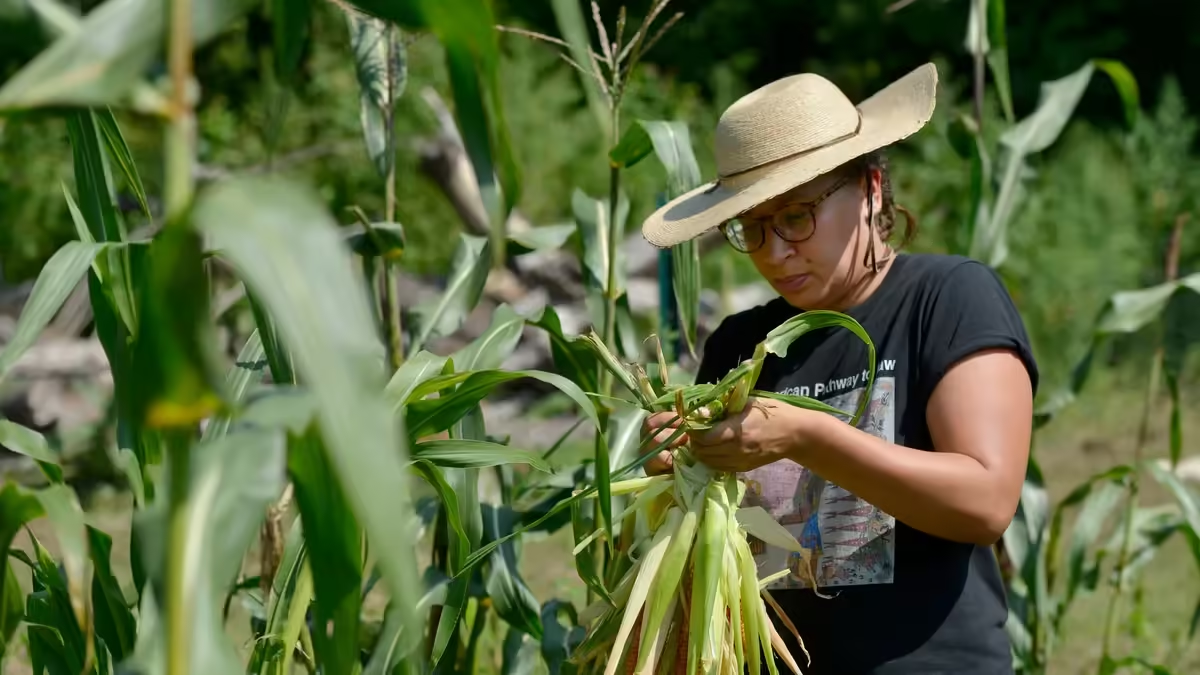


See what Preserving our Homelands camp in Mashpee is all about
Preserving our Homelands Camp teaches the Mashpee Wampanoag Tribe’s children science and Indigenous traditions.
- A new documentary, “Climate Voices,” explores combining Indigenous knowledge with Western science to address climate change.
- The film highlights the Indigenous concept of “two-eyed seeing,” which integrates different knowledge systems for holistic solutions.
- Filmmakers hope to inspire viewers to become better environmental stewards and reduce their carbon footprint.
As climate change continues to reshape coastal communities, a new documentary screening on Indigenous Peoples’ Day will spotlight how tribal knowledge and Western science can collaborate to build a more sustainable future.
“Climate Voices,” produced and directed by Mashpee Wampanoag land and water conservationist Leslie Jonas and Cape Cod artist and human rights activist Rachel Carey-Harper, explores environmental challenges through Indigenous perspectives that emphasize living in relationship with the land rather than treating it as a commodity, said Jonas.
“We fostered a relationship with the natural world in ways that protected, preservedhonored and celebrated these natural spaces that sustained us for thousands of years,” said Jonas. “We experience it, live it, feel it, smell it. We document what’s happening with the world by being with it. By being inside it.”
The film, which will screen from 2 to 4 p.m. Oct. 12, at Falmouth Museums on the Green, also features Western scientists and research from institutions around the world.
Film screening and panel discussion
“Climate Voices” was created to wake people up to what’s at stake when it comes to climate change and the health of the environment, Carey-Harper said.
“We also wanted to create a film that could counteract feelings of hopelessness,” said Carey-Harper. “We can have agency here. We can make a difference, especially if we work together.”
The film, which premiered in April, will also be shown on Nov. 18 at the Massachusetts Institute of Technology where Jonas, an elder and eel clan member, teaches an Indigenous environmental planning class.
Jonas and Carey-Harper will be on hand for a panel discussion that will follow the film, which will also include Adam Subhas, an associate scientist for the marine chemistry and geochemistry department at the Woods Hole Oceanographic Institution; Glen Gawarkiewicza senior scientist in WHOI’s physical oceanography department; and Woodwell Climate Research Center Senior Fellow Heather Goldstone.
The group will talk about how the film was made, said Jonas, and will address how Indigenous environmental knowledge and Western science can work hand-in-hand to create solutions for climate change.
What is ‘two-eyed seeing’?
In the film itself, said Jonas, Indigenous and Western science voices came together to explore what she calls “two-eyed seeing,” a concept that integrates Native American and Western ways of knowing. It emphasizes, she said, that each knowledge system has unique strengths. The combination of the two, she said, can create more holistic, inclusive and effective understandings of complex issues.
Other film participants include Nelson Andrews, Jr., a Mashpee Wampanoag tribe member and the tribe’s emergency management director; Darcy Peter of the Koyukon and Gwich’in Athabascan in Alaska; Mashpee Wampanoag Tribal Historic Preservation Officer David Weeden; and Permafrost Pathways Arctic Climate Senior Scientist Susan Natali.
“It’s looking at solving some of the world’s problems and weaving knowledge together to come up with more robust solutions,” said Jonas.
Can climate change be stopped?
One thing that Jonas hopes people can realize is that climate change isn’t a situation of political parties. It’s the result of social consumption and environmental policies on a local, state, and federal level that have weathered and waned from one administration to the next, she said.
“Right now endangered species acts have been rolled back and fossil fuels are just screaming out again,” said Jonas. “We make a few steps forward and then 10 steps backward. Environmental problems are across the board. We need to come to terms with that.”
Jonas also wants to encourage people to consider Indigenous concepts of considering seven generations forward and seven generations back. Through Indigenous oral tradition, she said, tribal people understood that decisions made today ensure well-being and sustainability of the world for seven generations into the future.
“Inject yourself into the natural world so you can build a respect and honor for it and celebrate it a different way,” she said.
How did the film come together?
Jonas did her first shoot for the documentary in 2021. At the time, she said, she was hoping to travel across the country and interview leading Indigenous environmentalists and climate experts. But the pandemic, she said, interfered with her plans. After a brief filming hiatus, Carey-Harper came into the picture and the duo decided to bring Western science into the mix.
“We pivoted and shifted the goals and objectives of the program,” said Jonas. “We realized that if we excluded Western science, we weren’t serving everybody.”
Jonas had served as the first Wampanoag advisor on the Cape Cod National Seashore Advisory Commission, a tribal liaison for the Woods Hole Oceanographic Institution, and had often connected with scientists at the Woodwell Climate Research Center, who were actively working with Alaskan tribes to improve trailways to food sources. She realized she knew a host of Western scientists that could speak to climate change.
“We wanted to be open to forming new relationships and friendships,” said Carey-Harper. “It’s about having love for each other person-to-person and to the environment in Mashpee and beyond.”
What can Cape Codders take away from the film?
Enlightenment, said Jonas, would be a huge takeaway from the film.
“But it’s bigger than that. It’s about becoming more active in your lifestyle. How big of a carbon footprint are we each leaving?” said Jonas. “We can be better stewards to our earth mother.”
For Carey-Harper, everything starts with a first step.
“One grain of sand can topple the entire dune. It takes resilience. It will take dedication. And it will take commitment. From all of us,” she said. “All of that can come once people are awake to the issues.”
Staff writer Rachael Devaney can be reached at [email protected].
Consider subscribing to the Cape Cod Times: https://subscribe.capecodtimes.com/offers.
Source: www.capecodtimes.com