




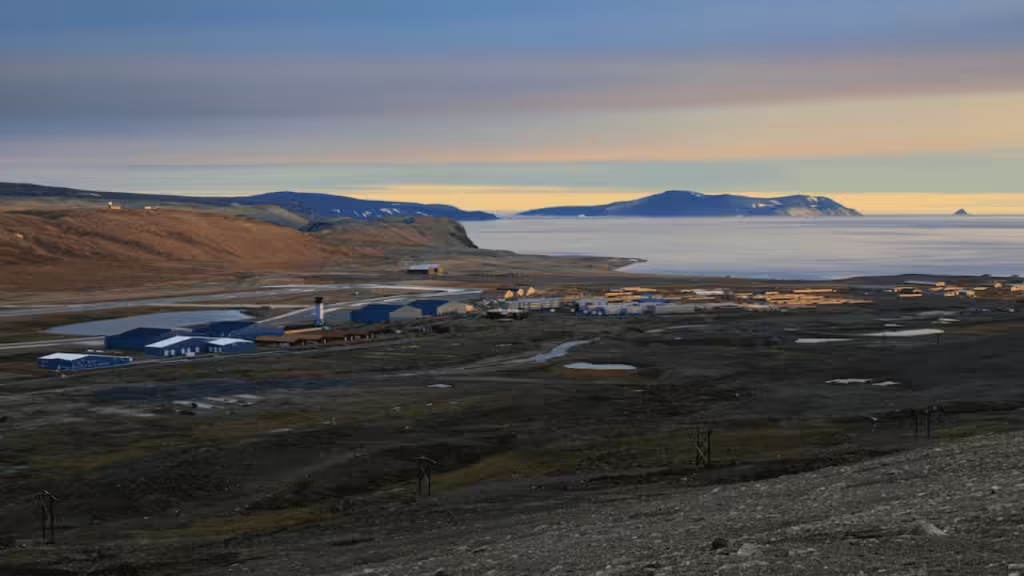


Pituffik Space Base
Photo. US Space Force
The Arctic is taking on new significance for the United States. This is demonstrated by recent agreements regarding Greenland as well as Secretary Rubio’s visit to Iceland.
Although the agreement itself, signed on 22 September this year on the sidelines of the UN General Assembly by President Donald Trump, Greenlandic Prime Minister Jens-Frederik Nielsen, and Danish Prime Minister Mette Frederiksen, does not contain many detailed provisions, it plays a vital role for the White House administration and demonstrates the importance of the Arctic to the US.
The agreement of 22 September is an „amendment and supplement” to the historic agreement of 27 April 1951 concerning the „agreement pursuant to the North Atlantic Treaty between the United States and the Government of the Kingdom of Denmark regarding the defence of Greenland”. It also represents an update to all subsequent agreements concluded over the last 75 years.
What does the agreement bring?
Beyond general statements supporting „stronger NATO involvement in the Arctic” or „stronger American military operations”, the text includes a point stating that the United States will be able to undertake the modernisation and expansion of activities at the Pituffik Space Base. More significant is the next provision, which states that the Americans will be able to establish an additional defence area in Narsarsuaq and Mestersvig.
The new document is also intended to provide greater freedom of movement for US troops „between defence areas through Greenland”. A certain novelty is the inclusion of the movement of „unmanned military installations” (subject to appropriate conditions). The update to the agreement also mentions US rights to underwater access to Greenlandic waters.
„The agreement gives the United States greater flexibility in strengthening its Arctic military posture, links Greenland to NATO even in the event of independence, and excludes American adversaries from the island,” concluded the American think tank CSIS.
Was it worth it?
The new agreement certainly provides some breathing room for Greenland, Denmark, and Washington itself. However, the question arises whether the weeks of pressure from Donald Trump and his administration did not cause greater damage to the United States. This refers mainly to reputational losses, which also carry significant weight in international politics. It turned out that for the sake of minor updates, Trump fell out with allies (record low poll results regarding Danes’ sympathy for the United States), repeatedly undermining the idea of the alliance itself (including NATO with the leading role of the US).
One of the main arguments used during the row initiated by Trump back in 2025 was cutting off Greenland from Russian and Chinese influence. Here, it is worth noting that the new agreement gives the Americans a formal role in overseeing investments in the island’s strategic sectors (including a ban on military installations from outside NATO).
„In practice, the new agreement largely codifies what Washington could already do. Expanded access, bases, and overflight rights were already available under the existing framework – Washington consciously reduced its military presence in Greenland after the Cold War, and not because Copenhagen or Nuuk stood in the way. (…) These provisions do not represent a ground-breaking change to the status quo,” indicates the CSIS report, which also mentions that as early as 2016 (i.e. 10 years before the new agreement), Denmark blocked a Chinese attempt to take over the Grønnedal naval base and the later construction of Chinese airports on the island. This shows that the alliance between Washington and Copenhagen was strong despite specific provisions.
The US does not forget Iceland
American engagement in the Arctic is visible not only through the expressed desire to increase its presence in Greenland. Recently, US Secretary of State Marco Rubio visited Iceland. During a press conference at Hofdi House (the same venue where the historic meeting between Ronald Reagan and Mikhail Gorbachev took place), declarations were made regarding the strengthening of the Arctic 7. Furthermore, the US Secretary of State emphasised Iceland’s importance for NATO deterrence.
„Since World War II, Iceland has allowed US armed forces to project power and operate together, using your land, air, and sea; giving us a crucial outpost to monitor covert behaviour and deter our adversaries from entering your sovereign territory and the territory of our common allies,” he said, reminding that this year marks the 75th anniversary of the 1951 US-Iceland defence agreement. He added that one of the most significant actions confirming mutual commitment was the recent Northern Viking manoeuvres, in which over 1,200 American soldiers participated.
Both the New York agreement and Secretary Rubio’s visit to Iceland clearly show that the Arctic region remains a priority for the authorities in Washington.
Source: defence24.com

