



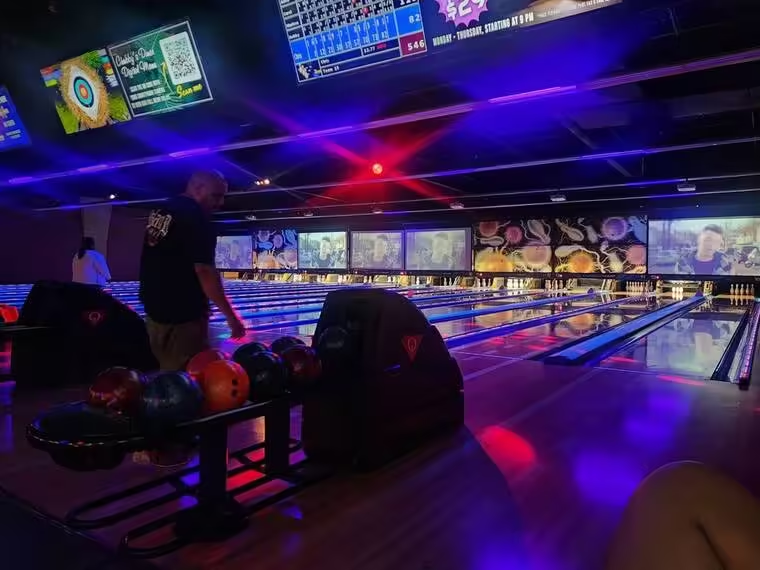

Hilo could once again have a bowling alley.
The Windward Planning Commission on Thursday voted 6-0 to forward a favorable recommendation to the County Council for amendments to an ordinance regarding a commercial property that would allow KBXtreme to build a bowling alley and entertainment complex in Hilo similar to its Kailua-Kona facility.
The unanimous vote gives KBXtreme Hilo LLC a 10-year extension to complete construction on a 5.075-acre parcel zoned neighborhood-commercial at 279 Komohana St. It also relieves the applicants of a 180-day deadline for establishing a water commitment — an estimate of water use and how water will be provided — for the project and gives them some flexibility in the scope and design of required infrastructure improvements, such as street lighting, curbs and gutters, subject to review and approval by the Department of Public Works.
KBXtreme Hilo LLC bought the undeveloped property — which is adjacent to the Hawaii Island Portuguese Chamber of Commerce Cultural and Educational Center under construction — for $575,000 in 2017. The county Property Tax Division website assessed the land’s current value at almost $1.3 million.
Hilo hasn’t had a bowling alley since Hilo Lanes shuttered in May 2014. That Kinoole Street building now houses Hilo’s BJ Penn UFC Gym.
A document submitted by the applicant describes KBXtreme’s proposal as a “highly-leveraged project, with construction costs expected to exceed $10 million.”
“Conceptual planning and pre-development documents are underway, and construction documents will be completed as the project advances through plan approval and permitting,” the document states. “Once these factors are in place, we estimate submitting for plan approval within the next two years. After obtaining the necessary permits, we anticipate an 18- to 24-month construction period.”
Planning Director Jeff Darrow didn’t support KBXtreme’s request to delay the water commitment until construction, nor did he support the applicant’s request to delete a condition requiring it install and pay for curb, gutter and sidewalk improvements or improved lighting on Komohana, based on recommendations by Public Works.
“DPW notes that the subject property is in proximity to an existing bus route, the (Department of Education) Hilo complex campuses, the University of Hawaii at Hilo campus and existing sidewalks on Ponahawai Street,” Darrow wrote in a document to commissioners. “Installation of curb, gutter and sidewalk improvements are necessary for safe pedestrian access to the proposed facility.”
Darrow did give a favorable recommendation to a request by KBXtreme that DPW consider a reduction of the speed limit on Komohana from 45 mph to 35 mph fronting the property.
Calvin Higa, president of KBXtreme, told commissioners the project “is centered around bowling but also includes food and beverage, arcade and other entertainment uses that are necessary to make a modern bowling facility economically sustainable.”
“We consider to pursue this project because we believe it meets a real community need,” Higa said. “We want to bring back senior bowling leagues, college intramurals, school bowling programs, family recreation, and the types of community events we have been fortunate to host in Kona for many years.”
Higa said he agrees that pedestrian and bicycle access and appropriate lighting are “important and should be required.”
“Our concern is prescribing one physical solution before the detailed engineering is complete,” he testified. “Based on the existing roadway conditions, there are no contiguous curb, gutter or sidewalk improvements fronting the other properties between Ponahawai and Mohouli streets. … Komohana, as you know, is a very busy roadway with limited frontage area, so the final design needs to safely account for pedestrians, bicyclists (and) vehicles turning … .
“We anticipate meaningful bicycle traffic, particularly from UH-Hilo and Hawaii Community College students, and intend to provide bicycle racks at the facility.”
Plans are for the facility to have 213 parking stalls for automobiles, including seven accessible stalls.
Higa asked for leeway in the amendments so “DPW, during construction plan review, can determine the safest, continuous multi-modal treatment, based on the final plans and actual corridor conditions — which may not be an isolated section of curb, gutters and sidewalks.”
Commissioners asked pointed questions concerning lighting, traffic, frontage infrastructure and accessibility, but the only public testimony was a letter from the group Aloha Independent Living Hawaii, which said the commission in 2019 refused to make sidewalks optional for the 171-acre Wailani construction project across Komohana Street.
The group said required improvements “should include a continuous sidewalk along the frontage, built to the U.S. Access Board’s Public Right-of-Way Accessibility Guidelines; curb ramps with detectable warnings at each crossing serving the site; lighting at those crossings and at any transit stop serving the site; and accessible pedestrian signals if a signal is installed.”
“We ask that the record show which frontage improvements exist today, and how the requested changes affect the pedestrian path of travel and night visibility, before the commission acts,” Aloha Independent Living Hawaii said in its letter.
According to Higa, the applicants “appreciate Aloha Independent Living’s testimony and agree with the underlying concerns.”
“We want this facility to be safely accessible to pedestrians, wheelchairs, people using transit and of all abilities,” he said.
Email John Burnett at [email protected].
Source: www.hawaiitribune-herald.com