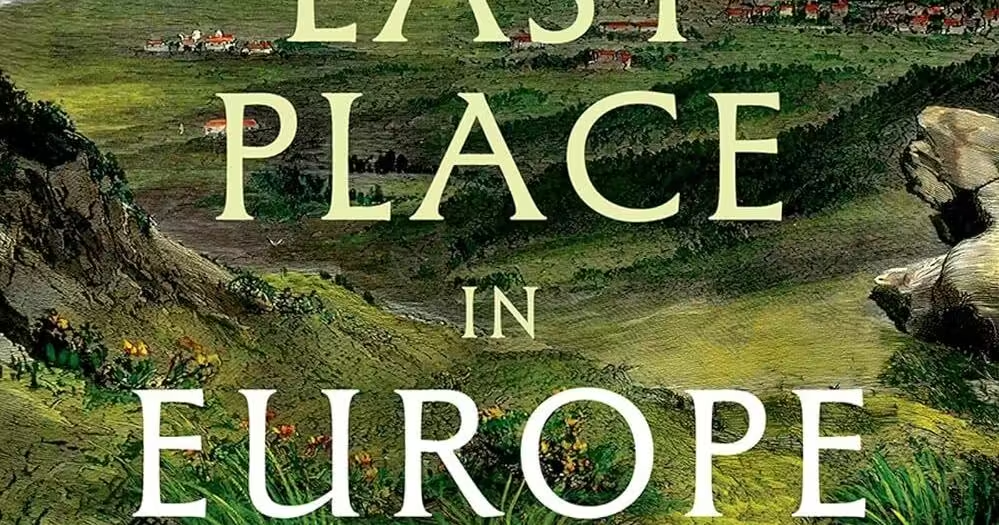

THE LAST PLACE IN EUROPE: A History of Gibraltar. By Geoffrey Plank. Oxford University Press. 368 pages. $34.99.
Long a symbol of stability and permanence, the famed Rock of Gibraltar nonetheless owns an unsettled history and unresolved future.
Gibraltar, a British Overseas Territory, occupies a mere 2.6 square miles on the southern tip of the Iberian Peninsula. It’s dominated by the Rock, a 1,400-foot-high limestone ridge overseeing the straight to which the territory lends its name, as much an emblem of the Atlantic as of the Mediterranean.
And with an outsized influence on world affairs.
Sovereignty over the island has proved an historical revolving door, first settled by the Moors in the Middle Ages, later dominated by Spain, and surrendered (albeit provisionally) to England in 1713.
Geoffrey Plank relates its changing cultural and political tapestries over the centuries with studied aplomb, using first-hand accounts, archaeological discoveries, and newly revised primary sources to cover a sweep of time from the Neanderthal period through numerous invasions, the Anglo-Dutch appropriation of Gibraltar in 1704, two world wars, the 1969-1982 Spanish blockade and the establishment of the European Union. He also charts the territory’s emergence as a center of offshore international finance.
Though Gibraltar formally has been an official British colony since 1830, Spain contests the UK’s territorial claims to this day.
Plank, a professor of early modern history at the University of East Anglia, is the author of “John Woolman’s Path to the Peaceable Kingdom: A Quaker in the British Empire,” and “An Unsettled Conquest: The British Campaign Against the Peoples of Acadia,” among other books.
“Historians trying to summarize Gibraltar’s history have often focused on two distinctive characteristics of the place, its barrenness and its strategically important location,” he writes. But summarizing misses many a subtlety and nuance.
Source: www.postandcourier.com