




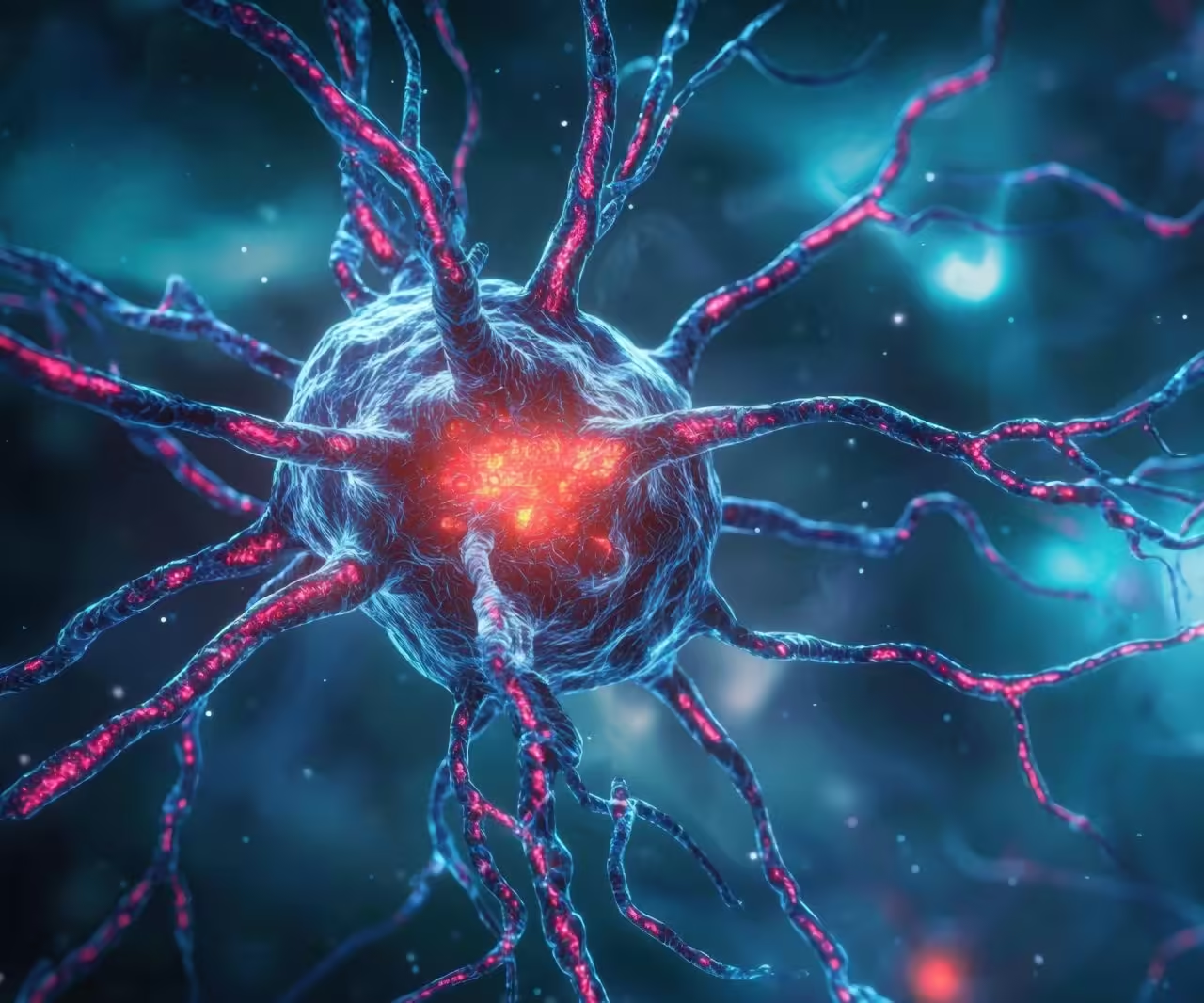

Inside our brains and spinal cords are many kinds of cells. Among them are the motor neurons, which control muscle movement and breathing.
In the devastating condition known as amyotrophic lateral sclerosis (ALS), or Lou Gehrig’s disease, the motor neurons degenerate and die. ALS usually starts with muscle weakness, twitches and cramps. People with ALS eventually lose the ability to walk or breathe on their own. Most die within three to five years of diagnosis.
What happens to the motor neurons as they degenerate has been a mystery — and one that is central to the disease. Motor neurons reside deep in the brain and spinal cord, entwined with other cells; you can’t collect data on them in a living person.
“You can analyze the motor neurons in people who have died of ALS, but it’s just a snapshot of things at the end,” said Aaron GitlerPhD, professor of genetics, whose lab studies ALS and other neurodegenerative diseases.
For a recent study, Gitler and his colleagues took snapshots of the motor neurons at different time points in a mouse model of ALS, recording what genes the cells were expressing and how they changed. The researchers captured the decline of the motor neurons as they switched from a normal, healthy state to something the team dubbed “disease-associated motor neurons.”
The work, described in a paper published recently in Cellcould eventually lead to a new kind of treatment for ALS that would work on the molecules that regulate what’s going on inside the neurons.
“It gives us hope,” Gitler said, “that if we can detect the disease earlier and understand the regulatory logic of what makes a motor neuron vulnerable, we’ll have ways of intervening.”

1. ISOLATION: Researchers use a Dounce homogenizer to gently break apart spinal cord tissue and release cell nuclei for molecular analysis.

2. ENRICHMENT: Fluorescence-activated nuclei sorting is used to enrich motor neuron nuclei, which are rare in the spinal cord, enabling researchers to study them in greater detail.

3. SEQUENCING: Researchers examine and count isolated nuclei under a microscope before single-nucleus RNA sequencing. This technique measures the activity of thousands of genes in individual nuclei to reveal how motor neuron populations change during ALS.

4. DISCOVERY: Computational analysis reveals a distinct disease-associated motor neuron (DM) state that becomes increasingly prevalent as ALS progresses, highlighting molecular changes associated with neurodegeneration and potential targets for therapeutic intervention.
- Intro
- 1
- 2
- 3
- 4
- End
Getting to know the neurons
ALS doesn’t affect all kinds of motor neurons equally. It mostly affects a kind known as alpha motor neurons, particularly the cells known as fast-firing alpha motor neurons, which connect to muscle fibers that contract quickly, like in jumping or sprinting.
“I’ve been fascinated by that question of selective neuron vulnerability,” Gitler said. “Why are motor neurons affected? And why some motor neurons and not others?”
To get at this question, the team a few years ago created an atlas of the cells in the mouse spinal cord, especially the motor neurons. They built it using RNA sequences from the nuclei of more than 40,000 individual cells. Sequencing RNA tells scientists which genes are being expressed — that is, which genes the cell is actively using.
Differences in expression are what make cells behave differently, so knowing those differences tells you a lot about the cell. The team identified genes that are differentially expressed in different types of motor neurons. They published the atlas online so anyone could use it as a basis for future discovery.
When Olivia Gautier, PhD, was looking for a dissertation project, she talked with Jacob Blum, PhD, now a postdoctoral scholar in the Gitler lab; the mouse atlas project was part of his doctorate.
Gautier was intrigued by using methods like those Blum used to create the atlas, but this time to study a disease. “As opposed to looking at one specific gene or protein, for example, I liked the idea of measuring everything I can and seeing what the data tell us,” she said.
She set out on a project that would measure changes in gene expression in motor neurons as they degenerate.
A new population of neurons
For the study, Gautier looked closely at a mouse model of ALS that was engineered to carry copies of the human SOD1 gene with a specific mutation. In humans, mutations in SOD1 cause about 2% of ALS cases. (Some are caused by other genes, but in most people, no single gene is implicated.)
As Blum had done with the atlas before her, Gautier identified the genes that were being expressed in the nucleus of each of more than 100,000 cells.
When she analyzed the gene expression patterns, a new group of motor neurons stood out: a subset of alpha motor neurons that the team named DMs, short for disease-associated motor neurons. They were marked by thousands of differences in gene expression.
The difference in the gene expression patterns was obvious. “I just thought, whoa — this is like night and day,” said Gautier, who recently finished her PhD under Gitler’s supervision and shares first authorship of the new paper with Blum. “From my experience, it’s not so common to see such an overt or extremely clear new population emerge.”
More and more motor neurons seemed to be converting into DMs — changing the pattern of gene expression as they entered the disease state. Even at the end stage of the disease, though, not all alpha motor neurons had turned into DMs. Some still looked like healthy, unaffected neurons and were likely doing the same work as always. The team identified other features of DMs, too.
The DMs were sickly; they had signs of increased stress, and they weren’t accomplishing some of the basic functions of neurons.
“We tend to think of disease onset at a person’s level — that someone has the disease or not,” said Gitler. “This makes us think about disease onset at a cellular level. Cells enter this disease state at different times, or don’t.”

Jacob Blum, Aaron Gitler and Olivia Gautier do the computational analysis that reveals a distinct disease-associated motor neuron (DM) state that becomes increasingly prevalent as ALS progresses. (Photo by Jim Gensheimer)
Swimming upstream
Identifying the DMs — the motor neurons associated with disease — opens a whole new set of questions. One is: Can you stop motor neurons from switching over to the disease state?
The first step toward that kind of intervention is to look upstream and figure out what controls the patterns of expression. The team studied the DMs to find key transcription factors, which are proteins that regulate which genes a cell expresses. They identified several, some of which have already been found by other researchers to be associated with ALS.
The team also looked at data from people who had died of ALS — and found evidence of DMs. That suggests that the research applies to humans, even though it was done in mice. The same held true for people whose ALS is not caused by the SOD1 gene — which is to say, the vast majority of people with ALS.
The researchers hope this knowledge about transcription factors could show scientists how to prevent cells from turning into DMs. It might not be possible to rescue cells that have entered the disease state, Gitler said. “But maybe we could intervene with the ones that are about to become DMs.”
Reasons for hope
ALS is still a devastating diagnosis, but the landscape may be starting to change, Gitler said. “Things actually look really good — there’s new hope in the last five years or so.”
For one thing, a medicine approved by the U.S. Food and Drug Administration in 2023 targets RNA made from the gene SOD1. For now, it is approved only for the 2% of people whose ALS is caused by the SOD1 mutation, but a clinical trial is underway to explore whether it would help people who have ALS but do not have that mutation.
Some of Gitler’s earlier work has led to an experimental medicine that is now undergoing first-in-human trials, to test for safety. He hopes that it could help counteract some of the effects of ALS.
“A few years ago, it wasn’t a settled fact that ALS was treatable. It was possible you just couldn’t treat it at all,” Gitler said. “I’m always optimistic, of course, but I think we’re really in an exciting time.”
Source: med.stanford.edu

