
THUNDER BAY, ONTARIO
|
|
8 min read
Once an economic hinge connecting a young Canada from east to west, Thunder Bay is again finding itself at the center of a national effort to strengthen the country’s economic independence.As head of the local Chamber of Commerce, Charla Robinson attends her share of ribbon cuttings and mundane company announcements in Thunder Bay, a Canadian city of more than 100,000 on the western shore of Lake Superior.
But at one such event in September, she cried.
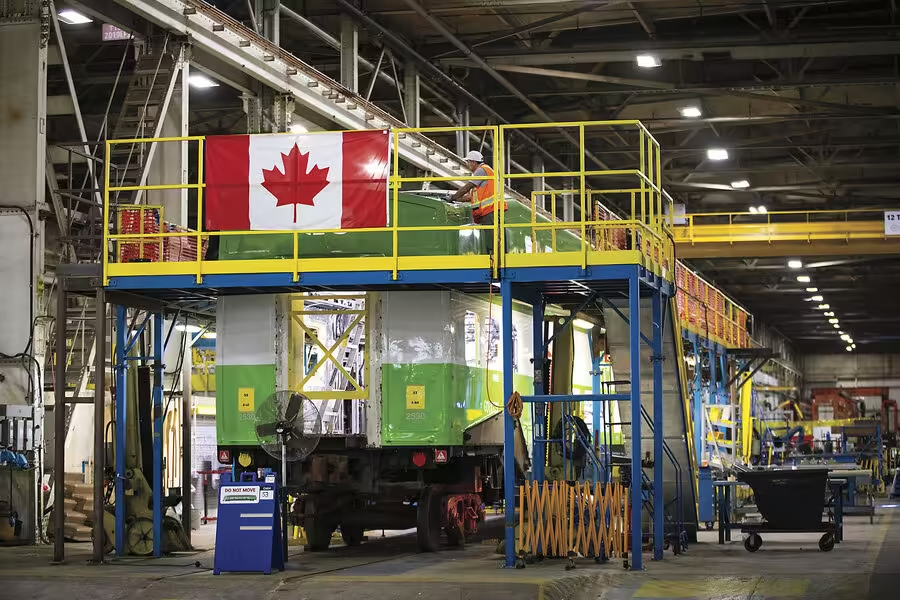
Canadian Prime Minister Mark Carney had come to the Alstom manufacturing plant on the edge of town to announce a new deal: Thunder Bay would be part of a national project to build a new fleet of Canadian passenger railcars.
For more than 20 years, Ms. Robinson had been pushing, in one form or another, for a Canadian-built rail project at the sprawling plant, one that manufactured Hawker Hurricane fighter planes during World War II. Now, thanks in part to a rupture between Canada and the United States, she will finally see it happen. “The surprise was we’re building it in Canada, all the way through. That was like, holy smokes. We’re finally doing it,” she says. “Properly.”
There is something fitting about that happening here. For centuries, the northwestern head of Lake Superior held a strategic position as a gateway to the country’s northern interior; with the arrival of Europeans, it became a significant hub of the fur trade.
Charla Robinson, president of the Thunder Bay Chamber of Commerce in Ontario, talks about the effects of U.S. tariffs on her city.
But in the years leading up to Canada’s creation in 1867, concerns over an expansionist U.S. and uncertain access to its markets helped push the British colonies toward union. The new dominion, still within the British Empire, eventually set out to become a transcontinental nation, building an east-west economy, in part, to resist the powerful pull of the U.S. The city now known as Thunder Bay, where the railway meets the Great Lakes, became a hinge point in that economy.
Over time, economic gravity shifted southward anyway. But now, amid a fracture with its biggest trading partner, Canada is trying to reverse some of that pull – building up its manufacturing base, drawing on its natural resources, and strengthening alliances east and west.

A handwritten sign at Rose N Crantz Roasting Co. in Thunder Bay has renamed its “Americano” offering the “Canadiano.”
In that sense, the forces that helped build Thunder Bay could today help Canada forge a more independent future once again.
It’s exhilarating. It’s also frightening. The opportunities come with trade-offs: New manufacturing jobs could mean higher costs or worker shortages. A mining boom promises jobs and greater self-reliance, but also raises questions over Indigenous rights and the environment.
Canada finds itself in a suspended moment, in which residents say they want to push back against the U.S. but haven’t been told what that might mean for their pocketbooks.
“I’m not certain if people understand what sacrifices they are going to be making,” says Livio Di Matteo, an economist at Lakehead University in Thunder Bay.

Alstom employees refurbish one of Toronto’s transit trains, which are stripped down to the walls and reconstructed.
New direction
The turning point came right before midnight on a Friday in August.
Since before his second term began, U.S. President Donald Trump has been steadily challenging assumptions that long
underpinned the relationship between the neighboring countries. He repeatedly taunted Canada by referring to it as the 51st state and ratcheted up economic pressure with tariffs on key industries and on-again, off-again threats of more.
Finally, Mr. Carney said he was forced to walk away from the negotiating table on Aug. 21 because, he told Canadians the following morning, American negotiators had “asked too much and offered too little.”
It was an unsettling moment for a country that sends roughly 70% of its merchandise exports to the U.S. Yet three-quarters of Canadians supported his decision, according to polling from the Angus Reid Institute.
As Mr. Trump posted a cartoon depicting himself in hockey gear looming over Mr. Carney, and ordered the U.S. government to refer to Lake Ontario as “Lake America,” Mr. Carney began an outreach campaign. In Toronto, he hosted hundreds of global investors and business leaders at a Canada Investment Summit on Sept. 14-15. The day after, he arrived in France, where Canada was invited to explore becoming the European Union’s first “associate member,” which Mr. Trump said could be considered a “hostile act” if done with “bad intentions.”

A ship is docked for loading next to huge grain elevators at the port in Thunder Bay, Ontario.
In front of the European Parliament in Strasbourg, Mr. Carney made the case for Canada’s new economic direction. “The economics are clear: The leverage of the powerful in an exploitive relationship collapses well before complete independence is achieved,” he said. “The objective is not self-sufficiency. It is collective resilience.”
Pulling together
Away from politics, Canadian cities including Thunder Bay are testing what this vision means on the ground.
The border with Minnesota is only a 45-minute drive away, but Thunder Bay feels far more isolated than other Canadian towns that sit near the U.S. It is the only major city for hours in any direction.

The city of Thunder Bay and Lake Superior are shown from the Hillcrest Park lookout.
Thunder Bay also starts from a less U.S.-dependent position than many Canadian industrial cities. It developed as a terminus: Grain traveled from the western prairies to the huge storage elevators that still line the waterfront here, and then continued east across the Great Lakes. “In an odd sort of way, Thunder Bay only exists because Canada exists,” Dr. Di Matteo says.
The port here still moves Canadian goods east and west – a key piece of infrastructure as the country seeks to diversify its economy.
The city is not among the top exposed to U.S. tariffs like auto-dependent Windsor, Ontario, which has an exposure score five times higher, according to a 2025 Canadian Chamber of Commerce report. One of its biggest vulnerabilities, however, is forestry, which had already been hit by a decades-old softwood lumber dispute with the U.S., and now faces new trade barriers and declining demand for some traditional products such as newsprint.
But the mining industry is booming. Thunder Bay is a gateway to the mineral-rich north with its deposits of lithium, nickel, copper, and other metals that Canada increasingly considers strategic.

Steam rises from Thunder Bay Pulp and Paper.
Trevor Walker, president and CEO of Frontier Lithium, which is developing a lithium project in northwestern Ontario that was advertised at Mr. Carney’s Canada Investment Summit, says he sees a generational opportunity. Canadians, he says, are starting to understand the importance of critical minerals “for our own sovereignty.” Part of his plan is to build a processing plant in Thunder Bay to keep value, and jobs, at home.
“Given all the geopolitical issues we’re seeing,” Mr. Walker says, “it’s a great moment for us to pull together and say, ‘We’ve got these materials. There’s this endowment of great resources in Canada that can help us with our independence and help us diversify, so we’re not just trading with one partner in the world.’”
But there is caution amid national pride and talk of an economic boom. Canada’s earlier nation-building projects, including the transcontinental railway, were built across First Nations lands with little or no consultation, says Jason Rasevych, president of the Anishnawbe Business Professional Association in Thunder Bay.

A worker grinds steel at Lakehead Ironworks, which makes bespoke pieces, Sept. 23, 2026. The company has been in business for 50 years and gets most of its steel from Canada.
He attended September’s summit to ensure that Indigenous groups are co-architects and majority equity owners in the projects Canada hopes to build.
“This shift is an exciting time,” he says. But “if this is truly a new nation-building moment, Canada cannot repeat any of the old resource extraction models under a new green or anti-U.S. banner,” he says.
Canada faces practical problems on the road ahead as well.
Gordon Blanchard is the managing director of Thunder Bay-
area steel fabricator Lakehead Ironworks. The 50-year-old company does significant business with the mining industry, and Mr. Blanchard says northwestern Ontario is receiving attention unlike anything he can recall, first and foremost because of the focus the prime minister has put on it.
“Now, we just have to make good on it,” he says. “It would be great to not just be known as the nice people of the planet, but the productive go-to people of the planet. But we need the capacity.”
Mr. Blanchard also says the Alstom deal, for example, gave him a moment of pause. It could eventually compete with him for workers – the same welders he needs to build and repair heavy mining equipment.
The 500,000-square-foot Alstom plant, where Mr. Carney promised to “bring industry home” and Ms. Robinson cried, once employed roughly 1,200 people, but its workforce has fallen to about 350 today. Asked whether he’s ever worried that the plant might close, team leader Jay Hansen’s answer is immediate: “Sure, all the time.”
The national government in Ottawa says the $4.7 billion (Canadian; U.S. $3.3 billion) VIA Rail contract for Alstom is expected to support roughly 700 jobs here and in Quebec, while another major order for Toronto transit cars finalized earlier this year will add hundreds more in Thunder Bay. Mr. Hansen, who has worked at Alstom for 17 years, says he now feels confident that he’ll have a job until retirement.

Shawna Liikala, a barista at Rose N Crantz Roasting Co., bags coffee from Costa Rica and Colombia for its house blend. Canada’s coffee beans come through the United States before heading to Canada.
Ms. Robinson, the Chamber of Commerce head, says some of her members are now scrapping five-year plans built around the U.S. market, looking instead to Quebec and Alberta. But new ideas have also exposed limitations that won’t change anytime soon.
At Rose N Crantz Roasting Co. in Thunder Bay, beans grown abroad travel first to an American warehouse before being imported into Canada. When U.S. tariffs on those other countries drove prices up last year, the levies indirectly increased prices in Canada. The company began looking for a way to pool resources with other Canadian importers. But even together, their relatively small volume would make a new shipping route prohibitively expensive.
“It’s just really hard to ship things directly to Canada,” says Moss Lizotte, the company’s head roaster. “They always, at some point, touch the States.”
That is the harder reality behind Canada’s new push for economic independence. The U.S. cannot simply be swapped out for Asia or Europe. Eric Miller, president of the Rideau Potomac Strategy Group, says Canada will instead have to piece together a collection of markets while building infrastructure and domestic capacity.

Author Jean E. Pendziwol poses at the Thunder Bay marina on Lake Superior. Ms. Pendziwol’s writings are deeply connected to the Great Lake and to northern Ontario. She has written about how the lake shapes life and imagination here.
And there will be a price. Much remains unknown, but one thing does not.
“Prices are probably going to go up,” Dr. Di Matteo says.
Behind the political rhetoric, Canada and the U.S. still cooperate on everything from defense to the small exchanges of everyday life. But at the individual level, small decisions are adding up to a collective mind shift.
At the twice-weekly Thunder Bay Country Market, whose motto is “Make it, Bake it, Grow it,” Stacey Victor says she is trying to do her part. She refuses now to travel across the border and looks for all the Canadian products she can. “That’s why I’m coming here to buy local and support our farmers and vendors,” she says. “We were neighbors, and now, there’s a divide. It’s upsetting.”
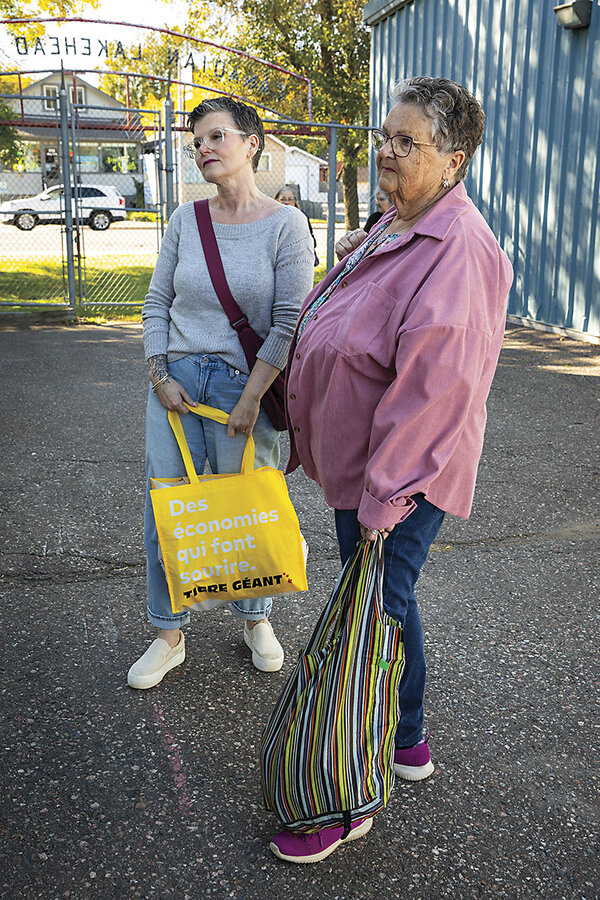
Stacey Victor (left) and her mother, Arlene Pientok, talk about U.S. tariffs and how they have affected Canadians’ lives.
Stasis
The realization that Canada’s relationship with the U.S. had fundamentally changed came at different times for different people. For local author Jean E. Pendziwol, the moment came this past summer, as wildfires raged around Thunder Bay.
Smoke still hung over the region when President Trump threatened Canada with more tariffs, while Republican lawmakers blamed Canada for failing to contain the fires. That same day, Ms. Pendziwol posted on Facebook about something familiar to those who live in Canada’s boreal forest: Fire, however destructive, is also essential to regeneration.
Deepen your worldview
with Monitor Highlights.
Politics with respect
Get political stories with respectful analysis.
There‘s a world of new ideas in every
Books newsletter.
There‘s more to life, enrich yours with
Culture & Learning weekly.
Follow humanity‘s discoveries with
Science & Nature stories in your inbox.
Gain a spiritual perspective
from the stories in your inbox.
Want to understand the deeper impact of critical events? Learn the Monitor‘s insight.
Already a subscriber? Log in to hide ads.
Months later, sitting in a Thunder Bay café, she sees a metaphor in those fires for the upheaval Canada is going through now.
“Stasis,” she says, “is not necessarily the best thing for us, for our economy, and for our environment and culture.”
Source: www.csmonitor.com