



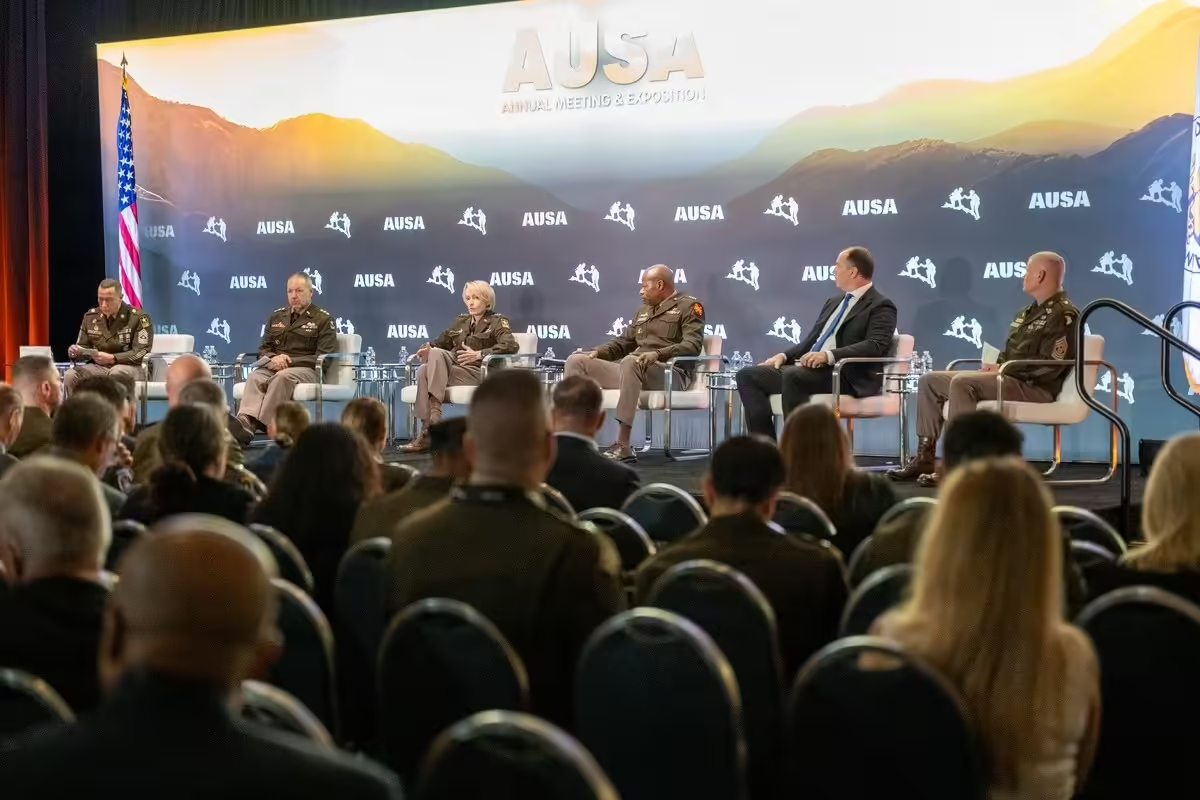

Sgt. Major Murillo, Senior Enlisted Advisor, Army Manpower and Reserve Affairs (ASA M&RA)-moderator, Lt. Gen. Charles Lombardo, Deputy Chief of Chief Staff, HQDA G-1, Brig. Gen. Jeremy Bartel, Deputy Commanding General, U.S. Army Installation Management Command, Lt. Gen. Mary K. Izaguirre, U.S. Army Surgeon General, Mr. David Dentino, Deputy Assistant Secretary of the Army, Installations, Energy and Environment (IE&E), Command Sgt. Maj. Christopher Goodart, 101 Airborne Division, Fort Campbell, Kentucky – from left to right- speaks at the Warfighter and Family Forums 2 during the 2026 Association of the United States Army (AUSA) Annual Meeting and Exposition at the Walter E. Washington Convention Center in Washington, D.C., Oct. 13, 2026. (U.S. Army photo by Antonio Turner)
View original
WASHINGTON — Army leaders are working to give Soldiers and Families more time to prepare for a permanent change of station move and more support once they arrive. At the Association of the United States Army’s Warfighter and Family Forum II on Oct. 13, they described changes to household goods shipments, in-processing, medical care and housing — along with work still to be done.
The forum, “Enhancing the Permanent Change of Station and Onboarding & Integration Experience,” brought together leaders who oversee the transition. Their discussion returned to a central point: A move is not complete when the boxes are delivered. Soldiers and Families also need care, housing and a connection to their new unit and community.
Maj. Gen. Lance Curtis, commander of the Department of War Personal Property Activity, said the organization reduced a backlog of 18,000 shipments in May 2025 to zero currently. A joint operations center and a single call center help track and resolve moving problems across the services.
Curtis said: “If you leave here today with only two things that you remember, encourage service members, Families and spouses to call 1-833-MIL-MOVE, where they will talk to an active duty service member if they’re having a challenge. We can solve almost any challenge on the spot from start to finish. Or use the website ppa.mil.”
Curtis noted service members with orders can begin booking household goods moves 48 days earlier than previously. They also now have one year, rather than nine months, to file a claim for damaged property, and their spouse or dependent who is listed on their orders can also now file an inconvenience claim. The organization, which is in the process of becoming a full agency, plans to replace its moving system with a new platform that includes mobile tools for vehicle shipments, household goods bookings and claims over the next two years.
After Curtis’ keynote address and audience questions, Sgt. Maj. Ruben Murillo Jr., senior enlisted advisor to the assistant secretary of the Army for manpower and Reserve affairs, opened a separate panel discussion on the PCS and onboarding experience. Lt. Gen. Charles T. Lombardo, the Army’s deputy chief of staff, G-1, said the Army wants to move beyond sponsorship that amounts to a name and phone number. Using the Integrated Personnel and Pay System – Army as a backbone, the goal is to share information earlier, reduce duplicate paperwork and give leaders more time to welcome incoming Soldiers and Families.
“The biggest thing we can do is get you to your squad leader, your platoon sergeant, your platoon leader,” Lombardo said. Getting pay and housing settled first makes it easier for a Soldier to focus on the unit, he added.
Lt. Gen. James M. Smith, commanding general of U.S. Army Installation Management Command, said installation personnel offices are working to process orders earlier so Families can plan their moves. His team also reviews Families displaced from housing and monitors how quickly homes are made ready for incoming residents. Smith said the standard between occupants is 10 days, though some homes require more work.
Smith said his team holds housing providers to the turnaround standard. “We hold ourselves accountable,” he added. He also highlighted the Civilian Employment Assignment Toolwhich helps spouses working in Army Child and Youth Services seek positions at a new installation before they move.
David H. Dentino, deputy assistant secretary of the Army for installations, housing and partnerships, said tenant satisfaction surveys help determine where housing needs attention. Installations use low scores to develop improvement plans, while the results also inform longer-term investments. Dentino said barracks scored lowest among the housing categories surveyed and outlined efforts to assess barracks conditions, improve heating and cooling systems and identify conditions that could lead to mold.
“Those improvements are directly driven by the results we see in the tenant satisfaction survey,” Dentino said of planned Family housing investments. He urged incoming Families to contact their installation’s Housing Services Officewhich can help with off-post rentals, deposits and landlord disputes.

Lt. Gen. James M. Smith, U.S. Army Installation Management Command, speaks at the Warfighter and Family Forums 2 during the 2026 Association of the United States Army (AUSA) Annual Meeting and Exposition at the Walter E. Washington Convention Center in Washington, D.C., Oct. 13, 2026. (U.S. Army photo by Antonio Turner)
View original
That same advance planning applies to medical care. Lt. Gen. Mary K. Izaguirre, the Army surgeon general, encouraged Families to review specialty referrals, prescriptions, ongoing appointments and records from civilian providers before leaving. She pointed to Tricare’s moving checklist and said her team is working with the Defense Health Agency to improve the handoff between locations.
Izaguirre said the installation a Soldier is leaving remains responsible for behavioral health care during the move: “They are responsible for your care until you sign in at that new installation.” She encouraged those already receiving behavioral health care to discuss the move with their providers in advance and noted that telehealth may help maintain access during the transition. Izaguirre also highlighted that spouses can now access the Exceptional Family Member Program system and acknowledged that access to older children’s medical records remains a barrier the Army is working to address.
Command Sgt. Maj. Christopher C. Goodart, division command sergeant major, 101st Airborne Division, Fort Campbell, Kentucky, said reception and integration start when a Soldier is placed on assignment. A six-day reception process brings finance, transportation and other administrative support together before brigades tailor training and introductions to the Soldier’s next unit. The aim is for a squad leader to receive someone who is “ready to go and ready to fight,” Goodart said, while giving the Soldier and Family time to settle in.
The panel also looked beyond the installation gate. Smith said most Soldiers and Families live off post, making local schools, housing providers and community leaders part of the arrival experience.
In his closing remarks, Lombardo emphasized that Soldier and Family feedback will guide the Army’s broader effort to make personnel and transition services easier to access by smartphone. “The most important thing we have is our Soldiers and their Families and that feedback, because that’s going to drive the speed and direction that we go as we continue to modernize these experiences,” he said.
He described a goal of giving Families one place to look for housing, enroll their children in school and manage their transition. Helping Families navigate those changes, he said, can improve their Army experience and help retain the all-volunteer force.
Murillo urged leaders to ask incoming Soldiers what they need and carry that feedback into their work with local partners.
“Know your Soldiers, know what your Soldiers are saying,” Murillo said.
Watch the panel discussion in its entirety at DVIDS.
Source: www.army.mil