Rural hospitals are lifelines for millions of Americans and core institutions in their communities. They provide essential healthcare services, support local economies and strengthen community resilience during emergencies. Yet mounting financial pressures threaten their ability to maintain services and preserve access to care for more than 46 million Americans. The challenges confronting rural hospitals are
Rural hospitals are lifelines for millions of Americans and core institutions in their communities. They provide essential healthcare services, support local economies and strengthen community resilience during emergencies. Yet mounting financial pressures threaten their ability to maintain services and preserve access to care for more than 46 million Americans.
The challenges confronting rural hospitals are both longstanding and intensifying. Structural pressures, including low patient volumes, workforce shortages, geographic isolation and inadequate reimbursement, have left many facilities operating on increasingly fragile financial footing. Recent policy changes and payer trends will magnify those pressures, increasing the risk of service reductions and hospital closures.
This report explores these challenges, the consequences for patients and communities, and the actions needed to preserve access to care in rural America.
Executive Summary
Rural hospitals are crucial to the health and economic vitality of rural America. For more than 46 million Americans, rural hospitals provide essential access to emergency, inpatient, obstetric, behavioral health and other critical services while supporting jobs, economic activity and community resilience.
Many rural hospitals face fundamentally challenging conditions. Low patient volumes, geographic isolation, workforce shortages, aging infrastructure and payment shortfalls continue to place financial pressure on rural providers.
Recent policy and market developments are magnifying these longstanding challenges. Medicaid reductions enacted through the One Big Beautiful Bill Act (OBBBA), the expiration of the enhanced premium tax credits (EPTCs) and the rapid growth of Medicare Advantage (MA) are expected to drive up the number of uninsured, increase uncompensated care, reduce hospital revenue, increase hospital costs and further strain already fragile rural hospitals and care providers.
Without additional action, rural communities will lose local access to care. Financial instability can lead to service reductions, conversions and closures, resulting in longer travel times, delayed care, poorer outcomes and economic losses for rural communities. These impacts also shift more costs to patients and families — longer trips to receive care mean more transportation costs, missed work and added childcare expenses.
Rural hospitals are innovating, but sustainable access will require supportive public policy. Through telehealth partnerships, clinically integrated networks and care redesign, rural hospitals are stretching limited resources to help keep care local. But these efforts cannot offset structural challenges on their own. Policymakers should strengthen rural payment models, preserve telehealth flexibilities, address harmful insurance practices, and invest in workforce and infrastructure solutions. The Rural Health Transformation Program (RHTP) included in OBBBA may support innovation, but it is neither sufficient nor adequately targeted.
Rural Hospitals Are Essential to the Health and Vitality of Their Communities
For the over 46 million Americans living in a rural community, the local hospital is often their only source of inperson care. These rural hospitals provide care 24 hours a day, 365 days a year for trauma, stroke, cardiac events, obstetric services and other time-sensitive conditions where timely access translates to lives saved. Rural hospitals also serve as the first line of emergency preparedness and response for their communities, providing critical surge capacity during natural disasters, mass-casualty events, infectious disease outbreaks and other emergencies. Their ability to provide care close to home reduces travel time, missed work, transportation expenses and delays in care.
The full value of rural hospitals, however, spans beyond just healthcare. They are economic engines producing stable jobs for millions of people and stimulating the local economy with the purchase of goods and services. Rural hospitals are typically one of the largest employers in their communities, employing physicians, nurses, technicians and staff who bring specialized skills and a shared sense of responsibility to every patient they serve.
When rural hospitals close, the damage extends well beyond the four walls. Rural closures are associated with:
Higher mortality.1
Population decline.2
Slower economic growth.3
Increased unemployment across both hospitals and non-healthcare industries.4
Increased poverty and lower income levels.5
Closures, though, are only part of the story. Among the roughly 1,800 rural hospitals in operation, over 40% have negative operating margins and hundreds are at high financial risk.6Many have been forced to end crucial services, including obstetrics services and chemotherapy, or even eliminate all inpatient care, in an effort to keep their doors open.7 This increasingly strained environment is the result of structural challenges, new funding cuts and coverage losses, as well as growing financial and administrative pressures associated with Medicare Advantage (MA).
Rural Hospitals Face Unique Challenges and Compounding Financial Pressures
Low Patient Volumes and Challenging Patient Mix
As low population density areas, rural communities produce lower, more unpredictable patient volumes for rural hospitals. Geographic isolation, combined with the risk of inclement weather, hazardous terrain and limited or nonexistent public transportation, often leads patients to delay or forgo needed services. Indeed, 3.6 million Americans delay or go without needed medical treatment each year because of a lack of transportation.8
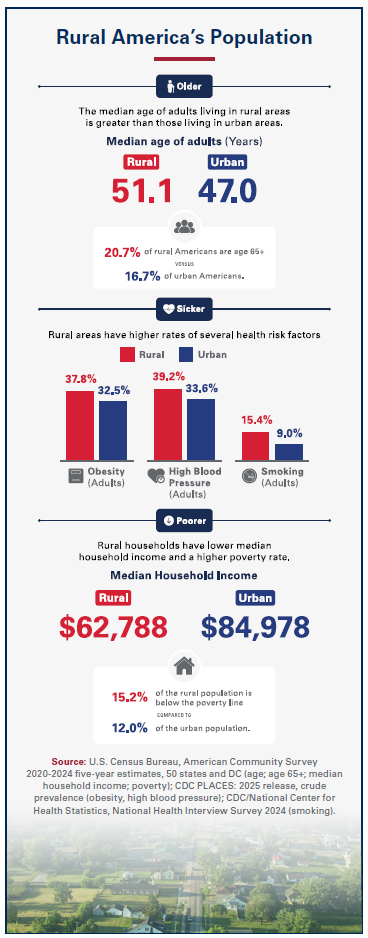
The patients rural hospitals do see are, on average, older, sicker and poorer.9They also are more likely to be uninsured — in 2024, rural hospitals provided more than $5 billion in uncompensated care.10 This unsteady stream of higher acuity, higher cost patients is a fundamental driver of rural hospitals’ financial difficulties.
Low Reimbursement
Rural hospitals’ payer mix challenges are due to their patient mix. Medicare and Medicaid are the dominant forms of coverage in rural hospitals, covering approximately 72% of all discharges.11 Yet, both programs pay below the cost of care, resulting in significant payment shortfalls for the majority of rural hospitals’ patient base. In 2024, rural hospitals incurred over $7 billion in Medicare underpayments alone, a 26% increase from 2020.12 This reliance on public payers also makes rural hospitals especially vulnerable to any changes that reduce or delay government reimbursement.
At the same time, rural hospitals receive significantly lower reimbursement rates from commercial insurers. This gap is especially pronounced for inpatient care, despite these rural hospitals sometimes being the only source for such care within hundreds of miles.13With low commercial patient volume and limited market power, these rural hospitals are often forced to accept significantly depressed rates as large insurers refuse to negotiate. The alternative is network exclusion, which would only worsen the long distances that rural patients must already travel to find in-network care.
Workforce Shortages
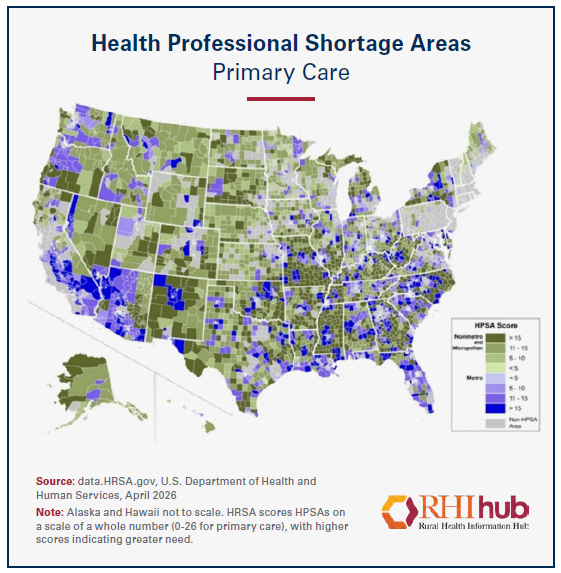
Rural hospitals also must grapple with significant barriers in the recruitment and retention of healthcare professionals. Across all three Health Professional Shortage Area (HPSA) disciplines (primary care, mental health and dental health), more than 70% are all rural or partially rural areas.14 Rural areas average only 30 physicians or specialists per 100,000 people, compared to 263 in urban areas, and that rural physician workforce is expected to decline by over 20% by 2030 due to retirements.15 These workforce shortages directly lead to reduced services and heightened closure risk as facilities struggle to sustain the staff required for 24/7 service lines. Shortages also inflate costs — labor already makes up 60% of hospitals’ expenses and reliance on more costly contract staffing can weigh especially heavily on rural facilities operating on thin or negative margins.16
Aging Infrastructure
Many rural hospitals were built nearly eight decades ago, following the Hill-Burton Act of 1947 that financed hospital construction and modernization. Unsurprisingly, roughly 4 in 10 rural hospitals have aging facilities and are in need of facility and technology upgrades to align with a new era of care delivery.17 Yet these hospitals face the steepest barriers to financing. Rural hospitals’ narrow margins both limit their ability to secure capital for infrastructure investments and frequently block them from qualifying for U.S. Department of Agriculture or Housing and Urban Development mortgage guarantees. The recent rise in cyberattacks on hospitals also demands stronger investments in cyber defense technology and specialized staff that may be difficult for a rural hospital to finance.
Recent Policy Changes Amplify the Pressure on Rural Hospitals
Medicaid Changes Under the One Big Beautiful Bill Act (OBBBA)
Rural hospitals already were facing a daunting set of structural challenges that threatened their sustainability. Recent changes to Medicaid under OBBBA, the expiration of the Health Insurance Marketplace EPTCs and the continued growth of MA have intensified those pressures and increased financial risks for rural hospitals and the communities they serve.
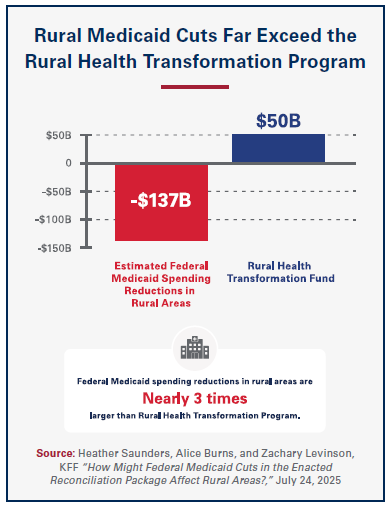
OBBBA included roughly $1 trillion in Medicaid cuts. These cuts will severely curtail a program that is a bedrock for rural communities, covering roughly 16 million rural Americans and nearly 50% of rural births.18 OBBBA is reshaping Medicaid from both financing and enrollment perspectives. On the financing side, it restricts provider taxes and state directed payments that rural providers rely on to help compensate for the Medicaid base rates that pay less than 58 cents on the dollar.19 On the enrollment side, new work requirements and more frequent Medicaid eligibility checks, among other changes, will result in millions losing coverage, swelling an already disproportionately high uninsured population in rural areas. For rural hospitals, this is a double blow: shrinking payments for the patients they still serve and more uncompensated care for those who lose coverage but still show up at their emergency departments. The resulting impact is staggering: OBBBA is estimated to cut nearly $140 billion in federal Medicaid spending from rural areas,20 increase rural hospital uncompensated care costs by nearly $20 billion,21 and put over 300 rural hospitals at risk of closure, conversion or service reductions.22
THE RURAL HEALTH TRANSFORMATION PROGRAM
OBBBAcreated the Rural Health Transformation Program (RHTP), providing $50 billion over five years to help support rural health providers. This program was intended to strengthen healthcare access, sustainability and workforce development in rural hospitals across the country. However, a $50 billion fund, spread across 50 different states, does not offset the large-scale healthcare cuts in OBBBA. And, notably, the Centers for Medicare & Medicaid Services (CMS) required that only 15% of RHTP funding can be used for provider payments, which limits rural hospitals’ capacity to compensate for the reduced Medicaid payments.
The first item in the statute guiding states’ RHTP applications is “to improve access to hospitals.” Therefore, it is critical that CMS and states prioritize rural hospitals and ensure funds flow to them in alignment with the statute. Absent that focus, the RHTP risks falling short of its purpose at precisely the moment rural communities can least afford it.
Expiration of the Enhanced Premium Tax Credits (EPTCs)
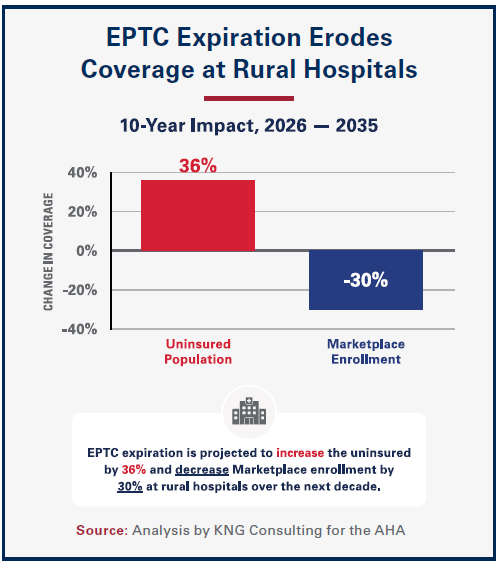
The EPTCs, originally passed in 2021, expanded eligibility for, and increased the size of, premium tax credits to help certain individuals and families purchase insurance on the Health Insurance Marketplace. Since benchmark Marketplace premiums run about 10% higher in rural areas, rural residents were among the greatest beneficiaries of the EPTCs and now stand to lose the most since they have lapsed.23 As premiums spike, rural states are projected to experience a 30% decrease in Marketplace coverage and a 36% increase in their uninsured populations.24 That will lead to falling revenue and rising unpaid bills: In 2026 alone, the expiration of the EPTCs is estimated to cause a $1.6 billion reduction in revenue, a more than 10% increase in uncompensated care costs and significant financial strain among rural hospitals.25
Medicare Advantage (MA) — Payer Practices and Administrative Burden
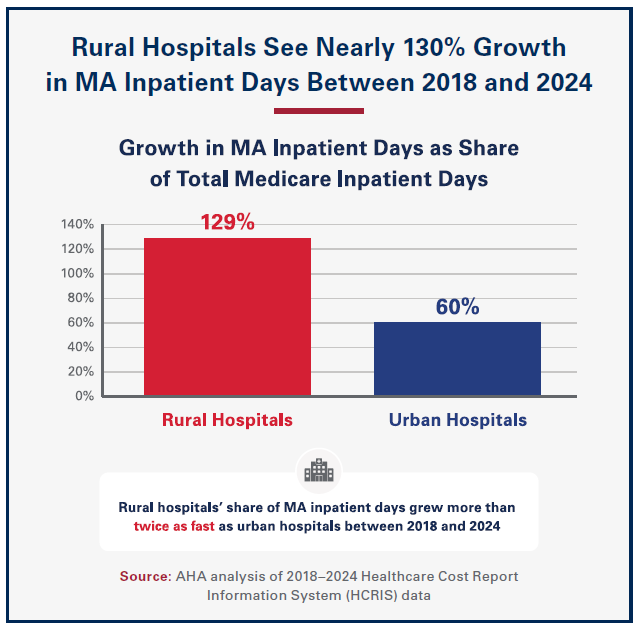
MA has become a defining financial pressure for rural hospitals. Now covering more than half of all Medicare beneficiaries nationally, MA has grown fastest in rural areas in recent years, where enrollment has quadrupled since 2010.26 This is especially important because rural hospitals depend disproportionately on Medicare, leaving them exposed to how these MA plans pay and operate.
A core problem is that many MA plans reimburse below Traditional Medicare rates, which already pay well below cost. An AHA analysis found that in 2024, MA plans paid rural hospitals just 91% of Traditional Medicare on a cost basis. Even cost-based critical access hospitals (CAHs) collected only 95%, undercutting the very protections Congress designed for them. The AHA estimates this lack of payment parity cost rural hospitals over $1 billion in 2024 alone.27
Beyond low payment, MA plans’ administrative practices delay care and drain resources. The total number of MA prior authorization requests surged to nearly 53 million in 2024.28 MA claim denials and prior authorization requirements disproportionately target post-acute care facilities. As a result, MA patients experience lengths of stay 9.6% longer before discharge to post-acute care than clinically similar Traditional Medicare patients, stranding patients and raising costs.29 Denials also compound the financial toll: Hospitals spend over $40 billion trying to collect payments insurers owe for care already delivered.30 Given their lower average staffing levels, rural hospitals are often the least equipped to manage this increased administrative burden.
These burdens also fall hardest on the staff that rural hospitals can least afford to lose. Nearly 4 in 5 rural clinicians report that insurer-required administrative tasks have risen over the past five years, and 86% say the burden has negatively affected patient outcomes.31 This fuels the burnout that makes recruiting and retaining staff even harder at already thinly stretched facilities.
Service Reductions, Conversions and Closures Have Consequences Beyond the Hospital
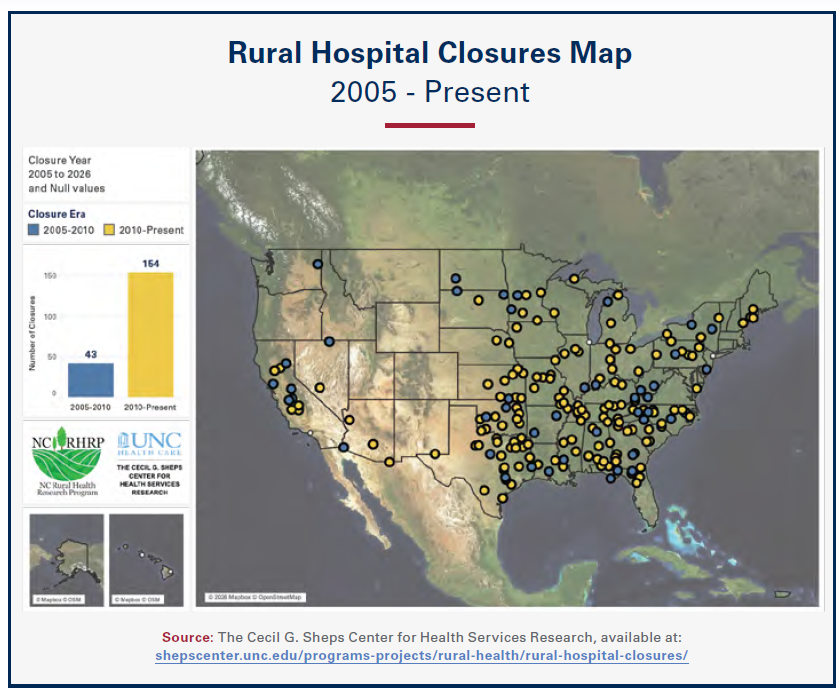
The combined effects of structural challenges, coverage losses, Medicaid funding reductions and MA pressures are already affecting the availability of care in rural communities. But loss of access rarely arrives all at once. It unfolds along a shifting continuum — reduced hours, elimination of service lines, discontinuation of inpatient care, conversion to a different provider type and, ultimately, closures. Each step narrows what a community can obtain locally, and the erosion is well underway: 331 rural hospitals ended obstetric services and 448 stopped offering chemotherapy in recent years.32 Since 2010, over 150 rural hospitals have closed or converted.33
For patients, the consequences are powerful: longer travel, delayed or forgone care, disrupted emergency response, fewer options for routine and specialty services, and more complex transfers when conditions escalate. Rural hospital closures are associated with a roughly 50% increase in emergency transport time and a significant rise in mortality for time-sensitive conditions.34 Critically, a hospital need not close for access to suffer: Losing obstetrics, behavioral health, surgery or inpatient beds can materially alter what care is reachable in an emergency, even as a facility’s doors remain open.
The economic toll is similarly devastating. Hospitals are frequently among the largest employers in rural counties, so when they close it brings about decreased per capita income, population loss and rising poverty. In fact, rural hospital closures have been associated with an up to 4% decrease in per capita income and a significant reduction in the local labor force.35 Losses extend outward through vendor purchasing and a community’s ability to attract employers and residents. Neighboring hospitals then try to absorb the overflow, taking on emergency volume, transfers and uncompensated care, often without any additional resources. Rural Hospital Closures Map 2005 – Present Source: The Cecil G. Sheps Center for Health Services Research, available at: shepscenter.unc.edu/programs-projects/rural-health/rural-hospital-closure
Policy Priorities for Sustaining Rural Access to Care
Sustaining access to care will require policies that strengthen hospital financing, support workforce recruitment and retention, improve insurer accountability and expand access to technology-enabled care. See the AHA’s 2026 Rural Advocacy Agenda for a full list of specific policies and legislation supporting these priorities. Some of these key priorities include:
Reverse Harmful Medicaid Cuts. Address Medicaid funding reductions and coverage losses that will reduce access to patient care and further strain hospital resources and services.
Direct Rural Health Transformation Program Funds to Rural Hospitals. Prioritize and distribute funding to hospitals, which serve as the backbone of rural healthcare delivery.
Modernize and Strengthen Rural Payment Models. Extend and update Medicare’s rural payment designations, including Low-Volume Hospital, Medicare-Dependent Hospital, Critical Access Hospital, Sole Community Hospital, and Rural Emergency Hospital, to give hospitals greater payment stability and predictability.
Preserve and Expand Telehealth Access. Permanently extend key telehealth flexibilities and continue investing in broadband, digital infrastructure and interoperability so rural patients can access care regardless of geography.
Strengthen the Rural Healthcare Workforce. Expand rural training opportunities, loan repayment and recruitment programs, nursing and allied health pipelines, and preserve pathways for internationally trained clinicians.
Improve Insurer Accountability. Improve MA payment adequacy, strengthen prompt-payment requirements, and reform insurer practices that delay care and divert hospital resources away from patients.
Protect Access to the 340B Drug Pricing Program. Ensure rural 340B hospitals can continue to generate savings through the 340B program, particularly as drug costs continue to rise. The 340B program has been a lifeline for rural hospitals to keep their doors open and sustain access to essential community services such as behavioral health, labor and delivery, and oncology care. In addition, the 340B program has enabled rural hospitals to reach patients living in areas with limited care options through mobile treatment clinics, transportation services and “meds to beds” programs to ensure patients get the care they need.
Rural hospitals are essential to the health and economic vitality of the communities they serve, yet many face a convergence of challenges: longstanding structural pressures, the deepest Medicaid cuts in the program’s history, coverage losses from the expiration of the EPTCs, and growing financial and administrative burdens linked to MA. Together, these forces are stripping billions of dollars out of rural hospitals that often already operate on narrow or negative margins, putting their ability to care for their patients and communities at risk.
Rural hospitals continue to respond through innovation, partnerships, telehealth expansion and care redesign. But innovation cannot offset inadequate payment and mounting financial instability on its own. Policymakers should reverse the harmful cuts to Medicaid under OBBBA and ensure RHTP dollars flow directly to hospitals, rather than being absorbed elsewhere, so that funding matches the scale of what rural communities have lost.
Preserving access to care for the more than 46 million Americans living in rural communities will require policymakers, payers, providers and community leaders to work together to strengthen hospital sustainability, maintain coverage, and invest in workforce and infrastructure needs. The time to act is now.
Reportage Media Is a Global News Platform Covering the Latest Developments and Breaking Stories from Around The World, Including World News, Business, Finance, Technology, Health, Politics, Science, Entertainment, Sports, and More.