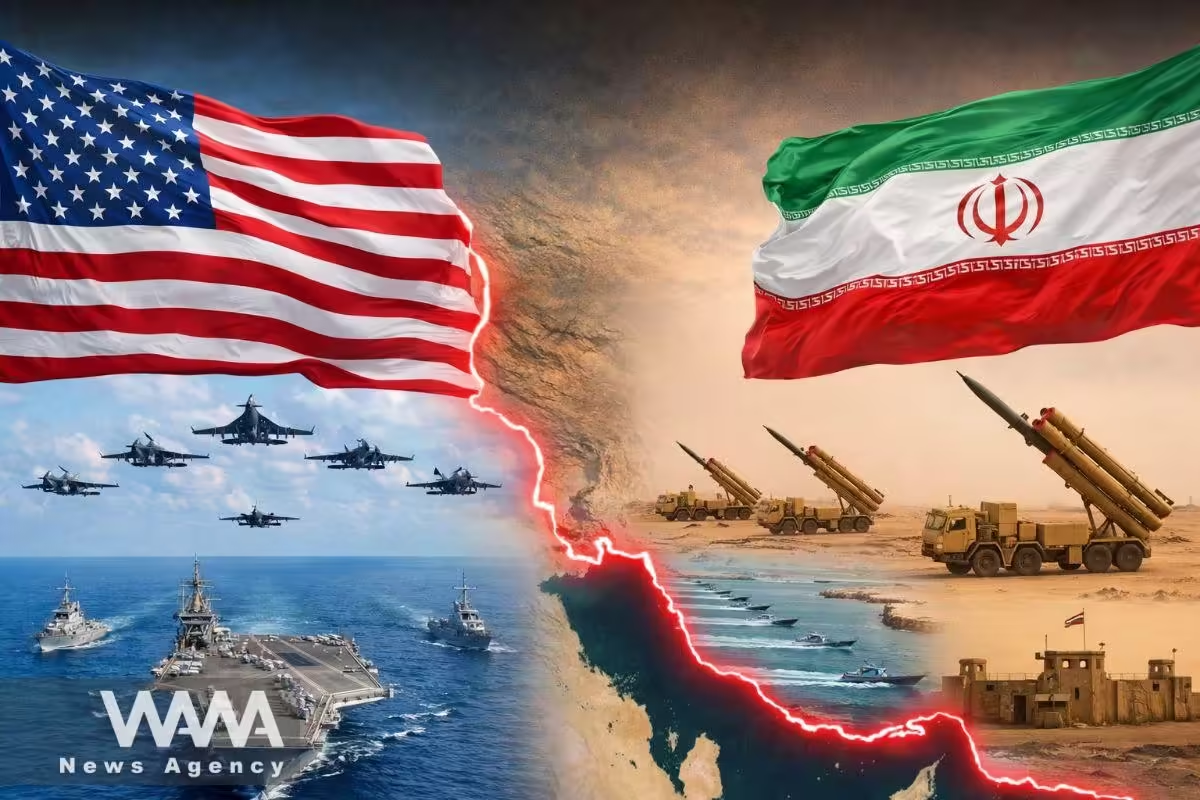

WANA (Oct 17) – As the possibility of renewed conflict between Iran and the United States grows, rising oil prices are adding fuel to the fire. Oil has surpassed $110 a barrel at a time when Donald Trump is threatening Iran, ostensibly to control prices and prevent further pressure on the global economy. Signs of a possible resumption of hostilities have also emerged.
Reports of American aircraft flying over Iraq, Israeli fighter jets patrolling near Iran’s borders, the opening of bomb shelters in Israel, and the reported clearing of airspace over the occupied Palestinian territories last night all point to rising tensions and an increased risk of escalation.
As the United States has threatened Iran in recent days with the MOAB, or the “Mother of All Bombs,” a member of parliament’s National Security and Foreign Policy Commission has said that Iran could respond with what he called the “Father of Missiles.” It remains unclear whether Alaeddin Boroujerdi’s remarks were simply a sarcastic response to Washington’s threats or were based on specific information.

Iranian missiles are displayed next to a banner with a picture of Iran’s Supreme Leader Mojtaba Khamenei, on a street in Tehran, Iran, September 27, 2026. Majid Asgaripour/WANA (West Asia News Agency)
In either case, they underscore Iran’s emphasis on its ability to confront the United States and potentially Israel if another conflict breaks out.
In the same context, Brigadier General Seyed Majid Ibn al-Reza, acting minister of defense and armed forces logistics, issued a message directly addressing Trump, stressing that the names and sizes of bombs do not matter. “The titles and dimensions of bombs are irrelevant! Your bombs will explode somewhere else: in your global standing, the U.S. economy, and even your electoral calculations!” he wrote. Ibn al-Reza added that Iran’s missile capabilities had changed the equation and brought the United States to a point where, in his words, it should already be saying, “Yes, sir!”
His remarks emphasize a point that could prove decisive in any potential confrontation between Iran and the United States: military power cannot be measured solely by the size of bombs or the extent of their destructive force. Even if the United States possesses powerful weapons, the consequences of an attack, Iran’s ability to retaliate, and the economic and political costs of war would also be part of the equation.

Iran’s Missile Power Has Changed the Equations, Defense Chief Tells Trump
WANA (Oct 17) – Brigadier General Seyyed Majid Ibn al-Reza, acting Iranian defense minister, said Iran’s missile capabilities had changed regional and international equations, adding that the consequences of U.S. bombs extend beyond the battlefield to affect Washington’s global standing, economy and even electoral calculations. In a post on X addressed to U.S. President […]
So far, U.S. military movements have heightened concerns about a possible attack on Iran. Some analysts consider the risk of escalation serious, pointing to the deadlock in negotiations, Iran’s capacity to withstand pressure, and rising oil prices. Iran, for its part, has not taken these threats lightly and has emphasized its defensive readiness, signaling that it will respond if attacked—regardless of whether its adversary enters the battlefield with the Mother of All Bombs or other weapons.
The MOAB is one of the largest conventional, non-nuclear bombs developed by the United States. However, a weapon’s destructive power alone does not determine the outcome of a war, nor can it be equated with the power of a nuclear weapon or the strategic consequences of its use.
Meanwhile, reports have emerged suggesting that the United States has asked Iran, through intermediaries, not to retaliate against a strike on Kuh-e Kolang, allowing the conflict to end. According to the same reports, Iran has stressed that any act of aggression will be met with a response. If this account is accurate, it could indicate an effort to contain the conflict and find a way out of the crisis—a crisis whose continuation could impose even greater costs on Washington.

Members of Iranian militia forces (Basij) ride on motorcycles as they participate in a march in Tehran, Iran, September 25, 2026. Majid Asgaripour/WANA (West Asia News Agency)
Trump is increasingly faced with the question of whether escalating the confrontation would achieve his intended objectives or instead drive energy prices even higher and put additional pressure on the U.S. economy. In these circumstances, Iran’s missile capabilities and the regional consequences of any attack are factors that cannot be ignored in military and political calculations.
Ultimately, the issue is not simply what weapons the United States possesses or how Iran would respond. The central question is whether Washington can achieve its objectives without imposing even greater costs on itself and the global economy.
Military threats may increase pressure, but they do not necessarily pave the way for political success. If another war breaks out, its consequences could extend far beyond the calculations of the party that initiates it.

Strikes on Super Tankers: Iran’s New Equation in the Strait of Hormuz
WANA (Oct 15) – Ali Ozamayi, commander of the Islamic Revolutionary Guard Corps (IRGC) Navy, who succeeded Tangsiri in the post, has a modest demeanor and a bold spirit. Forces under his command have carried out an unprecedented escalation in the post-war period in recent days by attacking three supertankers and two container ships. Following […]
Source: wanaen.com