
ST. LOUIS, MO – October 5, 2026 (STL.News) The criminal justice system is often described through its institutions — police departments, prosecutors’ offices, federal agencies, and courts.
But institutions do not investigate crimes, interview witnesses, prepare cases or stand before juries. People do.
Two men whose careers offer an unusual look at those different sides of justice are Thomas C. “Tom” Albus, U.S. attorney for the Eastern District of Missouri, and veteran federal prosecutor Donald S. “Don” Boyce.
Between them, Albus and Boyce have accumulated decades of experience in law enforcement, prosecution, government, and the courts.
Boyce brings an especially distinctive perspective. Before becoming a federal prosecutor, he was a St. Louis police officer. He later became an assistant U.S. attorney, rose to chief federal prosecutor for the Southern District of Illinois, and ultimately continued his prosecutorial career in the Eastern District of Missouri.
Albus followed a different path.
He spent 17 years as a federal prosecutor in St. Louis, moved into senior leadership in the Missouri Attorney General’s Office, became a St. Louis County circuit judge and eventually returned to the U.S. Attorney’s Office — this time as its leader.
Their careers provide a window into the relationships connecting police officers, federal agents, prosecutors and judges.
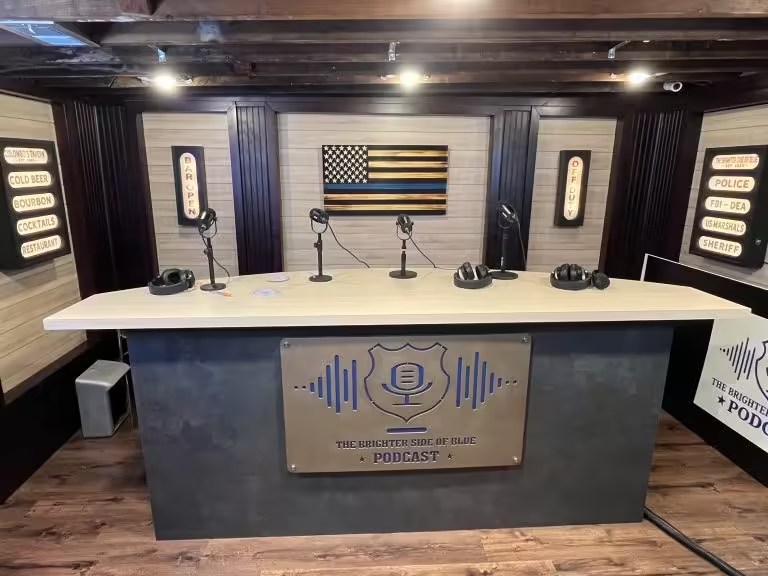
They also make Albus and Boyce natural subjects for The Brighter Side of Blue, a St. Louis-based podcast focused on law enforcement and the people who have spent their careers working within the justice system.
Don Boyce Started With a Badge
Boyce’s criminal justice career did not begin behind a prosecutor’s desk.
It began in law enforcement.
The U.S. Department of Justice identifies Boyce as a former St. Louis police officer, giving him a background few federal prosecutors have.
Police work offers a perspective you can’t get solely by studying criminal law.
Officers meet crime at street level.
They respond to emergencies, encounter victims and witnesses, preserve evidence, pursue suspects, and begin assembling the facts that may eventually become a criminal prosecution.
The work can also expose officers to the enormous difference between suspecting that someone committed a crime and developing the evidence necessary to prove it.
Boyce eventually moved from policing into the legal profession.
In 2006, he became an assistant U.S. attorney for the Southern District of Illinois. He later rose to become chief of the office’s Organized Crime and Drug Enforcement Task Force.
That position put him in the middle of federal investigations involving narcotics trafficking and other serious criminal activity.
His responsibilities continued to grow.
Boyce was sworn in as U.S. attorney for the Southern District of Illinois on July 8, 2016, after then-U.S. Attorney General Loretta Lynch appointed him.
The judges of the U.S. District Court for the Southern District of Illinois subsequently reappointed him on Oct. 28, 2016.
The former St. Louis police officer had become the chief federal prosecutor for a district that includes communities immediately across the Mississippi River from St. Louis.
Boyce remained U.S. attorney until his resignation became effective July 21, 2018.
However, his work as a prosecutor continued.
Today, Boyce serves as an assistant U.S. attorney in the Eastern District of Missouri, where his name still appears on significant federal criminal prosecutions.
Seeing Both Sides of a Criminal Case
Boyce’s police background is particularly relevant because investigators and prosecutors do different jobs, even when they pursue the same case.
Police investigate.
Prosecutors determine what the evidence can establish in court.
The distinction is fundamental.
An investigator may have strong reasons to believe that a suspect committed an offense. A prosecutor must determine whether admissible evidence can establish the elements of a criminal charge beyond a reasonable doubt.
Evidence has to withstand courtroom scrutiny.
Witnesses must be evaluated. Searches and seizures must satisfy constitutional requirements. Physical and digital evidence must be collected and preserved properly.
Prosecutors also carry responsibilities that extend beyond obtaining convictions. Their role is to pursue justice while operating within the Constitution and the law.
Boyce’s career has placed him on both sides of that relationship.
He knows what it means to work as a police officer.
He also knows what happens when an investigation reaches a federal prosecutor and potentially a federal courtroom.
Serious Cases and Serious Responsibilities
Some of Boyce’s recent prosecutions demonstrate the seriousness of that work.
One involved Eddie Marcus Love, a St. Louis County man sentenced in June 2026 to life in federal prison plus 15 years.
According to the U.S. Attorney’s Office, Love shot four teenagers in St. Louis on May 7, 2023.
Two 18-year-old women were killed, and two pregnant 17-year-olds were wounded. One wounded victim’s baby was delivered by emergency C-section and died about a month later as a result of gunshot wounds.
Love ultimately pleaded guilty in federal court to four counts involving marijuana distribution, firearms, and ammunition.
U.S. District Judge Stephen R. Clark sentenced Love on June 11, 2026.
The St. Louis Metropolitan Police Department and FBI investigated.
Assistant U.S. Attorneys Angie Danis and Don Boyce prosecuted the case.
It was a tragic case, but it also demonstrated how local police, federal investigators, and prosecutors can work together on particularly serious violent crimes.
Local Police and Federal Prosecutors
Other Boyce prosecutions illustrate the same cooperation.
In a case involving the armed robbery of the St. Louis Community Credit Union in Jennings, investigators eventually connected Shayne McKee to the 2018 robbery.
McKee pleaded guilty to robbery, brandishing a firearm during a crime of violence, and being a felon in possession of a firearm.
He received a 12-year federal prison sentence.
The FBI and St. Louis County Police Department investigated the case. Boyce and Assistant U.S. Attorney Cassandra Wiemken prosecuted it.
Boyce also prosecuted a federal carjacking case involving Darrell Gilkey of Belleville, Illinois.
Gilkey pleaded guilty to carjacking and brandishing a firearm in furtherance of a crime of violence and was sentenced to 100 months in federal prison.
The St. Louis Metropolitan Police Department investigated.
The cases are different, but they demonstrate a recurring feature of federal prosecution in the St. Louis region.
Local officers bring knowledge of their communities and investigative experience. Federal agencies contribute specialized capabilities and resources. Federal prosecutors evaluate whether the facts support charges under federal law and, when appropriate, take those cases into court.
No single part of that system operates effectively in isolation.
Tom Albus Builds a Career in the Law
Albus arrived at federal prosecution through a different route.
A native of St. Louis County, Albus graduated from Georgetown University in 1994 and earned his law degree from the University of Missouri School of Law in 1997.
His early career included clerkships with Judge Lawrence G. Crahan of the Missouri Court of Appeals and Judge John C. Holstein of the Missouri Supreme Court.
Albus then worked in the litigation department of the St. Louis law firm now known as Bryan Cave Leighton Paisner.
In 2002, he joined the U.S. Attorney’s Office for the Eastern District of Missouri.
He would spend the next 17 years there.
According to the Justice Department, Albus prosecuted white-collar crime, tax cases, public corruption and other federal offenses from 2002 through 2019.
That work put him alongside investigators from numerous federal, state and local agencies and gave him extensive experience with the relationship between investigators and prosecutors.
In 2019, another opportunity took Albus into state government.
From Federal Prosecutor to Missouri Government
Albus joined the Missouri Attorney General’s Office and became first assistant to then-Attorney General Eric Schmitt.
It represented another perspective on government service and the legal system.
Then, in 2020, Albus moved to the judiciary.
Missouri Gov. Mike Parson appointed him to the 21st Judicial Circuit in St. Louis County, where Albus was sworn in as a circuit judge.
The longtime prosecutor was now sitting on the other side of the courtroom.
That distinction matters.
A prosecutor advocates the government’s position.
A judge must remain impartial, rule on questions of law, and ensure proceedings follow legal and constitutional requirements.
Albus therefore accumulated experience not only arguing cases but also overseeing legal proceedings from the bench.
His career had now included private practice, federal prosecution, senior state-government service and the judiciary.
Five years later, he returned to the federal office where he had spent much of his career.
Albus Returns to the U.S. Attorney’s Office
Albus was sworn in as interim U.S. attorney for the Eastern District of Missouri on Aug. 1, 2025, after being appointed by Attorney General Pamela Bondi.
The appointment returned him to familiar territory, but in a dramatically different position.
Instead of serving as one of the office’s prosecutors, Albus now led it.
The U.S. Senate confirmed him as U.S. attorney on Dec. 18, 2025.
Today, Albus is the top-ranking federal law-enforcement official in the Eastern District of Missouri.
The district covers 49 counties in eastern Missouri and includes offices in St. Louis and Cape Girardeau.
Its prosecutors handle federal cases involving terrorism, fraud, public corruption, firearms, narcotics, child exploitation, human trafficking, and other federal offenses. The office also represents the United States in civil matters and works to collect debts owed to the federal government.
The job puts Albus at a key intersection between federal prosecutors and law enforcement agencies throughout eastern Missouri.
Cooperation as a Public-Safety Strategy
Albus has publicly emphasized cooperation.
When the U.S. Attorney’s Office announced the hiring of eight experienced attorneys in April 2026, Albus specifically praised what he called the “great, cooperative law enforcement community in the St. Louis region.”
That approach was demonstrated again during Operation Patriot Shield in June 2026.
The U.S. Marshals Service and its task-force partners conducted the regional public-safety initiative in Missouri and Illinois.
The results were substantial.
According to the Justice Department, U.S. marshals and task-force members arrested 224 fugitives and cleared 290 outstanding felony warrants.
Authorities seized 32 firearms as well as fentanyl, heroin, methamphetamine, marijuana, and other drugs.
Deputy marshals also located three missing children.
At the same time, the U.S. Attorney’s Office for the Eastern District of Missouri obtained federal indictments against 35 people for alleged violent crimes, drug crimes, firearms offenses or combinations of those crimes.
Those defendants are presumed innocent unless and until proven guilty in court.
Albus said the objective was to try to get ahead of the typical summer surge in violent crime.
Operation Patriot Shield also demonstrated the type of cooperation that has become central to modern law enforcement.
Federal authorities worked alongside state and local partners.
Different agencies contributed different resources.
The shared objective was public safety.
Where the Careers of Albus and Boyce Connect
Albus and Boyce reached federal prosecution from different directions.
Boyce started as a St. Louis police officer.
Albus began as a lawyer and judicial clerk before becoming a federal prosecutor.
Boyce moved from policing to prosecution and eventually became a U.S. attorney.
Albus moved from federal prosecution into state government, then onto the judicial bench before becoming a U.S. attorney himself.
Those careers provide different perspectives on the same system.
A patrol officer may encounter a crime first.
A detective may spend weeks developing the evidence.
A federal agent may help expand the investigation.
A prosecutor must determine whether the evidence supports criminal charges.
A grand jury may consider an indictment.
A judge oversees the court proceedings.
If a defendant is convicted, the judge ultimately determines the appropriate sentence within the framework established by law.
Every participant has a different responsibility.
But those responsibilities intersect.
Why Relationships Matter
Successful criminal investigations depend heavily on professional trust.
An experienced investigator learns what prosecutors need before a case can move forward.
An experienced prosecutor understands the challenges investigators face as they develop evidence.
Federal authorities rely on the local knowledge of police departments and sheriff’s offices.
Local agencies can benefit from the resources and jurisdiction available through federal agencies.
That does not mean police and prosecutors always agree.
Nor should they.
Professional cooperation does not require automatic agreement. Strong relationships let investigators and prosecutors discuss weaknesses, challenge assumptions, and determine whether the evidence actually supports the charges being considered.
That process strengthens cases.
It also strengthens the justice system.
Experience That Cannot Be Found in a Résumé
The résumés of Albus and Boyce document decades of accomplishment.
But résumés tell only part of the story.
They cannot completely explain what an officer learns after years of dealing with victims, suspects, and witnesses.
They cannot convey everything a prosecutor learns after preparing cases for trial.
They cannot describe every lesson learned when evidence fails to develop as expected or when an investigation suddenly changes direction.
And they cannot fully capture the professional relationships that develop when people work together across years and sometimes decades.
That is where conversations such as those presented by The Brighter Side of Blue become valuable.
They provide an opportunity to hear from the people behind the titles.
The badge.
The prosecutor.
The judge.
The U.S. attorney.
Behind every title is a person who has accumulated experience one case at a time.
The Brighter Side of Public Service
Law enforcement stories often focus on the worst moments a community experiences.
Murders.
Robberies.
Drug trafficking.
Carjackings.
Victims and families facing devastating circumstances.
Those stories must be reported.
But another part of the criminal justice story gets less attention — the people who spend decades doing the work.
Boyce’s career has taken him from the streets of St. Louis as a police officer to federal courtrooms as a prosecutor and eventually to leadership of a U.S. Attorney’s Office.
Albus’ career has taken him through private practice, federal prosecution, state government, the judiciary and ultimately leadership of the U.S. Attorney’s Office for the Eastern District of Missouri.
Both careers demonstrate the depth of experience that can accumulate through years of public service.
They also demonstrate how closely connected the different parts of the criminal justice system really are.
Cops, Prosecutors and Justice
It is easy to think of criminal justice as a collection of agencies.
Police departments.
The FBI.
The DEA.
The U.S. Marshals Service.
Prosecutors.
Courts.
But agencies are ultimately made up of people.
Those people build investigations.
They interview witnesses.
They analyze evidence.
They prepare cases.
They make difficult decisions.
And they develop professional relationships that can last for decades.
Don Boyce has experienced that system as both a police officer and a federal prosecutor.
Tom Albus has experienced it as a lawyer, federal prosecutor, senior state-government official, circuit judge, and U.S. attorney.
Their careers have followed different paths, but both have become deeply connected to the administration of justice in the St. Louis region.
That makes their story about more than titles or résumés.
It is about experience.
It is about cooperation.
It is about public service.
And it is about the relationships among cops, prosecutors, and other professionals who work every day to make the justice system function.
For Albus and Boyce, those experiences span decades.
For listeners interested in the people behind law enforcement, their perspectives offer something statistics and court records alone cannot: a look at the human side of the pursuit of justice.
We support The Brighter Side of Blue. Visit them at the following:
- Tag – The Brighter Side of Blue
- Profile Page on STL.News
- The Brighter Side of Blue Website
- YouTube Channel
- Apple Podcast Channel
Read St. Louis Local News at STL.News
Featured articles:
Source: www.stl.news