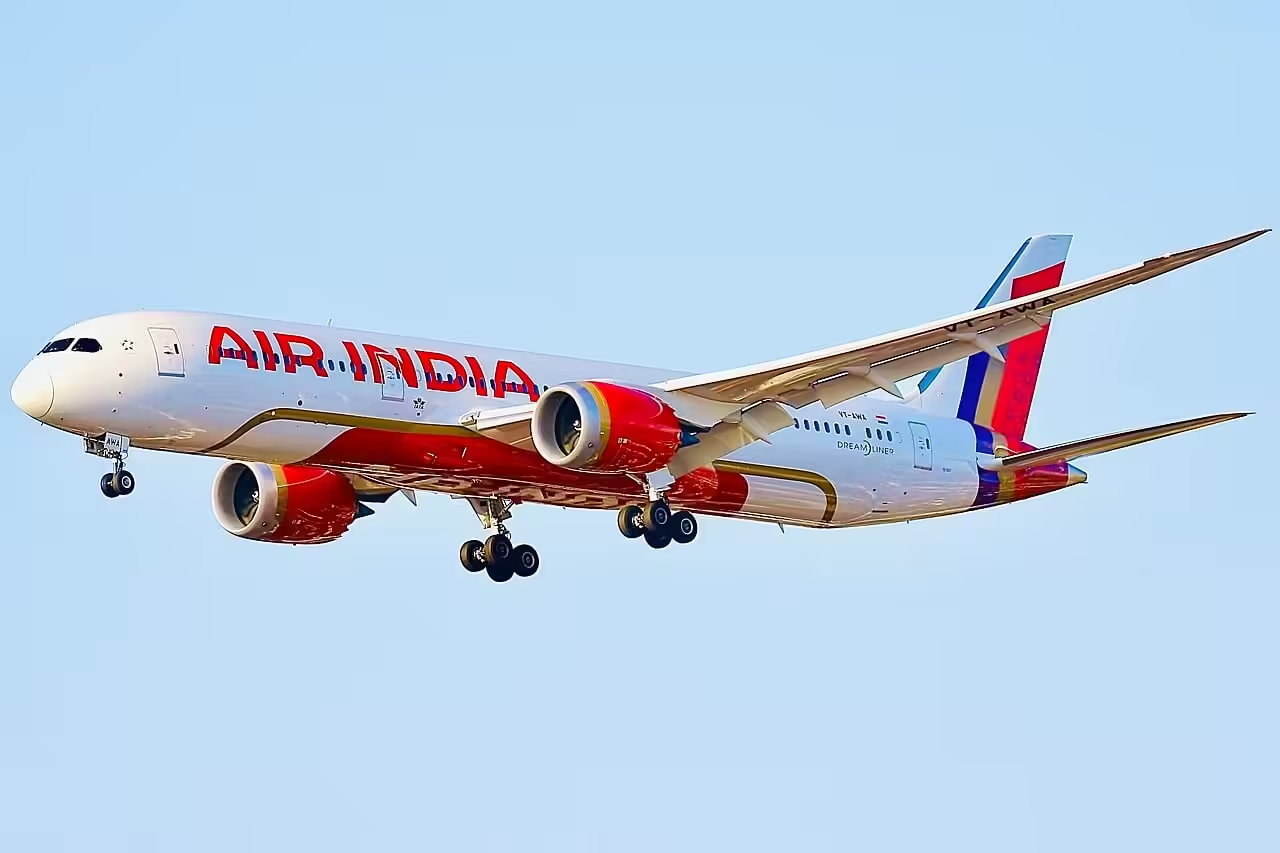

Less than a day after a Corendon Boeing 737 squawked the hijack code over Europe, it happened again, this time over India. On the morning of Wednesday, 14 October 2026, Air India flight AI2030 from Frankfurt to Delhi transmitted squawk 7500, the transponder code for unlawful interference.
The Boeing 787-9 never reached Delhi. Air traffic control sent it to Jaipur instead, where it landed safely and was towed to an isolation bay. Security forces then went through the aircraft, the passengers and the bags.
By lunchtime, the story looked less like a hijacking and more like a mistake. Jaipur’s airport chief said early indications pointed to a pilot error. The investigation is now trying to establish how the code came to be sent.
Quick Facts: Air India flight AI2030
Date: Wednesday, 14 October 2026 (departed Frankfurt on 13 October)
Route: Frankfurt (FRA) to Delhi (DEL)
Aircraft: Boeing 787-9 Dreamliner
Passengers: 306, according to several Indian reports
Code: Squawk 7500, unlawful interference, received around 9:00am local time
Where: Within the Mumbai Flight Information Region
Diverted to: Jaipur International Airport, landing at about 9:35 to 9:45am
Outcome: No injuries; aircraft searched in an isolation bay
Suspected cause: Pilot error, per preliminary indications (not confirmed)
A Signal That Lasted Seconds
According to airport sources quoted by the news agency IANS, the emergency signal reached air traffic controllers in Ahmedabad at around 9am local time and lasted only a few seconds. Police sources told PTI that the crew had selected the code while the jet was inside the Mumbai Flight Information Region. A few seconds is enough. Once a 7500 squawk is received, it cannot be ignored, and the decision was taken to bring the aircraft down at the nearest suitable airport rather than let it continue to the capital.
Jaipur International Airport received the 787 at around 9:35 to 9:45am, depending on the report. The aircraft was moved to an isolation bay, and the Central Industrial Security Force, local police and a bomb detection and disposal squad searched it. Passengers were taken off in phases under security supervision and moved to a holding area in the terminal, while their baggage was screened. Aviation A2Z reported that the Anti-Terrorism Squad was involved and that the National Security Guard was placed on standby in Delhi.
Hijack, Bomb Threat or Mistake?
The early reporting was messy. Some outlets, citing police sources, described a bomb threat. An airport official told the Hindustan Times that it concerned a hijacking rumour, not a bomb warning. What all reports agree on is the transponder code itself: 7500, which is reserved for unlawful interference with an aircraft.
The most concrete explanation came from Jaipur airport head Charan Singh, who told The Indian Express that preliminary indications suggest the pilot may have “activated the alert by mistake”. Air India had not issued a detailed statement by the time of the first reports, and India’s aviation regulator, the DGCA, is investigating what triggered the alert. Until it reports, the cause remains officially unconfirmed.
Two in Two Days
The timing is a coincidence, but it is a striking one. On Tuesday, a Corendon 737 flying from Corfu to Nuremberg also set 7500 and then could not be reached by radio. Luftwaffe Eurofighters escorted it in, and the airport was closed for about an hour. There, police blamed a likely radio fault.
Both cases show the same thing. The hijack code is a blunt instrument by design. It does not come with an explanation, so the people on the ground have to assume the worst until they can prove otherwise. That costs passengers a morning, an airline an aircraft and a crew out of position, and an airport an hour of chaos. It is the price of a system that works on the safe side.
For the 306 passengers on AI2030, an overnight flight from Frankfurt ended with a security search in Rajasthan instead of a landing in Delhi. An airport official said they would continue to their destinations under standard procedures.
WION’s report on the diversion of Air India flight AI2030 to Jaipur on 14 October 2026.
How do fighters respond when an airliner squawks 7500? Our explainer: Quick Reaction Alert Explained: How Fighters Intercept a Hijacked Airliner.
Sources: Aviation A2Z; The Statesman / IANS; Business Today / PTI; Gulf News / The Indian Express; Hindustan Times (via The Logical Indian); WION.
Frequently Asked Questions
What happened to Air India flight AI2030 on 14 October 2026?
Air India flight AI2030 from Frankfurt to Delhi, a Boeing 787-9, transmitted the hijack transponder code 7500 at around 9am local time. Air traffic control diverted it to Jaipur, where it landed safely and was searched in an isolation bay. Nobody was hurt.
Why was Air India AI2030 diverted to Jaipur?
The aircraft transmitted squawk 7500, the code for unlawful interference, while inside the Mumbai Flight Information Region. Indian authorities ordered a landing at the nearest suitable airport, Jaipur, instead of letting it continue to Delhi, so that security forces could check the aircraft.
Was Air India flight AI2030 actually hijacked?
No hijacking has been reported. Jaipur airport head Charan Singh told The Indian Express that preliminary indications suggest the pilot may have activated the alert by mistake. India’s regulator, the DGCA, is investigating, and the official cause had not been confirmed at the time of writing.
How many passengers were on Air India AI2030?
Several Indian reports put the number of passengers on board Air India flight AI2030 at 306. All were taken off the Boeing 787-9 at Jaipur and moved to a holding area in the terminal while security forces searched the aircraft and baggage.
What does squawk 7500 mean?
Squawk 7500 is the transponder code for unlawful interference with an aircraft, in practice a hijacking. When controllers receive it, authorities treat the flight as a possible hijack until they can rule it out. The radio-failure code is 7600 and the general emergency code is 7700.
Source: migflug.com