



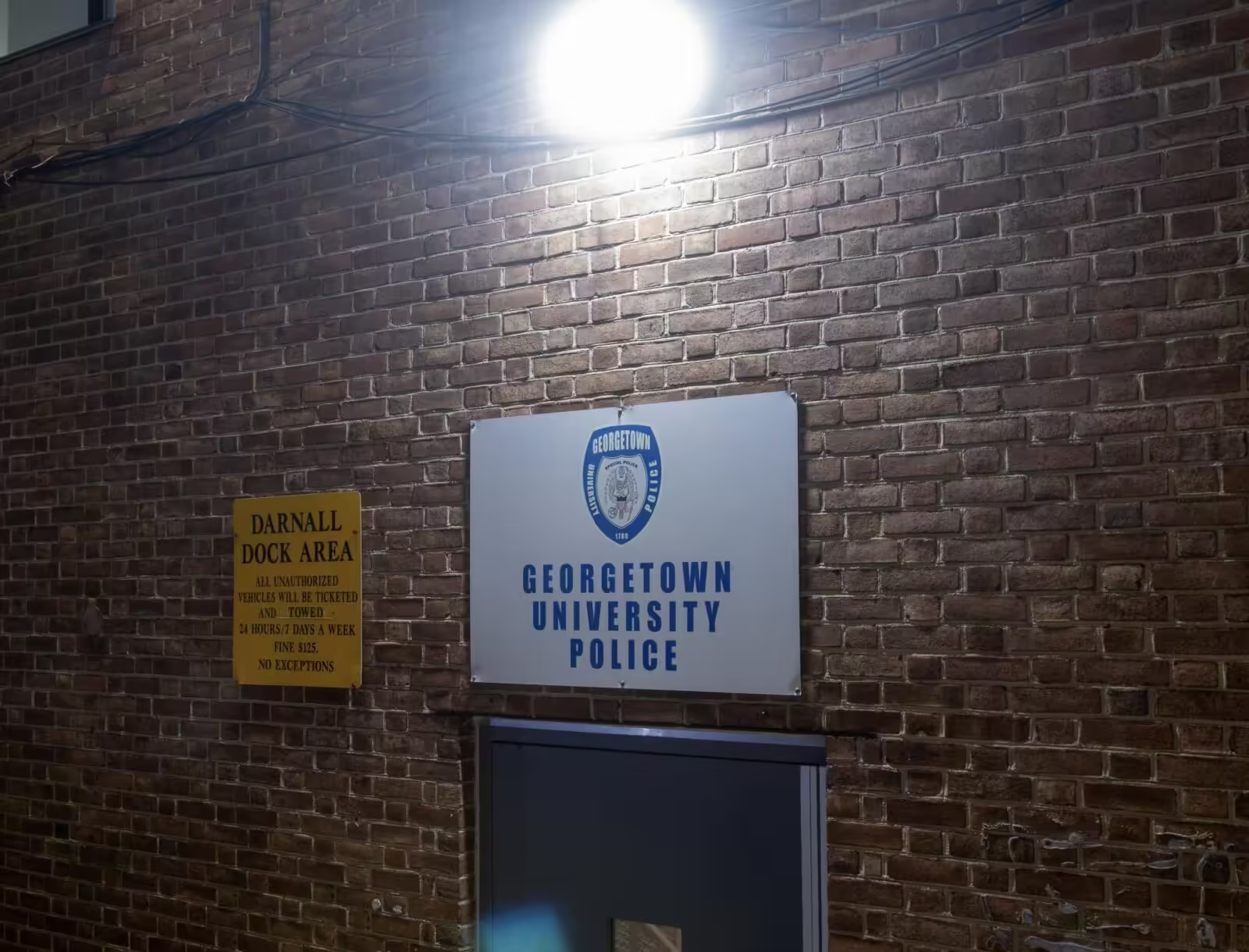

Reported crime on Georgetown University’s campuses and overseas properties increased by over 17% in 2025according to the university’s annual security report.
The Georgetown University Police Department (GUPD) received 168 total incident reports across all Georgetown University campuses in 2025, up from 143 in 2024. The report, which federal law mandates from universities, notably showed a rise in burglaries, exacerbating some students’ fears about campus safety.
A Georgetown University Office of Public Safety spokesperson said GUPD remains vigilant to student safety needs.
“The safety of our community is our top priority,” the spokesperson wrote to The Hoya. “The Office of Public Safety (OPS), including the Georgetown University Police Department (GUPD), works 24 hours a day, 365 days a year to protect our community, including responding to thousands of calls each year to support students, faculty and staff who are in need.”
The spokesperson added that GUPD collaborates with Washington, D.C. emergency services “to prevent and deter crime on campus and in the surrounding communities, enhance safety and respond quickly to incidents.”
Garrett Gao (MSB ’29)whose dorm was burglarized last winter break, said he reported the theft of over $100 from his room.
“I came back, and my lock was smashed in two, it looked like with a hammer, and it was in two pieces on the floor, and so I was like ‘What the heck,’” Gao told The Hoya. “I opened the cabinet, and it didn’t look like anything was stolen. But then my roommate was like, ‘Oh, do you think they took any cash?’ And then I checked, and all my cash was gone.”
“We both had over $100 in cash taken from our room,” Gao added. “No signs of forced entry or otherwise into the room.”
The university reported more than a 37% increase in burglaries, from 35 to 48from 2024 to 2025.
Mansi Peters (CAS ’27)whose credit card was stolen from Yates Field House in June, said students deserve better measures to prevent these incidents.
“I just think that generally, it’s pretty unsettling that of all the places in D.C. I could go to the gym to, I choose my university gym, and these things still happen,” Peters told The Hoya.
“I just think that navigating that public accessibility with safety for the students that pay to go here is a pretty important thing,” Peters added.
Gao said his experience with burglary was representative of a larger trend at Georgetown.
“I got an email — I don’t remember when it was, it might have been like April, May — that said there were a bunch of robberies in Darnall,” Gao said. “People had cash and similar things stolen from them with no signs of forced entry into the room.”
Amanda Pfundstein (MSB ’27)whose dorm room in LXR was burglarized in early 2025, said her room was entered by an unknown man.
“I woke up at around 4:30 to this man standing at the door, and he was in the room, and he had the door like held open with his hand,” Poundstone told The Hoya.
“He wasn’t really leaving on his own,” Poundstone added. “Eventually, I got up and walked towards the door, and he still wasn’t leaving. He was just standing with the door being held open with his hand, and then I had to grab the door and I just shut it so that he left.”
Poundstone said the intruder, who she reported to GUPD for burglary, behaved abnormally and refused to leave the room.
“He basically introduced himself as Dez, and he said that he was someone newly hired by Georgetown to do open door policy checks, which was a little off-putting at four in the morning,” Poundstone said. “He was so calm, so I didn’t really freak out right away. But I obviously knew something was off. And then he kept restating his name.”
Iliana Bassin (CAS, MSB ’27)Pfundstein’s roommate, said her experience with the intruder changed their living habits.
“Obviously we should have locked our door at night in the first place, or locked it at all,” Basin told The Hoya. “So we started doing that.”
This year’s report was the first to cite a hazing incident, in accordance with the Stop Campus Hazing Act, a December 2024 federal law that newly requires universities to report hazing statistics. The university prohibits hazing, even if consent is given, implemented an anti-hazing education program and will publish a hazing transparency report.
Annabelle Kim (CAS, McCourt ’27) — co-director of the Student Advocacy Office (SAO)a confidential student-run service to aid individuals going through the disciplinary process — said Georgetown’s anti-hazing policies have also resulted in student organizations being investigated for hazing, as opposed to individual students.
“We have seen organizations getting in the community standards process rather than individuals who are hosting for organizations,” Kim told The Hoya.
Sean Clavadetscher (CAS ’27)a student concerned about crime on campus, said the Georgetown neighborhood’s positive reputation overshadows crimes committed within it.
“It provides the student a sense of normalcy and a source of independence that the school gives us to make the right decisions, to be a conscious citizen on campus,” Clavadetscher told The Hoya. “So while there aren’t those safety checks in place, it kind of puts that role onto the students, which I think can be a valuable experience.”
“I think that the biggest proponent of that fact is that we live in one of the nicer neighborhoods, if not the nicest neighborhood in D.C.,” Clavadetscher added.
Peters said while her experience was upsetting, she hopes the university continues its efforts to protect students from more serious crimes.
“I’m sure that there are security and privacy concerns of a much higher degree,” Peters said.
“I have no solution for how to tackle that, but I just think maybe a reevaluation of the types of security we protect and maybe the use of money that could be allocated to those kinds of things need to be reassessed,” Peters added.
Gao said although he was never able to recollect the stolen money, he is hopeful future incidents can be reconciled.
“I did get over $100 stolen from me, and that is a lot of money,” Gao said. “When it comes to a college student’s life and what they spend money on, that’s significant damage.”
“That really stings, and it sucks because I paid so much to go here, and this is a great university,” Gao added.
Source: thehoya.com