
Listen to this article
Estimated 4 minutes
The audio version of this article is generated by AI-based technology. Mispronunciations can occur. We are working with our partners to continually review and improve the results.
More than a year after losing his 31-year-old son to an overdose, Rob Louie is using his own recovery to send a message to others struggling with addiction.
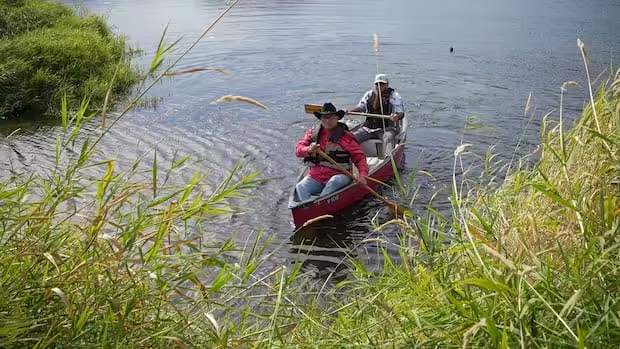
He recently paddled across the Canada-U.S. border on the Kootenay River in a symbolic journey meant to raise awareness of the toxic drug crisis and the possibility of healing. The route also holds generations of significance for Ktunaxa people.
“If my son were here … I would say, you know, ‘Dad made it. I recovered,'” Louie said.
Like his son, he has also struggled with addiction, and says he has now been sober and in recovery for more than a year.
The recovery is still intertwined with the loss of his son.
“Sometimes I look back and ask, ‘What else could I have done so that he could have been here?'” he said.

For Louie, who is from Yaqan Nuʔkiy, the paddle was a way to honour his son while retracing a river route with cultural meaning for his people.
Yaqan Nuʔkiy is one of four Ktunaxa First Nations in southeastern B.C., along with ʔaq̓am, ʔakisq̓nuk, and Yaq̓it ʔa·knuqⱡi’it.
Beyond one family’s loss
First Nations people make up about three per cent of B.C.’s population, but accounted for nearly 16 per cent of toxic drug poisoning deaths last year, according to the First Nations Health Authority.
And while deaths are highest in urban centres, some of the hardest-hit areas per capita in B.C. are in smaller rural and remote communities.
Ktunaxa Nation governments declared a state of emergency in 2021 due to concerns about addiction, mental health and gaps in services.
More than five years later, the crisis remains part of the backdrop amid efforts to expand culturally based healing and treatment.
In April, First Nations Health Authority chief medical officer Dr. Nel Wieman said “lives are saved through connection and culture and when programs and services are community led.”
Louie used his trip to raise money for personal-care items for clients entering the Seven Nations Soaring Eagle Treatment Centre in Creston.
The centre is being developed as a culturally-rooted Indigenous treatment facility.
Louie said his fundraiser had collected about $650 at the time of the paddle.
Having gone through treatment himself, he said seemingly small items such as razors and soap can help people rebuild self-esteem and a sense of self-care.

Louie said there was a time when he had written himself off and believed he would never recover from addiction.
He said he made it out of Vancouver’s Downtown Eastside with help from others, while his son did not.
“I went two different directions — but there’s also that one single solution, which is recovery, that I’m trying to bring us back to,” Louie said.

A river with generations of history
For Louie, that broader story of loss and healing is also tied to the Kootenay River itself.
He remembers his grandmother telling stories about travelling the river by canoe. Long before the modern international border, he said, the river connected Lower Kootenay people between what are now the communities of Creston, B.C., and Bonners Ferry, Idaho.
“The river was, in a very real sense, like our highway,” he said.

Travelling that waterway now, Louie said, is a reminder that illicit drugs are not the only thing that can cross the border. Recovery and healing can, too.
He plans to make the recovery paddle an annual event.
“I’m standing here at the U.S.-Canada border paddling for those that can’t paddle themselves yet,” Louie said.
Source: www.cbc.ca