

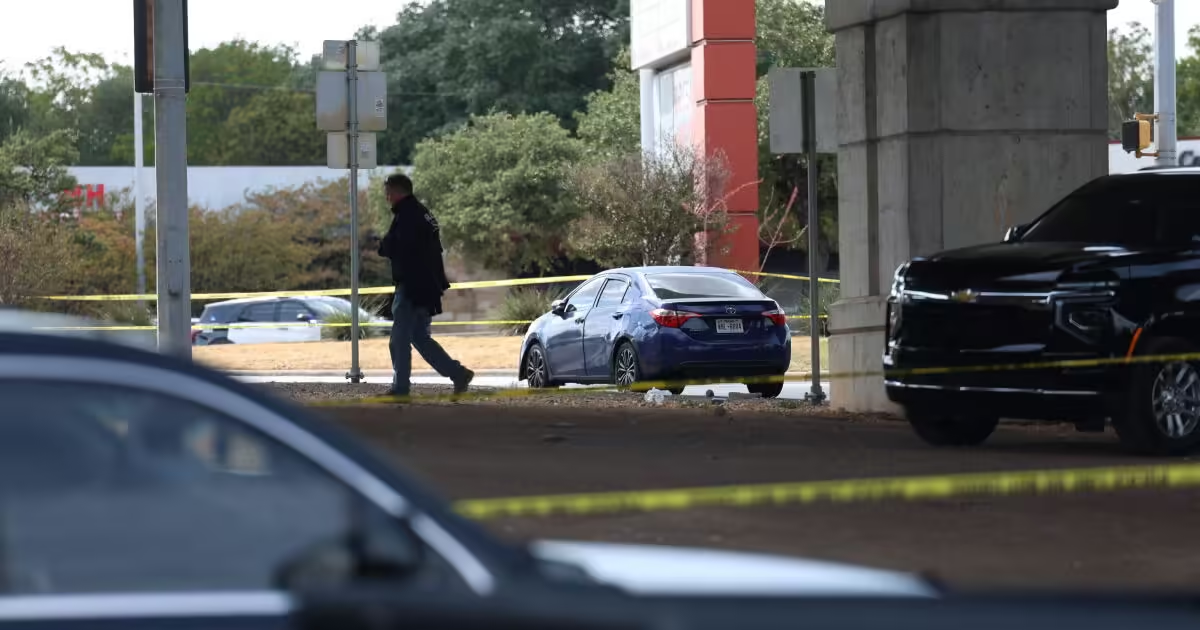

Security guards pushed Wilber Garces Perez in a wheelchair into a federal courtroom in Austin on Wednesday. Garces Perez is the Venezuelan delivery driver who was shot by an Immigration and Customs Enforcement agent on Sept. 20 in North Austin.
ICE is now saying he struck the agent who shot him with his car’s side mirror while fleeing an immigration stop minutes before the shooting.
The court hearing concerned whether the charge against him for assaulting and resisting a federal officer will proceed. The judge said it will.
But the hours of evidence, witness testimony and lawyers’ arguments also revealed more details than have previously been made public about what happened that day and about ICE activity in Austin.
Here are three takeaways from the hearing.
1. ICE agents are randomly checking license plates around Austin
The one witness who spoke at the hearing was Homeland Security Investigations Special Agent Rick Bazan.
Bazan is the investigator who was tasked with looking into the initial interaction between Garces Perez and the two ICE officers who pulled him over.
He was not at the scene, but he described the “everyday” workload of ICE enforcement officers as driving around and running people’s license plates to see if they have immigration enforcement orders against them.
Bazan said that’s what the two agents involved in the incident were doing when they spotted Garces Perez picking up a food delivery order from a restaurant in his blue Toyota Corolla.
“They were doing immigration enforcement, random checks on random places,” Bazan said. “They’re out there everywhere running license plates.”
During cross examination, Garces Perez’s lawyer Shane McMahon asked Bazan if ICE agents can look up anyone’s license plates in government databases to check their immigration status.
“That’s right,” Bazan said.
This kind of fishing expedition paints a different picture of ICE activity from what many Austinites have typically seen, in which federal agents have partnered with state traffic enforcement to pull people over then run a background check.
Bazan also made it clear that, once the agents identified Garces Perez as someone to detain, they preferred to arrest him via a traffic stop than at the restaurant.
He said agents preferred the traffic stop because they feared Garces Perez might flee by foot and “because there was more people” at the restaurant.
2. The ICE investigator who says Garces Perez hit an agent with his car has not spoken with that agent
The federal charges against Garces Perez are based on a criminal complaint Bazan wrote after interviewing Garces Perez and one of the officers who initially pulled him over.
The officer Bazan spoke with, named “D.F.” in the complaint, is not the officer who shot Garces Perez after pursuing him to the corner of U.S. Highway 183 and Anderson Square.
That officer is referred to as “L.G.” in the complaint.
During his testimony, Bazan said there is a separate investigation into the shooting.
He did not comment on the status of that investigation, but said “my team has not talked to L.G. at all.”
Bazan said he based the criminal complaint in part off of footage from the body camera worn by “D.F.”
He testified that the other officer, “L.G.,” has access to body camera equipment but was not wearing it that day.
Bazan said he did not ask why.
3. ICE body camera footage was shown for first time, but it cuts off at crucial moments
At the hearing, government prosecutors submitted footage from the body camera worn by “D.F.” as evidence supporting their charges.
That video evidence is currently sealed from public view, but it was shown in court and those who attended the hearing got the opportunity to watch it.
But it raised a lot of questions.
The tape runs about eight minutes, starting with Garces Perez’s initial stop by ICE.
In the recording, the officer who is not wearing the body camera stands by the driver’s side window of Garces Perez’s car and speaks to him in Spanish.
Garces Perez suddenly pulls away against the commands of the officer.
At the moment the car begins to move, the officer wearing the body camera quickly turns away, making it impossible to see what happens next.
A still image taken from the video before the camera turns away was presented by prosecutors and became the subject of scrutiny at the hearing.
In early testimony, Bazan testified that the image showed contact between the mirror of Garces Perez’s car and the torso of the agent in the image.
But, under cross examination, he conceded that it was only “possible” that contact was shown because the agent’s hand is “blocking the mirror” in the image.
Prosecutors later asserted they have other images that better show contact but did not submit them for the hearing.
After Garces Perez drives away, the body camera video shows the pursuit of “D.F.,” who is driving behind Garces Perez and the other officer.
It records “D.F.” first calling a friend who works for the Texas Department of Public safety to ask if anyone can provide backup, and then calling a DPS dispatcher to make the same request.
While talking with the dispatcher, “D.F.” pulls over and soon after he turns off his body camera.
In the criminal complaint against Garces Perez, “D.F.” said he later spoke by phone with “L.G.,” who told him he had shot Garces Perez because he feared being hit by his car.
But none of that conversation was recorded because the body camera had been shut off.
Under cross examination, Bazan said he did not know why “D.F.” turned off his body camera.
“You could have asked but you didn’t?” McMahon asked.
“No,” Bazan said.
Source: www.kut.org