



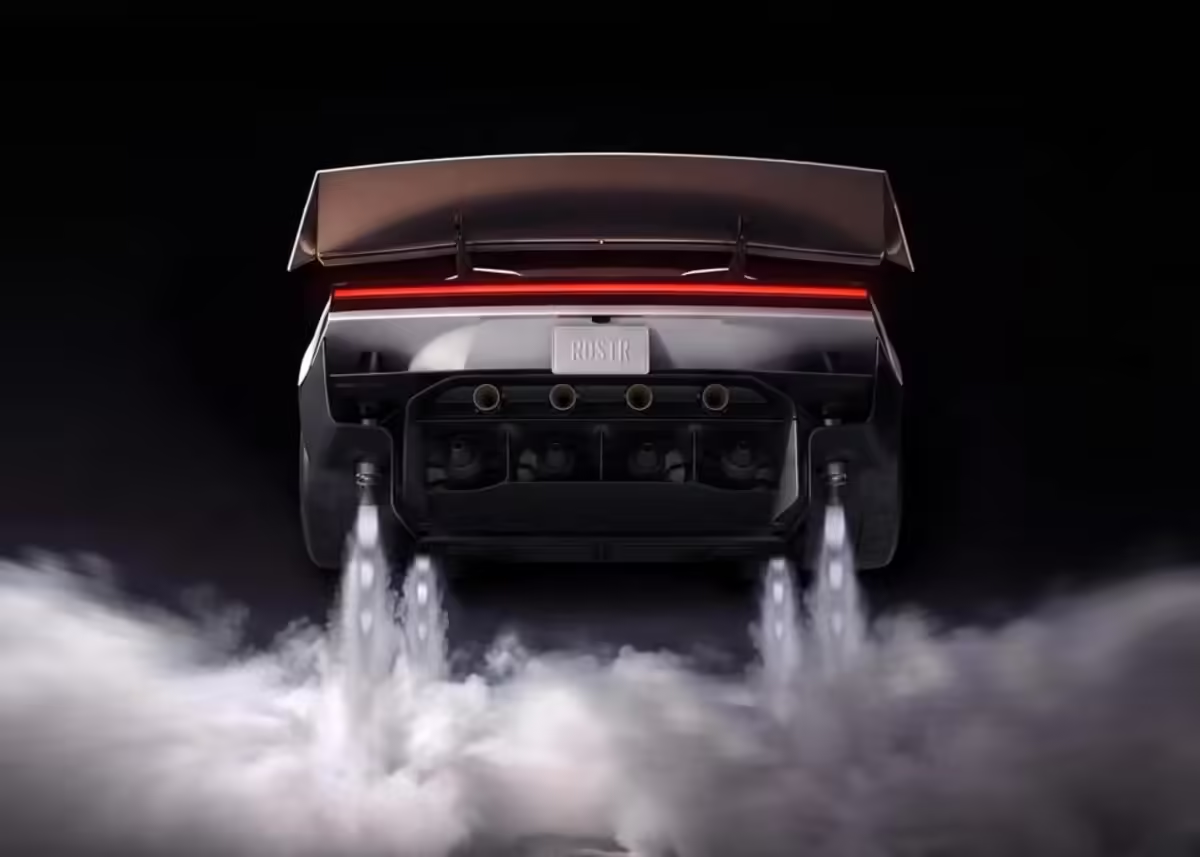

Elon Musk introduced the long-awaited second-generation Tesla Roadster last week. As expected, the debut wasn’t subtle. Tesla showcased the Roadster Rocket variant, which it describes as “a prototype with production intent.”
For more than a century, automakers have been content to roll their latest creations onto raised platforms for the world to gawk at. But not Elon—he went with a giant, C-shaped ramp (think half a Hot Wheels loop) nearly six stories tall. The Roadster Rocket climbed the ramp, launched upside down from its curled-over lip, executed a half-roll, and used its thrusters to slow its descent and settle gently onto its wheels. The crowd went wild.
“Thruster control” is new vocabulary for street vehicles. The Roadster Rocket uses SpaceX-derived cold-gas thruster technology, coordinated by Tesla’s proprietary control software, to maneuver in midair and control its landing (a brief, controlled aerial maneuver rather than sustained flight). Regardless, it beats pulling a silk sheet off a car.
Cold-Gas Thrusters Aren’t Preposterous
Critics quickly raised objections: The thrusters would never be approved for use on public roads. They could blast other vehicles off the highway, blind following drivers, or become a high-pressure hazard in a crash. And, of course, leapfrogging slower traffic is morally wrong (because it’s cheating).
Advertisement
Advertisement
But set aside the performance gains and aerial antics for a moment. Think safety. What if cold-gas thrusters could help prevent vehicles from skidding out of control, thus preventing crashes, saving lives, and reducing property damage?
Modern vehicles are equipped with an array of systems engineered to maintain vehicle stability. The main system is electronic stability control (ESC), which is supported by anti-lock brakes, traction control, and—on some vehicles—torque vectoring, active suspension, and rear-wheel steering. Together, these systems help keep the vehicle pointed where the driver intends and manage how its tires use the available grip. While these systems work extraordinarily well when there is friction on the contact patch (the small area where the tire meets the road), they all fail when conditions are slippery—water, gravel, ice, and snow on the contact patch are common culprits. Even the best ESC (paired with brand-new tires) can’t always keep a vehicle from sliding into a guardrail on black ice. A sophisticated control system cannot simply command grip that isn’t available.
How Do Cold-Gas Thrusters Work?
Cold-gas thrusters rely on momentum exchange, rather than tire-road friction under a contact patch. They expel pressurized gas in one direction, producing a reaction force that pushes the vehicle in the opposite direction (the underlying physics are Newton’s laws of motion and conservation of momentum—the same principles that propel a rocket). Cold-gas thrusters work in any weather, at any time of day—even in the vacuum of space.
Imagine your vehicle enters a corner on a dark winter night and hits a patch of ice, pitching the nose toward a guardrail. The vehicle’s ESC tries to stabilize it, but with no grip under the contact patch, the slide continues. An innovative new safety system—cold-gas thrusters—immediately springs into action, releasing high-pressure air to stabilize the vehicle and keep it safely on the road.
Advertisement
Advertisement
The applications are unlimited, from keeping vehicles in their lanes and making emergency maneuvers safer, to slowing a vehicle before a collision. Thrusters could buffer an impending impact or (with enough power) blast a leaping deer out of a vehicle’s path before it hits the windshield. Cold-gas thrusters could even help move a disabled vehicle off railroad tracks if a train is approaching.
Cold-Gas Thruster Technology Is Proven
Bosch explored this idea in 2018, when it demonstrated that a motorcycle using gas thrusters could counter a slide and help the rider stay on the bike. The system monitored bike dynamics throughout the ride. When special sensors detected excessive sideways slip, the system discharged pressurized gas through a nozzle, producing a corrective force to keep the bike upright and on course. It wasn’t for additional propulsion or momentary flight—it was a safety-first system that provided emergency lateral correction, allowing the rider to maintain control.
While Bosch proved the viability of the gas thruster concept, its engineers developed a research prototype as a one-shot system—once discharged, it had to be replaced. Tesla uses a different system that stores compressed air in a carbon-fiber-overwrapped pressure vessel, and it appears to deliver only seconds of cold-gas thrust before the tank runs low (Tesla says the car can replenish its compressed-air supply, but it likely takes considerable time).
Could Tesla Cold-Gas Thrusters Become The Next Automotive Safety Device?
It’s possible. The challenge isn’t whether high-pressure gas can move a vehicle and change its trajectory—that’s proven. The hurdle is packaging enough corrective force—high-pressure gas thrust—into a system that is safe, affordable, refillable, and dependable. (Of course, engineers would also have to evaluate exhaust-jet hazards, noise, displaced debris, accidental deployment, and pressure-vessel crashworthiness.)
Advertisement
Advertisement
Early gas thruster systems will likely be lower power, just enough to provide modest intervention early in the skid to prevent a larger departure from the intended path (physics dictates that less intervention is required early in the skid—so catching it early pays off). On that note, stopping a skid is much easier than stopping a spin, which requires control of both rotation and trajectory. This makes stabilization, rather than dramatic last-second rescue, the most compelling application. (Nozzles on the front of the vehicle could be used similarly—for supplemental deceleration.)
Installing cold-gas thrusters on passenger vehicles is not a preposterous idea. Bosch has shown that gas thrusters can help a motorcycle stay upright, and Tesla has now shown the effectiveness of cold-gas thrusters for maneuvering and accelerating a passenger car—it could be only a matter of time before engineers overcome the challenges and apply the technology to save lives.
This article was originally published on Forbes.com
Source: autos.yahoo.com