



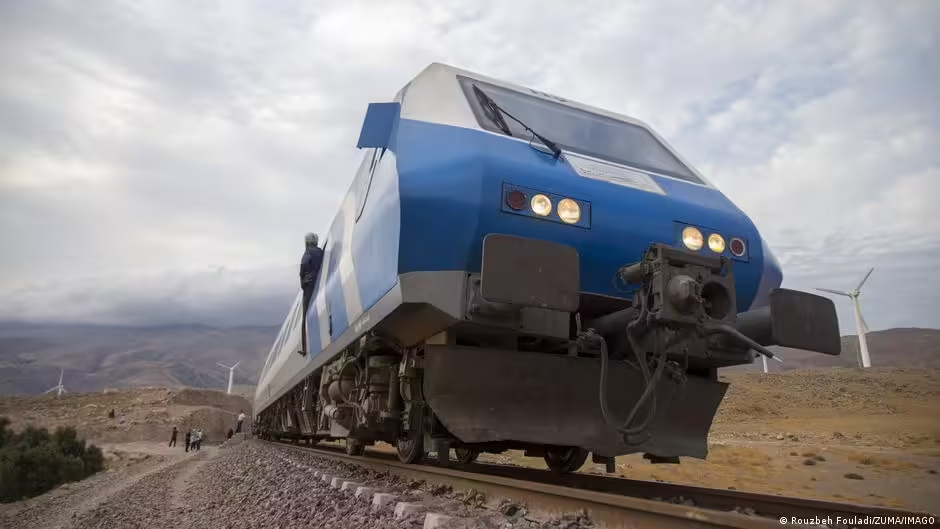

The United States has opened another front in its economic pressure campaign against Iranthis time targeting the railways Tehran increasingly relies on as maritime trade becomes more difficult.
On October 1, the US Treasury sanctioned three Iranian railway companies alongside seven automakers and five foreign suppliers of automotive parts as part of its Operation Economic Outcast.
Washington says Iran’s rail and automotive industries provide revenue and logistical capacity to the state and are connected to networks involving the Islamic Revolutionary Guard Corps (IRGC).
The timing of the move is significant. Since the US maritime blockade sharply restricted Iran’s southern trade routes, Tehran has tried to move more goods through its land borders and railway connections with China, Central Asia, Russia and Turkey.
Rail transport has become more important just as Washington decided to target it.
Iran expands regional rail links
Shahriar Naghizadeh, director general for foreign trade at Iran’s railway authority, was quoted by the semi-officialMehr news agency as saying that the country has around 15,000 kilometers (9,300 miles) of main and secondary railway lines, more than 35,000 wagons and nearly 500 diesel locomotives.
The network carried around 44 million tons of freight in the Iranian year ending in March 2026, up from about 40 million tons the previous year, according to Naghizadeh. And authorities are targeting 54 million tons this year.
Iran is linked to neighboring markets through 13 rail crossings, providing overland access to Turkey, Azerbaijan, Afghanistan, Pakistan, and onward routes to Central Asia and China via Turkmenistan.
The new US sanctions raise questions about how foreign railway operators, freight forwarders, banks and insurers will continue dealing with Iranian rail companies.
China-Iran rail traffic expands
Bloomberg reported in May that freight trains traveling from the Chinese city of Xi’an to Tehran had increased from around one per week before the US blockade to roughly one every three or four days.
In September, a train left China carrying automotive parts, consumer goods and other cargo. It ran through Kazakhstan, Uzbekistan and Turkmenistan before entering Iran at Sarakhs with an expected transit time of 14 to 16 days.
For Iran, such services offer a route to Chinese suppliers that avoids the area around the Strait of Hormuz. But advertised transit times do not necessarily reflect what an importer experiences.
Delivery date cannot be guaranteed
A Chinese freight company told DW that actual delivery times can stretch far beyond advertised schedules because of border inspections, customs procedures and train availability.
It estimated that rail transit along the main route from western China to Tehran would take 50-60 days under current conditions. Road transport along a similar route is around 22 to 25 days.
The gap between a scheduled 14-day transit time and commercial estimates of up to 60 days highlights one of the central challenges facing Iran.
Customs inspections, gauge changes, payment problems and sanctions can all be another potential point of delay.
Increasing the number of trains also requires more locomotives, wagons and cooperation from several transit countries.
Rail works best for critical inputs
Alireza Salavati, managing director of London-based Middle East Analytica, said rail is increasingly useful for Iran but should not be mistaken as a replacement for maritime trade.
“A workable overland route now links China and Iran, but I would not call it a replacement for sea freight,” he told DW.
Under normal conditions, ships can move far larger quantities at lower unit costs. Rail becomes more attractive for goods where speed and continuity matter more than the cheapest transport.
That includes automotive components, machinery, electronics and industrial inputs whose absence can stop an entire production line.
When delays become a cash problem
Salavati argues that the effect on companies cannot be measured only in freight charges.
For a manufacturer importing $1 million (€890,000) worth of inputs every 30 days, a 30-day journey means roughly a million dollars of inventory may be tied up in transit.
Cutting the journey to 15 days could reduce that amount significantly, depending on payment arrangements. The reverse can be much more damaging.
If input costs rise while delivery times stretch from 30 to 45 days, companies need more working capital simply to maintain the same production flow, the expert explained, pointing out that a factory can have customers and orders but still have to reduce production because too much cash is trapped in goods that have not arrived.
“Reliability matters as much as speed,” Salavati said. “A 15-day train is little use if the container waits a week to depart, or if the bank or insurer will not touch it.”
The new US sanctions add another source of uncertainty to that calculation.
Sanctions push trade toward other corridors
Optimizing its railway use would give Iran more options than having to rely on southern ports alone, but the overall scale remains limited.
Washington’s sanction strategy is designed to isolate Iran by closing maritime, financial, aviation and now railway channels.
Still, Salavati argues that the same pressure may accelerate Iran’s integration with alternative networks.
“Washington’s efforts to isolate Iran may also be pushing it deeper than at any point in recent years into China’s economic orbit and closer to Russia’s wartime strategic system,” he said.
That does not mean China or Russia can make up for the economic cost of US pressure, since Iranian importers still need insurers, banks and customers able to absorb higher prices.
Container trains can only carry a fraction of what a large cargo vessel can transport, so for now, rail provides Iran with a limited alternative trade channel.
Its wider success depends on better financing and becoming more reliable — but even then it is not a wholesale substitute for sea freight.
Edited by: Tim Rooks
Source: www.dw.com