





Temperatures amplified by climate change are linked to more gun violence incidents across 100 U.S. cities.
October 19, 2026
KEY FINDINGS
Hotter temperatures increase the risks of violence and aggression, including incidents of gun violence.
Climate Central analysis shows how temperatures boosted by human-caused climate change contributed to the number of gun violence incidents from 2021–2025 in 100 U.S. cities.
More than 1,900 incidents of gun violence were attributed to heat driven by climate change, out of the nearly 116,300 shootings that occurred during this time period.
INTRODUCTION
Gun violence in the United States claims tens of thousands lives per year, prompting many organizations to declare it as a major public health issue.
Researchers have consistently found that the risks of aggression and violence — including firearms incidents — increase with temperature. The exact causal links between high temperatures and aggressive or violent behavior aren’t fully understood; however, both theory and observations have found that heat can trigger aggression by activating the regions of the brain responsible for emotional regulation and by increasing adrenaline. Researchers also hypothesize that warmer weather could increase the number of interactions between people and, as a result, increase the number of opportunities for conflict and violence.
Rising temperatures driven by human-caused climate change have the potential to amplify the risk of aggressive and violent behavior and, in turn, increase the number of shootings.
Gun violence is a complex phenomenon influenced by many factors, including environmental and socioeconomic stressors, mental health, and firearms policy. For this analysis, Climate Central isolated one underlying contributor — high temperatures —and quantified how much climate change is contributing to U.S. gun violence incidents attributable to temperature.
Using gun violence data from the Gun Violence Archive and applying a previously published model relating temperature and gun violence incidents, Climate Central assessed how temperatures boosted by human-caused climate change contributed to the number of temperature-driven gun violence incidents from 2021-2025 in 100 U.S. cities.
RESULTS
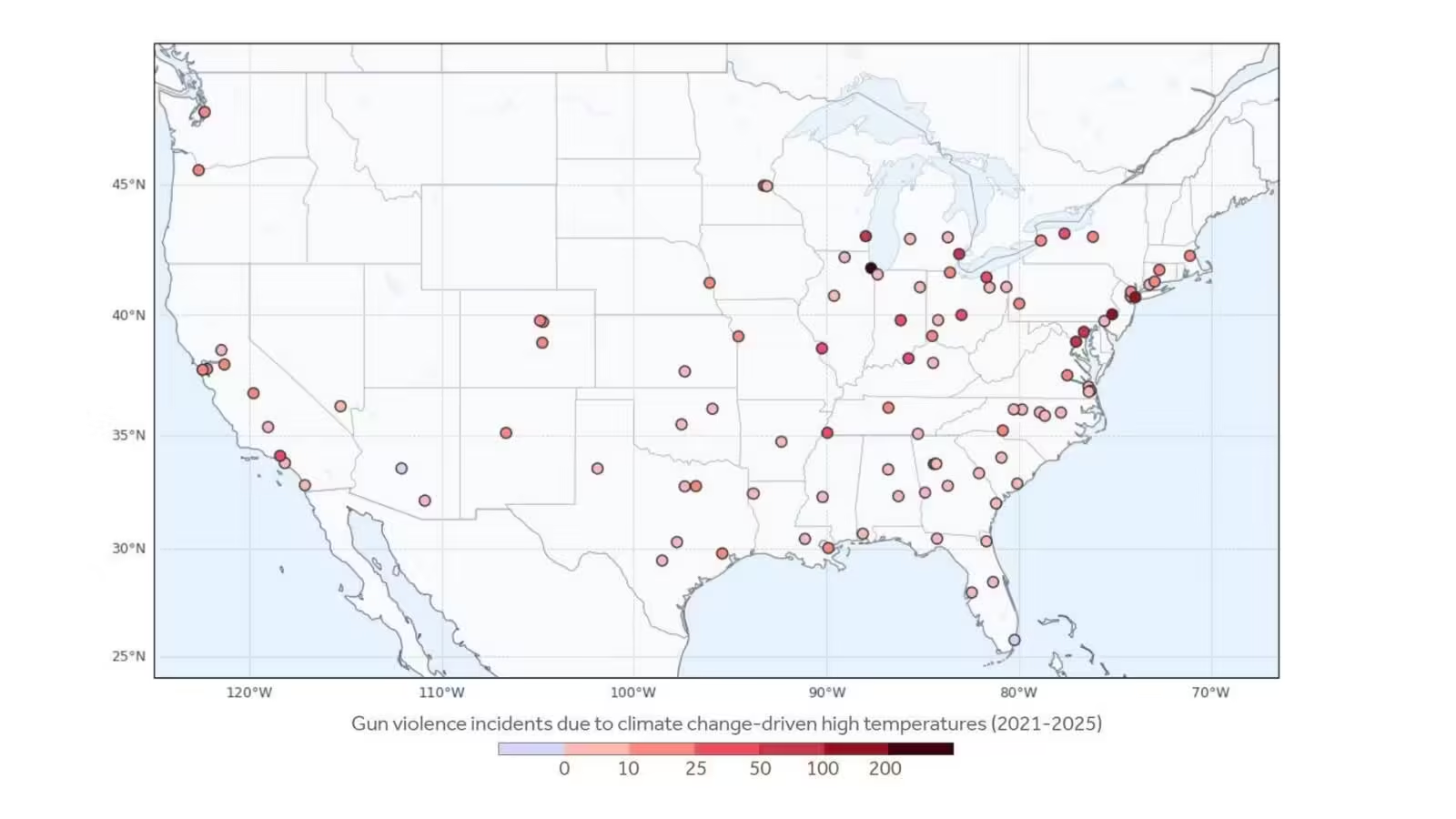
Over the 2021–2025 period, climate change increased the number of gun violence incidents attributable to high temperatures in 97 out of the 100 cities analyzed (Figure 1).
On average, these 97 cities experienced an additional 20 gun violence incidents as a result of climate change during this five-year period.
Chicago, Philadelphia, and New York City each experienced more than 100 gun violence incidents attributable to climate-induced high temperatures.
Across all 100 analyzed cities, more than 1,900 gun violence incidents during 2021-2025 were attributable to temperatures boosted by climate change. This is out of the nearly 116,300 shootings that occurred during this time period.
The influence of climate change on gun violence incidents overall is small (less than 2% of total incidents during the period of analysis), but it’s measurable and of concern given that continued warming is expected and every additional incident of gun violence represents a person who faces harm.
Figure 1. Gun violence incidents attributable to high temperatures influenced by climate change, across
100 U.S. cities during 2021-2025.
METHODOLOGY
This analysis utilizes a Distributed Lag Nonlinear Model originally published by Lyons et al. (2022). This model, which benefitted from code developed by Antonio Gasparrini, quantifies city-specific relationships between temperature and reported firearm incidents while accounting for seasonal patterns and day of the week. Since the cities are compared to themselves across time, this method automatically accounts for bias caused by differences between places, being sensitive only to things that vary over time within cities. We refit the Lyons et al. model using ERA5 reanalysis daily maximum temperature data and gun violence data for each city from
the Gun Violence Archive over the five-year period (2021-2025).
After establishing each city’s relationship between daily maximum temperature and the number of reported gun violence incidents, we applied the same model to each city’s counterfactual temperature data derived from Climate Central’s Climate Shift Index (CSI) system. Climate Central typically expresses this influence as a change in the likelihood of the observed temperature due to climate change. However, it is also possible to use the CSI system to estimate what daily temperatures would have been without climate change. By comparing the model output using observed daily temperatures vs. daily counterfactual temperatures, we then calculate the number of gun violence incidents that can be attributed to climate change’s influence on daily
temperatures.
This method only evaluates the linkages between climate change, temperature, and gun violence incidents. Implicitly, this assumes that all other drivers of gun violence — including stress, mental health, financial insecurity, and local firearms policies—would have been the same in a counterfactual world without climate
change. While this assumption lets us isolate and evaluate the effect of climate change on gun violence incidents associated with high temperatures, it cannot address the full and complex range of drivers that could have also influenced the number of gun violence incidents in a counterfactual world without climate change. Additionally, acclimatization to higher temperatures could, over time, change the relationship between temperature and gun violence in any given location.
REPORT CONTRIBUTIONS
Analyst: Brandon Bourassa
Writer: Kristina Dahl
Editor: Raina DeFonza
Subject matter review: Emma Gause (Boston University School of Public Health)
Designer: Megan Martin
Climate Central is an independent group of scientists and communicators who research and report the facts about climate change science, impacts, and solutions and how they affect people’s lives. We are a policy-neutral 501(c)(3) nonprofit.
Source: www.climatecentral.org

