




By Whitney Baxter
Dawn Koltes wants to increase Iowa State University students’ awareness of the many opportunities available within the poultry industry in Iowa and beyond.
“There’s a lot of poultry production in Iowa, but students often don’t realize poultry is an option when they come here to study animal science or that it’s as prevalent as it is in the state,” said Koltes, an assistant professor of animal science.
Iowa is the No. 1 egg-producing state, with more than 40 million laying hens, and the state’s egg producers create more than 7,000 jobs, according to the North Central Poultry Association.
Through the College of Agriculture and Life Sciences Innovation and Entrepreneurship Faculty Fellows programKoltes recently developed a new course and co-led a study abroad program to Brazil and Argentina to expand students’ exposure to the poultry industry.
Formerly, animal science students could take ANS 2230: Poultry Science, one of a series of species-specific courses offered. However, that was the only poultry-specific course in the curriculum. Koltes changed that by creating ANS 4230: Poultry Systems Management, which will now be offered each spring.
Eight students enrolled in the course during the spring 2026 semester. Assignments included addressing an issue in the poultry industry. Students were divided into smaller groups with rotating leaders to problem solve.
Harlee Lester, a senior in animal science, said the group projects were like solving “real world puzzles.”
“We were given data and a description of the farm’s issue. Through discussions, we pieced together nutrition, management guidelines, and ventilation issues as a team to formulate a feasible plan of action,” Lester said.
The students realized the “devil is in the details,” as Lester said. The cause of the issue could be small and simple, making it easy to overlook. That is why it is important to keep accurate records of the movement of people and animals and document various procedures completed at a farm for traceability and biosecurity reasons.
Kiana Dotson, a senior in animal science, took the course to expand her knowledge of poultry. She connected concepts from her nutrition and genetics courses and saw how they applied to domesticated birds.
“This course exposed me to a lot of resources that will be very useful to reference as I begin my career in poultry management,” Dotson said. “It also gave me a wider perspective of how making decisions impacts not only animal health but people, finances and much more.
Widening students’ perspectives

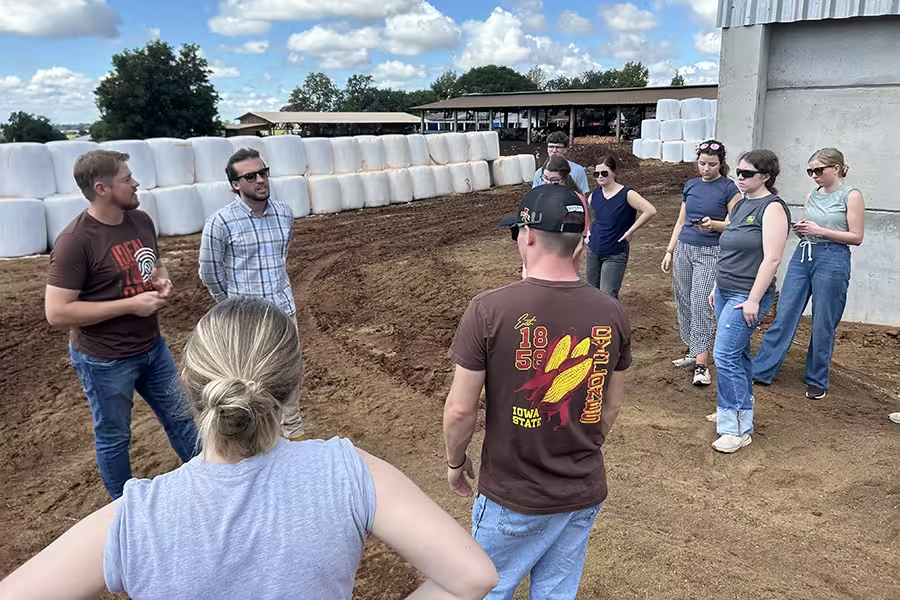
Also last spring, Koltes and Steven Goodhue, assistant professor of practice of economics, co-led a group of 14 students on the Proteins! Poultry, Pork, Plants & Beef in Brazil and Argentina study abroad experience over spring break. The experience lets students compare agricultural businesses and farms in the South American countries with those in the U.S.
Emma Seiboldt, a senior in agricultural studies and international agriculture, enjoyed interacting with the local farmers as she sought to understand their farming practices and how agriculture affects them.
“Learning about something in a classroom is very different from experiencing it firsthand,” Seiboldt said. “Through research prior to the study abroad trip, I educated myself a little more on topics that we would be exploring in Brazil and Argentina. When we arrived at our planned stops, the experiences were much different, in a positive way, than I had expected.”
As an aspiring high school agriculture teacher, Seiboldt plans to use what she learned in South America, and from her other study abroad trips, to teach her future students about the importance of global agriculture.
Exposing students to international animal production through experiential learning is one of the objectives of the study abroad experience, Koltes said.
“It widens your perspective of the field you’re in, and you learn the most by seeing something done differently,” Koltes said. “It provides an opportunity for you to ask yourself why they are doing it that way.”
The students often began discussing what they saw on the bus ride to the next stop, which Koltes said was exciting to see.
She and Juan Steibel, professor of animal science, will be leading another spring break trip to Brazil and Argentina March 13-22, 2027. Interested students must submit their applications by Nov. 1. More information and the application link can be found on the Proteins! Poultry, Pork, Plants & Beef in Brazil and Argentina – Spring Break webpage.
Source: www.cals.iastate.edu