




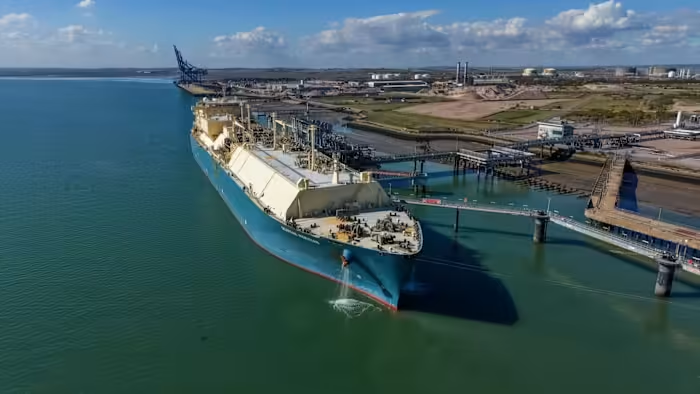

If you take a quick look at natural gas prices in Europe, the picture is worrying. The TTF European benchmark yesterday hit its highest level this year at more than €88 per MWh, triple the level before the Iran war started in February. UK natural gas prices have jumped in an identical fashion.
This is not yet a repeat of 2022, when spot prices peaked briefly above €300 per MWh and spent much of the year over €100 per MWh. But there has been little let-up in the relentless rise in the natural gas price, just as winter in Europe comes into view.
If the chart above is worrying for households, industry and service sectors such as restaurants, the chart below points to a cause: European gas storage is the lowest on record for this time of year. That implies that a cold snap or prolonged freeze this winter would push wholesale prices significantly further upward. With lower stockpiles, Europe has to rely more on immediate supplies and the winter spot price.
Higher energy bills already raised Eurozone inflation to 3.8 per cent in September and are all but certain to increase the UK’s headline inflation rate well over 4 per cent in January.
It is all rather worrying for central banks, which are desperate to avoid a repeat of the post-pandemic level of inflation.

If there is so much bad news around, why is the headline on this article positive? If storage is historically low and prices high, how can there be good news in European gas at a time when global liquefied natural gas (LNG) supply through the Strait of Hormuz has fallen 20 per cent this year and not recovered?
20% is the wrong figure to use
There is no doubt that Iran has severely damaged the outflow of natural gas from Qatar and the United Arab Emirates, which between them controlled 20 per cent of global LNG supply in 2025.
But most gas flows via pipelines, not as LNG, which involves a rather expensive process of transportation to a port, liquefaction, shipping and regasification in a different location. Qatar and the UAE’s LNG exports represented only 3 per cent of total natural gas supply in 2025.
Moreover, other LNG suppliers have raised production and exports to the global market. The International Energy Agency (IEA) found that other producers expanded exports sufficiently in the period between March and June to offset three-quarters of the lost supply from Qatar and the UAE. Global LNG supplies in summer were only 4 per cent down on 2025.
Everyone should be wary of arguing with a price change, but European gas demand would need to be incredibly inelastic for the current prices to continue for long. Remember: although the wholesale price has tripled, global LNG supply is down about 4 per cent and total gas supply much less than that.
The evidence on European demand elasticity for gas
Is it reasonable to assume that European gas demand hardly responds to price increases? There is a short answer to this: no.
As the chart below shows, the rolling annual European consumption of natural gas was 16 per cent lower year on year in the 12 months to January 2023, when the average wholesale price doubled.
Clearly, any estimate of the demand elasticity over the post-Covid-19 period will depend on the exact dates chosen, but the magnitudes involved generally suggest an elasticity figure between 0.1 and 0.2. That is inelastic, but not close to zero as implied by this year’s price change.

Just as important as the immediate responsiveness of gas demand to price, consumption did not recover once the price fell. Some of this can be explained by a destruction of European industrial capacity, but most reflected efficiency gains, installation of substitutes such as heat pumps and an uptick in renewable electricity generation.
What about the shortage of storage?
Many of the fears about this year’s European winter relate to the fact that storage capacity is at less than 75 per cent across the EU. This compares with a level of 98 per cent in 2023 and an average of 90 per cent in mid-October between 2011 and 2025.
Here we can be more definitive. Although stockpiles only represent one part of European winter gas supply, the amount of gas stored is the wrong measure of European resilience precisely because consumption fell sharply during 2022 and 2023 and has not returned. We should instead be quantifying storage by the number of days of average consumption.
The chart below shows the standard storage fullness chart, which shows capacity to be exceptionally low in 2026. It also depicts three alternative measures of the continent’s gas stockpiles alongside Eurostat data on EU gas consumption. By these other measures, Europe has gas storage levels close to the historical average.

Storage levels close to the seasonal norm plus only a small fall in global gas and LNG supply do not justify a tripling in price. It is no wonder the European Commission is rather bullish about the prospects for gas supplies this winter.
The electricity market provides further good news
In 2022, electricity prices peaked alongside gas prices for two reasons: French nuclear generation was beset by outages, and the wholesale electricity price was generally set by the gas price. Neither of these applies in 2026.
In Spain, gas prices used to set the electricity price 80 per cent of the time. But that figure is now down to 20 per cent. France and Germany’s reliance on gas has also declined. Italy, on the other hand, is still heavily dependent on the fuel for pricing its electricity.

The decline in reliance on gas will lower the responsiveness of electricity prices.
What about the future?
Futures prices of European natural gas have risen alongside the spot price in 2026, as the chart below shows. That said, no one should take much comfort in 2029 futures prices having declined from more than €80 per MWh to around €30 per MWh, because earlier futures prices were so wrong.

Nevertheless, there is a reason gas futures prices are downward-sloping. LNG exports to Europe from the US, Canada and Mexico are set to increase rapidly, more than offsetting the fall in supply from the Gulf.
The US alone has approved and begun constructing LNG liquefaction terminals that by the end of 2027 could supply 30 per cent of European annual consumption. The IEA expects that the projected increase in global LNG exports alone by 2030 will be sufficient to account for 88 per cent of European consumption.
Clearly, Europe will not want nor receive all of this new transportable gas. But it is implausible to expect prices to remain as high as they are when the new supply comes online.

The final question is whether Europe can rely on the US as a stable supplier of LNG in the future. There are reasons to be wary about Washington in areas such as defence and security co-operation. But energy is different. Europe will, after all, pay for the gas. And the European wholesale price is currently eight times that in the US when measured in the same units.
With so much money to be made exporting US LNG to Europe, gas is unlikely to be a source of European inflation for long.

What I’ve been reading and watching
One last chart
There has been a lot of talk about exchange rate movements between large G7 economies recently following a fall in the euro against the dollar. As the chart below shows, we should not get too excited. The notable thing about the past 18 months, other than the yen, is the stability of exchange rates.

Central Banks is edited by Harvey Nriapia
Source: www.ft.com

