


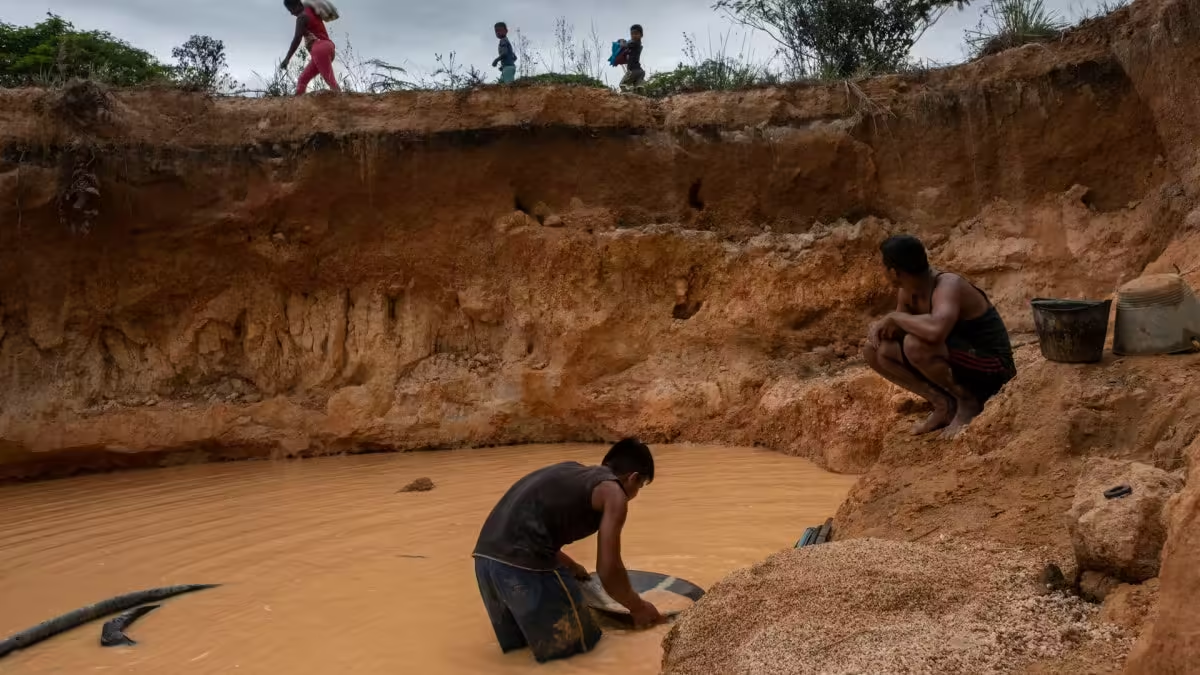

The gold in your wedding ring or smartphone may have a dark history. Across the Amazon, illegal gold mining is enriching criminal groups while devastating local communities. European countries can help by voting to pursue a new legal instrument to enhance international law enforcement cooperation, that comes up for discussion at a United Nations conference in Austria on October 19 to 23.
Over several years, on behalf of Human Rights Watch, we have interviewed people whose lives have been upended by illegal gold mining. In Venezuela, former miners told us they witnessed armed groups that control such mines carrying out amputations as punishments and other appalling abuses. In Brazil, Indigenous people described illegal gold miners invading their territories and poisoning communities with mercury. And in Peru, local officials said that routine bribery of soldiers and police has undermined efforts to stop illegal gold mining.
Gold’s escalating price, reaching an all-time record this year, has only increased the incentives for criminal groups, which blend illegal mining with illegal logging, drug trafficking, and other crimes into powerful business empires that terrorize communities and undermine countries’ institutions through corruption.
Brazil’s efforts to tackle the problem offers hope. Brazil has expelled thousands of illegal miners from the Yanomami Indigenous territory and reduced deforestation linked to illegal mining there by 97 percent in 2025, compared to the peak in 2022. It has also required recording all gold transactions in a government online financial registry instead of just on paper, leading to an 81 percent reduction in illegal gold entering the legal market, one study concluded.
But the problem only moved elsewhere. Illegal gold from Brazil is now flowing into Venezuela and Guyana for laundering and shipping to consumer markets. “It is very difficult for a single country to address the problem,” Mauricio Cabrera, a geologist and former deputy environment minister of Colombia, told us. “If one country increases control, illegal groups easily move to a neighboring one.”
Strong cooperation is needed among countries where the gold is mined, those where it is refined and transformed, and those where consumers will ultimately buy it in jewelry or electronic products.
The discussion in Austria will take place at a UN meeting on transnational organized crime. The harrowing experiences of communities living in the Amazon should be high on their minds. Under the leadership of Brazil, a group of governments is proposing a new legal instrument—a protocol on environmental crime—be appended to the UN Convention on Transnational Organized Crime.
The proposed protocol aims to enhance international cooperation in law enforcement against illegal mining and trafficking of minerals, trafficking of wild fauna and flora, and waste trafficking.
The European Union and its member states should support the initiative. The proposed protocol could help curb deforestation and other environmental crimes in the Amazon and elsewhere and push governments to adopt stronger tools to cooperate across borders to tackle organized criminal groups involved in illegal mining and other environmental crimes—groups that undermine the rule of law and abuse human rights.
France and Spain have indicated their support for starting negotiations on a new protocol, but other EU countries are on the fence. Yet the measure could help the EU realize its own objectives such as tackling climate change and deforestation and ensuring that companies conduct due diligence throughout global supply chains.
The proposed protocol could also help to prevent severe human rights abuses by criminal groups against people affected by illegal gold mining, such as hazardous child labor, forced labor, the dire harm to health from mercury pollution, attacks against environmental defenders, and sexual violence.
European governments should step up and provide much-needed political support for discussions of the new protocol. Illegal gold crosses borders, so the fight against it also needs to. In Austria, EU governments will have a chance to help build the kind of international response that communities in the Amazon, and the environment they are living in, urgently need.
Juliane Kippenberg is a senior children’s rights adviser and Cesar Munoz is Brazil director, both at Human Rights Watch.
Source: www.hrw.org