



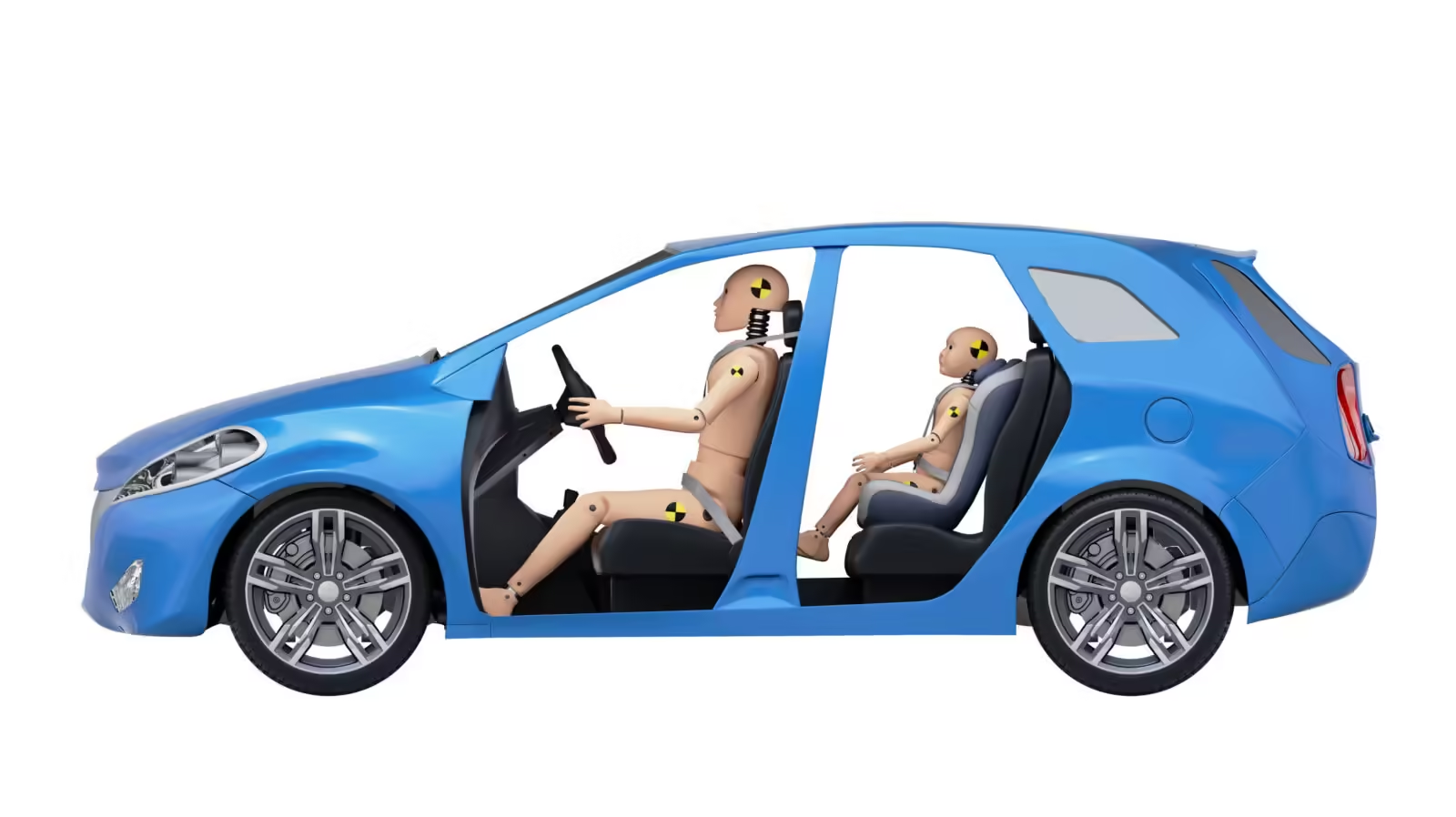

A Detroit Free Press article explores how tailoring vehicle sensors to individual body types could one day aid in crash safety for those involved in collisions.
The article centers on the belief of vehicle safety researchers and engineers that “the next frontier of safety focuses on catering the front seat safety system to the human behind the wheel.”
“At the urging of regulators in Europe and North America, automakers and their supplier partners plan to move into occupant classification ― using vehicle sensors to identify the approximate height and weight of drivers so the safety systems protect them more effectively,” the article states.
Erin Keating, Cox Automotive executive analyst, notes that a 5-star safety rating in the U.S. is the National Highway Traffic Safety Administration’s standardized measure to inform consumers how a vehicle performs in a defined crash safety test; however, it doesn’t show how the vehicles perform for every individual.
“The auto industry is starting to move beyond those constraints, Keating said,” according to the article. “Instead of trying to build a perfect set of dummies for every scenario, the plan is adaptive safety, where vehicle systems ‘sense’ who is driving [and] adjust protection accordingly. That’s how you start to close the gap, she said, between a standardized rating and a more individualized outcome.”
Lisa Furton, a vehicle performance owner for occupant protection at General Motors, adds that “collecting accurate passenger data and adjusting vehicle protective systems accordingly is safety’s next frontier,” according to the article.
Dr. Steward Wang, professor emeritus of surgery at the Trauma Burn Center at the University of Michigan, notes in the article that personalized protection systems in vehicles are still years, if not decades, away. The Free Press reports that Wang spent 14 years as a principal investigator for the multidisciplinary Crash Injury Research Engineering Network (CIREN), a government-industry-academiaresearch consortium.
“We’re still a number of decades away from getting a good human body model that can be predictive of all injuries. It’s pretty good now, but they don’t get everybody in the population,” Wang said, according to the article. “You need more detailed information about what the end results are, the specific injuries that occur. The cars need to make it out there into the real world, and unfortunately live people are the real crash dummies.”
The article adds that, “despite technological innovations and advancements in data collection of crashes,” differences in injury patterns and severity between men and women of different sizes, even in the same crash conditions, mean there’s “‘no clear solution’ to protect everyone equally.”
However, “Wang agrees that getting more body types involved in the crash test scenarios that automakers have to pass could improve safety,” the article states. “If the driver isn’t secure because their body type does not allow them to sit behind the wheel the same way a dummy does, the vehicle ‘doesn’t know,’ Wang said. And without advanced sensor technology and some degree of artificial intelligence, a vehicle ‘can’t know.’”
Wang added, according to the article: “The thought is, if it is safer for some, it should be safer for most.”
Jason Hallman, senior manager of Toyota’s Collaborate Safety Research Center, told the Free Press that today’s vehicles “rely on a robust system that covers a broad spectrum of the population generally,” and “more data needs to be collected, analyzed, and verified before making adjustments to the vehicles themselves.”
Jessica Jermakian, senior vice president for vehicle research at the Insurance Institute for Highway Safety (IIHS), adds: “What we’re ultimately looking for is not an individual restraint system tailored to each individual person — though the Holy Grail would be one that is somewhat adaptable — but one that is generally robust, that even when it doesn’t perform perfectly like the crash test, it’s still doing a good job.”
Images
Featured image: EduardHarkonen/iStock
Share This:
Related
Source: www.repairerdrivennews.com