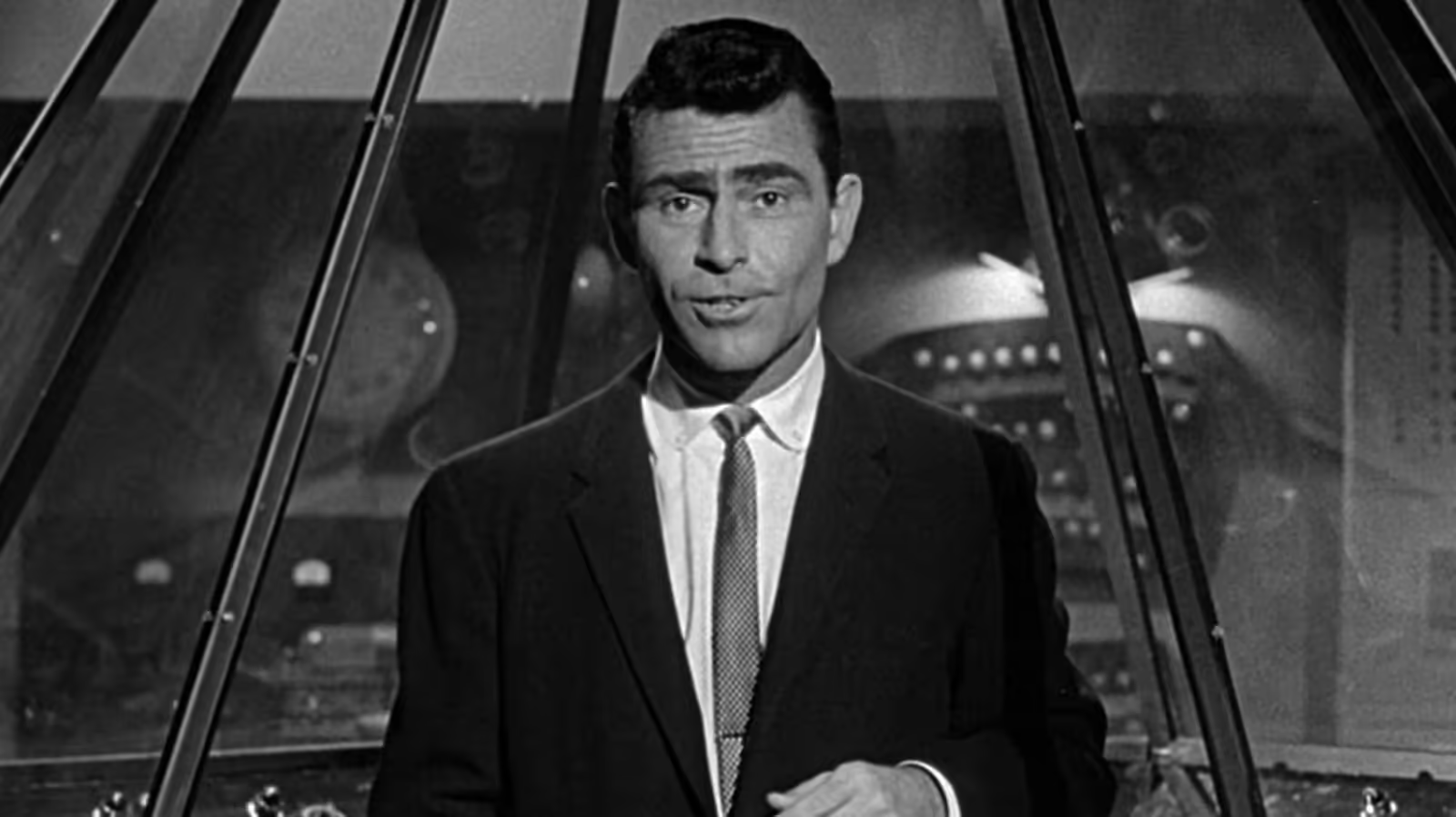

As one of the best anthology shows of all time, “The Twilight Zone” told some of the most imaginative stories on television for its era. With the series frequently delving into the supernatural and science fiction, this included tales involving time travel. These stories could have characters transport across time and space through conventional sci-fi means, or sometimes through something more magically paranormal. Whatever the time-bending premise is, we love it whenever Rod Serling’s enduring creation plays with the space-time continuum.
This time around, we’re highlighting our personal favorite episodes from the show that prominently feature time travel. For this particular list, we’re sticking with episodes from the original “Twilight Zone” series that premiered in 1959. Even just focusing on the original show, there was a surprising number of time travel stories that were told. These are the 10 best “Twilight Zone” episodes about time travel ranked from the classic series.
10. The Odyssey of Flight 33 (Season 2, Episode 18)
The Season 2 episode “The Odyssey of Flight 33” feels like a story conceived for an audience still terrified of the Bermuda Triangle. The episode follows an airliner on a transatlantic flight toward New York City, only to catch a strange airstream. This cuts off the airplane from radio contact outside and accelerates their speed, depositing them in prehistoric times. Running low on fuel and desperate to return to their own time, the pilots look for a way to navigate this jetstream back to the future.
“The Odyssey of Flight 33” follows a prototypical premise for subsequent shows like “The Time Tunnel” and “Last of the Lost.” While visibly limited by its production budget, the episode is able to convey the sense of otherworldly peril as the characters find themselves displaced from their timeline. The episode also keeps the plot twists coming when it becomes clear that an attempted voyage home isn’t as linear as it seems. Predating many of the best shows about time travel, “The Odyssey of Flight 33” sets the standard for the sci-fi sub-genre.
9. The Trouble with Templeton (Season 2, Episode 9)
Among the movie stars who appeared in “Twilight Zone” is actor and filmmaker Sydney Pollack, playing a supporting role as a stage director in “The Trouble with Templeton.” The Season 2 episode centers on older stage actor Booth Templeton (Brian Aherne), unhappy with his current lot in life. Leaving the stage of his current play in a huff, Templeton seemingly finds himself transported back to 1927 during his professional glory days. Templeton is reunited with his late first wife, Laura (Pippa Scott).
While it doesn’t feature time travel in the most conventional sense, “The Trouble with Templeton” definitely involves a story revisiting the past. More importantly, this is a narrative about avoiding dwelling on the past and focusing on enjoying the life in front of you in the present. Aherne captures those themes beautifully in his performance, displaying an introspective vulnerability of a man reevaluating himself at a crossroads. One of the more low-key time travel stories in the series, “The Trouble with Templeton” keeps its stakes intimate for the better.
8. Once Upon a Time (Season 3, Episode 13)
Silent film star Buster Keaton delivers one of the best acting performances on “The Twilight Zone” in his memorable guest-starring appearance. Starring in the Season 3 episode “Once Upon a Time,” Keaton plays Woodrow Mulligan, a disgruntled janitor living in 1890. Trying out a strange contraption, Mulligan is transported to 1961, where he is horrified by the noise and inflated prices compared to his timeline. Looking for a way to return to his native time period, Mulligan encounters a modern scientist (Stanley Adams) who is enamored with the 1890s.
Given Keaton’s silver screen legacy, “Once Upon a Time” wisely leans into his penchant for physical comedy. To further reflect Keaton’s career, the sequences in the 19th century are played out silently, using title cards to provide dialogue to the audience. Most of the time, “The Twilight Zone” struggles whenever it attempts more light-hearted fare than its usual darker stories. But with a slapstick icon like Buster Keaton center stage, “Once Upon a Time” turns into a perfect time-traveling showcase for his talents.
7. Of Late I Think of Cliffordville (Season 4, Episode 14)
If there was ever the perfect ’60s television femme fatale, it was Julie Newmar, who played a “Twilight Zone” villain before portraying Catwoman on “Batman.” Newmar brings a devilish twist to the Season 4 episode “Of Late I Think of Cliffordville,” playing the cheekily named Miss Devlin. Approaching amoral business tycoon William Feathersmith (Albert Salmi), Devlin offers him the chance to revisit his younger days armed with knowledge of the present for his presumed benefit. Agreeing to Devlin’s offer, Feathersmith discovers the past isn’t quite how he remembered it, and his knowledge of future events actually becomes something of a destiny-altering burden.
The devil is always in the details, and “Of Late I Think of Cliffordville” applies that axiom to time travel as only “The Twilight Zone” can. Years before “Bedazzled,” Newmar is the ultimate beguiling demon, luring Feathersmith into a deal that will derail the businessman’s future success. Salmi plays his protagonist role as such a scumbag that each time his schemes are thwarted, we’re thrilled seeing his attempts to cheat history blow up in his own face. Making the most of its premise, “Of Late I Think of Cliffordville” combines time travel and hellish consequences with great results.
6. The Last Flight (Season 1, Episode 18)
One of the best “Twilight Zone” episodes not written by creator Rod Serling is the Season 1 story “The Last Flight.” The episode has World War I pilot Terry Decker (Kenneth Haigh) mysteriously arrive decades in the future after going missing during the war. As Decker becomes acquainted with modern technology, he learns about all the history that’s transpired since his disappearance. In order to preserve the timeline, Decker realizes he has to find a way back to his own time to fulfill his tragic fate.
There are several episodes that involve time-displaced military units in “The Twilight Zone,” like the subpar “The 7th Is Made Up of Phantoms.” “The Last Flight” more effectively incorporates those elements, largely because it’s much more cohesively told, with its closing scene bringing everything together. The other big strength to this episode is that it gives its time traveler a clear redemption arc, as Decker reconciles with his cowardly nature. A story about second chances, “The Last Flight” provides an aerially tinged tale of pilots high-flying through time.
5. Execution (Season 1, Episode 26)
With Western shows like “Gunsmoke” still very much in vogue during the original “Twilight Zone” run, the genre creeped into the series frequently. This includes the Season 1 episode “Execution,” the grimmest tale in the show to revolve around time travel. The story opens with condemned outlaw Joe Caswell (Albert Salmi), who is brought to the 20th century moments before his hanging. After murdering the scientist responsible for his time-bending salvation, Caswell becomes desperate for a way to return to his time, overwhelmed by this brave, new world.
“Execution” definitely provides a surprising amount of murder for a time-travel story, with its own twisted form of justice by the end. On multiple levels, the episode also thematically depicts people dealing with forces beyond their control and paying the consequences. Professor Manion (Russell Johnson) has no idea the person he brought through time will betray him, just as Caswell doesn’t know how to function in this period. A murderous take on time travel tropes, “Execution” is all about victims of circumstance with a time-bending scope.
4. Back There (Season 2, Episode 13)
President Abraham Lincoln figures prominently in several stories throughout the series, including the severely underrated “Twilight Zone” episode “The Passerby.” The ill-fated president’s fate is also explored in the Season 2 episode “Back There,” particularly within the context of his assassination. The story follows engineer Peter Corrigan (Russell Johnson), as he suddenly finds himself on the date of Lincoln’s murder in 1865. While no one seems to believe Corrigan’s frantic claims that the president is in danger, he discovers his actions have other consequences to history.
“Back There” is positioned as a desperate race against time to prevent an infamous American tragedy from unfolding. But history isn’t quite as malleable as “Twilight Zone” characters seem to hope that it is. Corrigan’s actions do alter the timeline, but not on the scale that he hopes and more close to home than he realizes. That familiar sense of irony falls right into the creative wheelhouse that “The Twilight Zone” is known for, with “Back There” pulling off its surprises expertly.
3. A Hundred Yards Over the Rim (Season 2, Episode 23)
Another Western approach on time travel stories, “A Hundred Yards Over the Rim” offers a more esoteric take on its premise. The Season 2 episode centers on 19th-century pioneer Chris Horn (Cliff Robertson), as he leads a wagon train towards California. With his son deathly ill and the convoy’s supplies running desperately low, Horn forges ahead to find water for the rest of his group. Instead, he finds himself wandering into 1961 New Mexico, astounded by the strange sights of the 20th century and its modern comforts.
“A Hundred Yards Over the Rim” largely works because of the earnestness of Robertson’s guest-starring performance as the story’s unwitting time traveler. At his core, Chris Horn is just a father looking to do anything he can to save his son from the merciless perils of the frontier. This informs the story and gives it a solid emotional core that counters its admittedly bare-bones methodology in sending Horn through time. Offering a more family-focused tale with time-spanning stakes, “A Hundred Yards Over the Rim” succeeds thanks to emphasizing emotion.
2. No Time Like the Past (Season 4, Episode 10)
Several “Twilight Zone” episodes involving time travel follow protagonists dissatisfied with modern times trying to find comfort in the past. Among the ones that execute this premise the best is Season 4’s “No Time Like the Past.” Protagonist Paul Driscoll (Dana Andrews) uses a time machine to travel back through time and change history for the better, but finds the timeline to be unmalleable. Dejected, Driscoll tries to live a quiet life in the 19th century, only to find firsthand how sacred history truly is.
“No Time Like the Past” is worthy of being recognized among the best “Twilight Zone” episodes of all time. Seeing Driscoll realize that his presence only reinforces a self-fulfilling prophecy, even when keeping a low profile, informs much of the story’s charm. This gives the episode’s final scenes a real bittersweet quality, particularly with the time-displaced romance between Driscoll and 19th-century schoolteacher Abigail Sloan (Patricia Breslin). A late-series highlight, “No Time Like the Past” doesn’t reinvent the time traveling-wheel, but refines its themes considerably.
1. Walking Distance (Season 1, Episode 5)
One of the best rewatchable “Twilight Zone” episodes, Season 1’s “Walking Distance,” is also one of its best overall. The story centers on 30-something corporate executive Martin Sloan (Gig Young), who brings his car to an auto shop within walking distance of his hometown. However, as Martin walks into town, he discovers that it seemingly hasn’t changed at all since when he lived there as a boy. When he realizes that he somehow traveled back in time by 25 years, Martin tries to warn his younger self to not take his youth for granted.
“Walking Distance” is “The Twilight Zone” at its most effectively sentimental in its own understated way, something the show doesn’t get enough credit for. This is a story about living life constantly looking in the rearview rather than enjoying the moment we’re in right now. Ironically, Martin can’t quite comprehend that lesson even as he tries to impart it to his younger self and that comes with a consequence. One of the gentlest and quietly heartwarming episodes in the series, “Walking Distance” is “The Twilight Zone” at its best.
Source: www.tvline.com