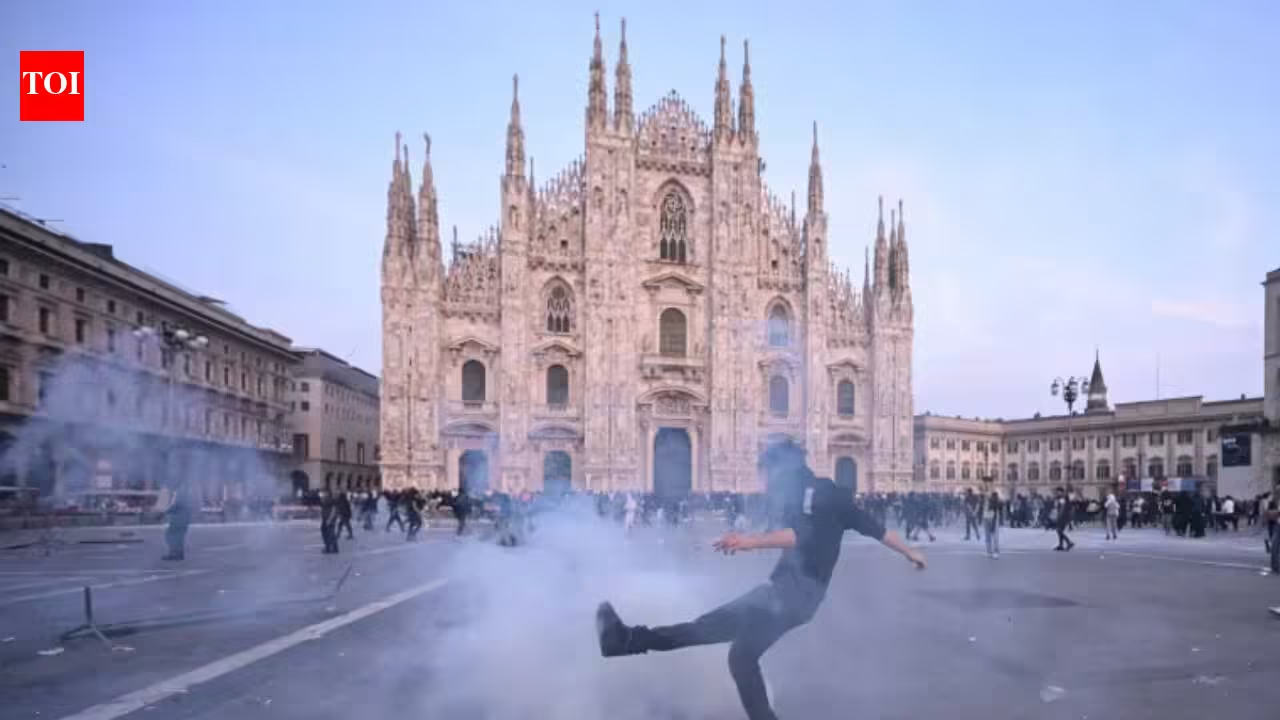

Protests over the rising cost of living swept France, Belgium, Italy and Portugal on Saturday, as thousands of people took to the streets over economic pressures, housing affordability and education costs.Demonstrations in France drew the largest crowds, while unrest in other countries reflected growing discontent over wages, university fees and access to housing.According to Al Jazeera, the protests were driven by country-specific grievances, although demonstrators shared concerns about the cost of living and public services.While housing and low wages dominated protests in Portugal, student concerns over education costs fuelled demonstrations in Belgium. In France, protests extended beyond living costs to school conditions and public spending, while demonstrations in Italy also included opposition to wars.France witnessed one of its most turbulent days of protests in decades on Saturday, with more than 550,000 people taking part in demonstrations across the country, according to Al Jazeera.The protests began last month with high school students highlighting teacher shortages, deteriorating school facilities and overcrowded classrooms before expanding into a broader movement against inequality, rising prices and declining public services.President Emmanuel Macron appealed for calm ahead of the demonstrations, defending the right to protest while warning against violence.“There is a constitutional right to protest and to express oneself,” he said, adding that the right required respect for people and property.In Portugal, tens of thousands of people marched through Lisbon against rising living costs, low wages and a worsening housing crisis. Protesters, mobilised by the country’s main trade union confederation, demanded higher wages and pensions and action on housing and fuel costs.Portuguese Parliamentary affairs minister Carlos Abreu Amorim said the government would not give in to pressure from street demonstrations, stating that the “government will not yield to shouts from the street”.Protesters, meanwhile, accused political leaders of being “out of touch” with the difficulties faced by ordinary households.In Belgium, several hundred mostly young protesters clashed with police in Brussels on Saturday, opposing rising education costs and reforms they fear could make higher education less accessible. Police deployed tear gas and water cannon after some demonstrators overturned a car, while protests also took place in the eastern city of Liège.Belgian interior minister Bernard Quintin condemned the violence, saying, “What is unfolding in Brussels is no longer mere protest,” and warned that “all necessary means will be used to restore order in the face of the rioters”.In Italy, demonstrations over the cost of living in Milan and Bologna turned violent on Saturday, with protesters throwing stones at police and officers deploying tear gas and water cannon to disperse crowds.Italian media reported injuries and arrests, while police in Bologna arrested seven people after clashes.Prime Minister Giorgia Meloni condemned the violence while defending peaceful demonstrations. “Demonstrating is a right. Turning our cities into battlegrounds is not,” she said in a post on X.She also urged opposition parties to condemn the violence and called for protests to remain peaceful.Alberto Alemanno, professor of EU law and policy at HEC Paris, told Al Jazeera that the protests could spread to other European countries, including Greece, Germany and Austria.He said the demonstrations were not part of a single coordinated movement but reflected shared grievances over rising living costs, underfunded education and uncertainty over employment prospects.Alemanno said the protests could also influence political debates in Europe, with governments facing pressure to address concerns over living standards and public services.
Source: timesofindia.indiatimes.com