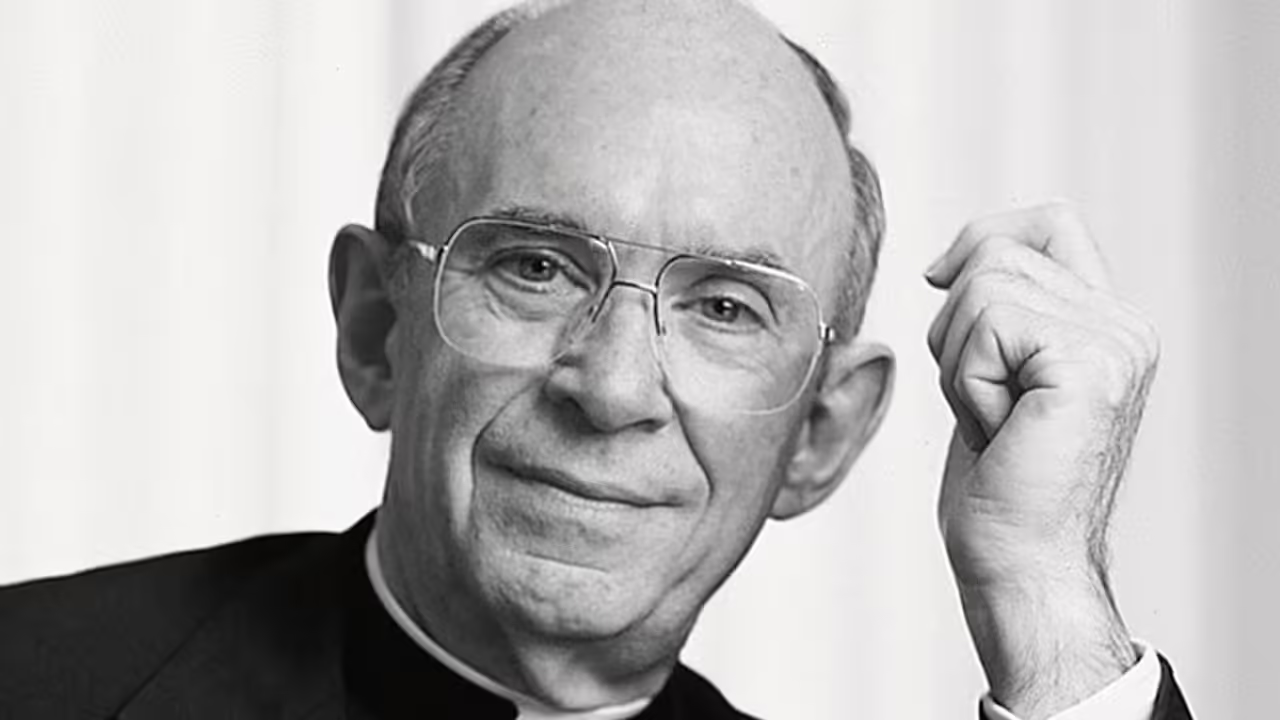

Thirty years after the death of Joseph Louis Cardinal Bernardin, archbishop of Chicago from 1982 to 1996, the Italian archdiocese of Trento has organized various events in memory of the prelate, whose origins lie in the region.
We are publishing the full text of the Lecture delivered Friday evening, 16 October 2026, by Cardinal Blase Joseph Cupich, Archbishop of Chicago, as part of the initiatives carried out at Fiera di Primiero, in Trento, in memory of Cardinal Joseph Louis Bernardin thirty years after his death.
Cardinal Bernardin, born in the U.S. state of South Carolina to parents of Trentino origin who had immigrated to the USA, led the archdiocese of Chicago from 1982 until 1996, the year of his death.
The Italian towns of Rovereto and Trento are also taking part in the initiatives, which were promoted by the archdiocese of Trento. The three-day event concludes Saturday evening with the celebration of a Mass presided over by Cardinal Cupich in the cathedral of the Trentino capital.
By Cardinal Blase Cupich
I, who come from the city that Cardinal Bernardin called home, feel honoured to be here at Fiera di Primiero, where the Cardinal equally felt at home, thanks to your welcome and your esteem. Tonight, I would like to reflect briefly with you on how Joseph Bernardin took the best of what he learned from Trentino’s rich culture and matured into a world-class figure whose impact on the Church and the world has not yet faded.
Ethics and life
The historic speech he delivered at Fordham University in 1983, with which he introduced his famous “consistent ethic of life” approach to the examination of crucial issues of the contemporary world, as well as the leadership role he played in the drafting of the pastoral letter on peace written by the American bishops, offer insights into appreciating this impact.
Revolutionary beliefs
There were three truly revolutionary beliefs that guided him. He was first of all convinced that it was necessary to follow up on the invitation of the Second Vatican Council to read the signs of the times. The Cardinal understood that the Church can only be credible if fully engaged in the world and attentive to what happens in people’s real lives, as well as to the forces that influence politics and public opinion. In many ways, he anticipated the famous phrase of the late Pope Francis: “Reality is superior to the idea.”
His reading of the signs of our times led him to the conclusion that it was useless to address issues such as abortion, capital punishment, nuclear proliferation, use of military force, or anything else separately. He realized that this approach was motivated in large part by the fact that such issues were already divisive in themselves. But he was also convinced that an all-encompassing commitment to respect for life as a true principle connecting these issues would benefit them all. In his words: “The purpose of proposing a consistent ethic of life is to argue that success on any one of the issues threatening life requires a concern for the broader attitude in society about respect for human life.… The viability of the principle depends upon the consistency of its application.”
Second, the cardinal was convinced that the comprehensiveness of the Church’s social doctrine made it distinctly capable of guiding the definition of such issues in the public arena. As a case in point, he asked how it was possible that only Catholic bishops strongly opposed both abortion and the nuclear war policies of the United States. It was the completeness of the doctrine, that is, its consistency, that distinguished the Church. Consequently, the social doctrine of the Church could not be confined to one of the political categories that characterize American public life. Yet this is precisely why the consistent ethic of life has attracted criticism. It affirms that the doctrine of the Church cannot be shaped according to our political divisions nor should it be diminished by minimizing the importance of its fundamental social teachings, even to approximate important political objectives. Along the same lines, Pope Leo recently observed that one cannot define oneself as a defender of Life if one opposes abortion but at the same time is in favour of the death penalty or does not oppose the inhuman treatment meted out to immigrants.
Finally, the Cardinal was convinced that the Church can count on a unique position to incentivize the promotion of the common good, through a redefinition of public policies. The way we cultivate faith, pastoral life, the ministries of health care and education: all demonstrate the completeness of the social doctrine of the Church. So much so that Cardinal Bernardin readily admitted that he chose a Catholic university to introduce his approach of coherent ethics of life, as he appreciated the particular role that Catholic universities have in shaping public debate.
Sound Advice
The moral framework of a “consistent ethic of life” championed by the Cardinal is essential today, at a time when deep social divisions set people against one another in extreme ways. His sound counsel invites us to reflect on the risks of living in “bubbles”—surrounded by people like ourselves, yet fearful of engaging in genuine dialogue on a range of critical issues. Many of these are, in fact, matters of life and death: the healthcare crisis exposed during the pandemic; the scourge of racial injustice, which diminishes the dignity of immigrants; and the threat that climate change—becoming more evident with each passing year—poses to all life on Earth.
Theological and Moral Legacy
The theological and moral legacy of Cardinal Joseph Bernardin remains one of the most influential currents of thought within the modern social doctrine of the American Church. As Archbishop of Chicago, Bernardin articulated a vision that wove various moral imperatives—from nuclear disarmament to the protection of the unborn—into a cohesive whole. His legacy is fundamentally linked to two landmark moments: his leadership in drafting the pastoral letter on peace (“The Challenge of Peace: God’s Promise and Our Response”, 1983) and his lecture at Fordham University, where he introduced the “consistent ethic of life”.
Prescient Insights
Although he faced detractors—even among his fellow bishops—his insights were remarkably prescient, mirroring the holistic moral vision later developed by John Paul II in The gospel of life. It is no exaggeration to say that in The gospel of lifePope John Paul II affirmed Bernardin’s broader synthesis, explicitly placing direct attacks on innocent human life—such as abortion or euthanasia—on the same level as wider, structural threats to human life, including war, poverty, and ecological degradation. In doing so, he reinforced the principle that a true culture of life must take into account every threat to human dignity.
New life and new strength
In more recent times, Bernardin’s words have gained new life and strength through the teachings of both Pope Francis and Pope Leo; both have championed a culture of encounter, mutual listening, and discernment, aimed at a shared path forward. We are the privileged heirs to the gentle and wise spirit that animated Cardinal Bernardin. As a successor to that good cardinal, I am truly delighted to be with you to celebrate his memory and his historical legacy. His words and his example continue to inspire us in our work for peace, the education and formation of young people, the promotion of understanding and collaboration among Christians and non-Christians alike, and, of course, the respect for life in all its precious forms.
I pray that the prophetic voice and the legacy of our beloved Cardinal Bernardin—which remain as relevant as ever—will continue to inspire us all toward an even deeper mutual solidarity, as members of the same family of God. We need this now more than ever.
Source: www.vaticannews.va