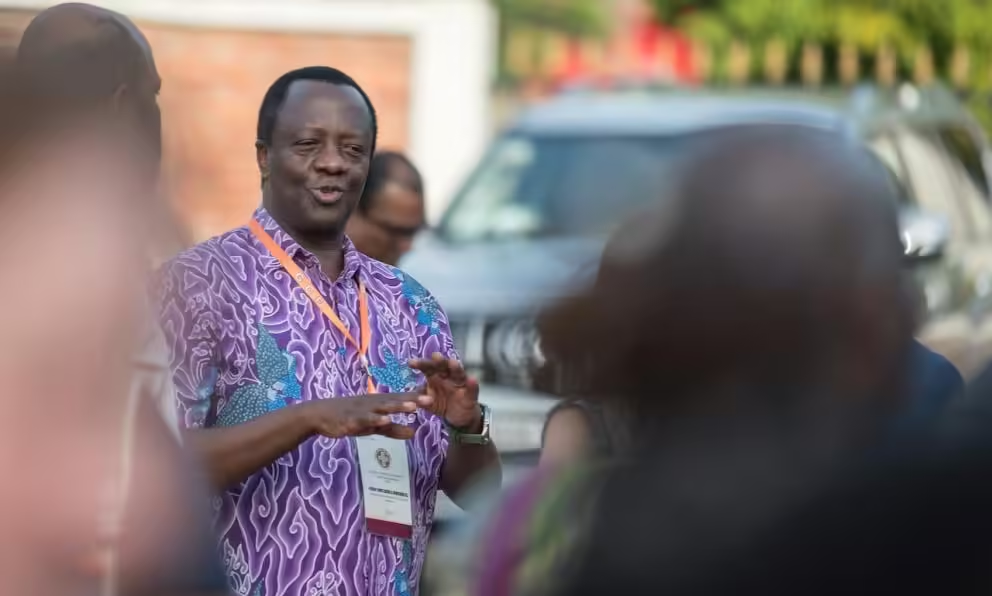

Over 100 church leaders, theologians, academicians, and victims of persecution attended the 5-8 October gathering organized by the All Africa Conference of Churches.
Rev. Dr Fidon Mwombeki, the conference’s general secretary, said that religious persecution was a major global challenge rooted in the friction between dominant and minority religious communities.
“Many conflicts labeled ‘religious persecution’ are also rooted in economics, ethnicity, and resource competition,” he said, while cautioning that the phenomenon could not simply be addressed as physical violence, terrorism, and martyrdom alone.
The pastor from the Evangelical Lutheran Church in Tanzania called for the backing of local advocacy efforts like the biblical model of Esther, through education, legal training, and economic support, rather than public shaming of governments.
In Sudan, the Sudan’s Catholic Bishops’ Conference has used public letters to demand religious freedom from the state, while in Nigeria and Kenya, Christian leaders, who have publicly forgiven attackers after terrorist attacks, are countering jihadist discourse and building alliances with moderate Muslims.
Mwombeki urged the participants to address economic causes by targeting resource management, agricultural support, and reconstruction microcredit funds in conflict zones like Nigeria’s Middle Belt, where poverty and conflict reinforce each other.
The symposium was seventh in a series that the Africa-wide ecumenical body has organized since 2019 to help its members analyze and develop theologies that address current cultural, social, historical, religious, and political realities.
Illia Djadi, senior analyst on Freedom of Religion and Belief from Arise Africa Campaign, told the conference that Africa as a vast mission field was also a centre of proselytism and tensions, with persecution of Christians becoming a reality in sub-Saharan Africa.
“It is a phenomenon that is gaining momentum and affecting thousands…. Violent persecution has reached alarming proportions,” said Djadi in a presentation that called for deeper reflections on the political, social, and religious factors challenging the freedom of religion and belief.
Loid Taye Negatu, a senior law student from the University of Addis Ababa, addressed how violence related to religious persecution affected gender groups. She said while men and boys were often targeted in shooting and killings, women were the ones who fled.
In Nigeria, at least 52,250 Christians have been killed over 14 years, making the West Africa nation a clear case of religious persecution. Driven by climate change and desertification, the Fulani pastoralists have pushed into the country’s Middle Belt triggering a clash with Christian farmers. The violence has displaced over 4 million people, with Christians bearing the brunt of the violence.
In the northeastern region, Boko Haram has also destroyed more than 200 churches, displaced 1.5 million people, killed 13,000 people, and kidnapped and enslaved hundreds of Christian children and women.
Coptic Christians in Egypt face violence and restrictions on church buildings, while in Libya Christians, mostly migrant workers, face forced veiling, executions, and floggings by militias since the fall of Muammar Gaddafi. An estimated 9,000 migrants are arbitrarily detained in the north African country.
According to Rev. Dr John Ngige Njoroge, All Africa Conference of Churches executive secretary for Theology and Interfaith Relations, the symposium based its call to action on Isaiah 1:16–17, “Wash and make yourselves clean; learn to do right; seek justice for the oppressed.”
“The participants noted the importance of approaching religious liberty within specific African contexts, with clarity on what genuine freedom entails and the rights that must be protected,” said Njoroge.
“It reaffirmed the responsibility of the churches and partners to advance freedom of belief, defend human dignity, challenge injustice, and contribute to societies in which people of different faiths can live together with mutual respect, peace, and security.”
The priest from the Orthodox Church in Kenya said the organization will translate the insights and commitments from the symposium into continued advocacy, theological engagement, interfaith cooperation, and practical action across the continent to mitigate and create resilience over persecution.
Source: www.oikoumene.org