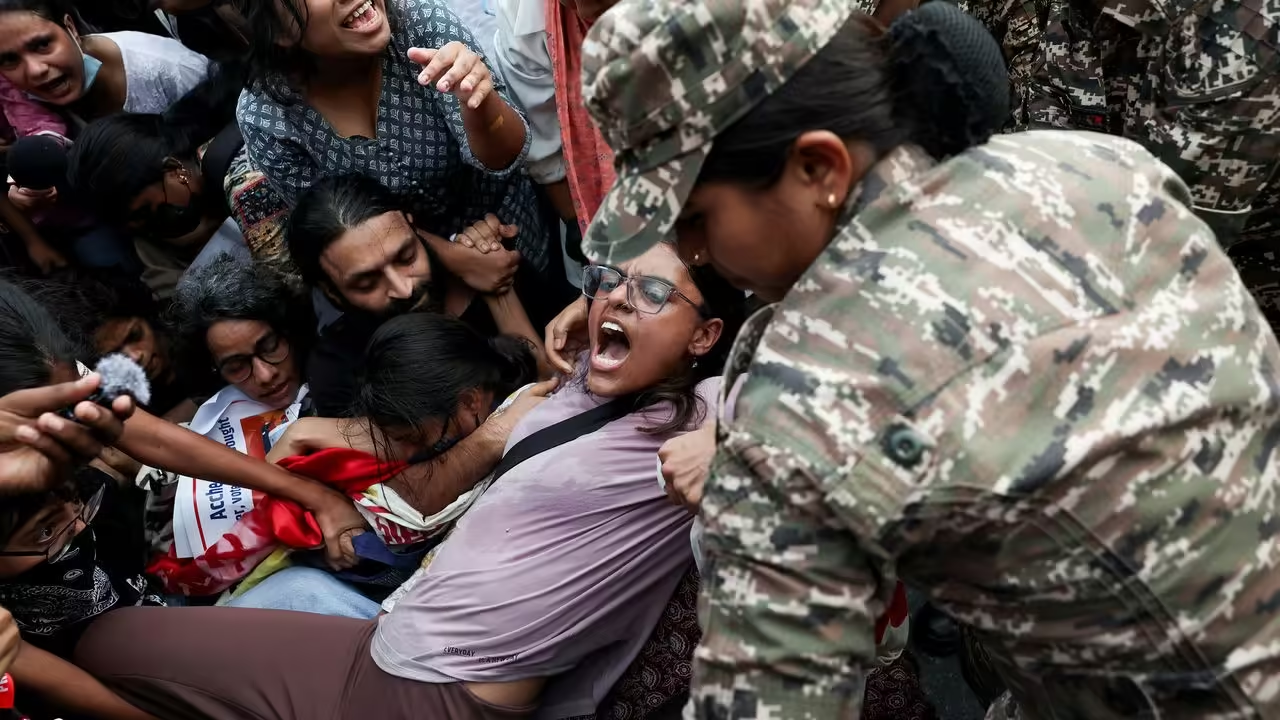

This past weekend, in a shocking show of force by the Indian government, thousands of anti-government protesters were arrested in New Delhi. Authorities have not said how many thousands were taken into custody, but they released the leaders of the protest movement, known as the Cockroach Janta Party, on Sunday. For the past several months, the government of Narendra Modi and his Bharatiya Janata Party (B.J.P.) have faced widespread unrestwith enormous demonstrations of young Indians demanding reforms to the country’s education system, leading to the resignation of the Minister of Education, in July.
More recently, however, the C.J.P.’s protests have centered on the government’s astonishing decision to remove more than a hundred million people from voter rolls. The government has claimed that this is intended to eliminate discrepancies and duplicates from the rolls, but it has left the process in the hands of the election commission, whose head was effectively chosen by Modi. I recently spoke by phone with Yogendra Yadav, an activist and political scientist, and the national convener of Bharat Jodo Abhiyaan, a civil-society group that was established to protect Indian democracy. During our conversation, which has been edited for length and clarity, we discussed whether the Modi government should fear the protests, the uncertain future of Indian democracy, and the circumstances of Yadav’s own arrest at this weekend’s protests.
What has made the past several days of protests different from previous protests against the Modi government?
What is different above all is the participation of youth unaffiliated with any organization or any ideology. The sporadic protests in the past were primarily sectoral. Minority groups protested against the Citizenship Amendment Act in 2020. Farmers protested in 2021. You had lower-caste and Indigenous people protesting. But all these were sectoral protests, led by organizations that were section-specific. All of them had energy. Some of them had huge mobilization, like the farmers. But none of them were cross-sectional.
This one is cross-sectional, in that it cuts across geographies. It cuts across social boundaries. And it specifically attracts the youth. It also, in many ways, cuts across political boundaries, in that the protesters are not necessarily from anti-B.J.P. backgrounds. In fact, what worries the B.J.P. most is that a very significant proportion of the protesters come from families that have supported Mr. Modi for quite some time. These are middle-class, upper-caste youths, who have been bastions for the B.J.P. This development is what worries the B.J.P. most, and this is what makes this moment so very different.
You mentioned the middle-class and upper-caste identity of many of the protesters. Is there a concern that the protests are too focussed on the concerns of people with these identities?
No. I should clarify what I said. What I said was that the protests include middle-class and upper-caste youth, who were almost entirely absent in the past. It does not mean that it’s dominated by the so-called middle-class and upper-caste protesters. In fact, it so happens that one of the key leaders of the youth protest from the Cockroach Janta Party, whose name is Abhijeet Dipke, is a Dalit, which is to say ex-Untouchable. And his being a Dalit has actually insured significant participation from the Dalit community. If you look at the participation of the youth on the streets, it includes people from the middle to the lowest rung of the lower middle class.
The reason you don’t have substantial participation from the bottom one-third of Indian society is that most of them can’t manage to come to urban areas to participate in the protests. But, because this middle-class section has been the bastion of the B.J.P., the fact that there is significant participation from this section is of enormous worry to the B.J.P. This is not to say that the other sections that have been anti-B.J.P. for quite some time are missing, they are just not the only sections now, and that makes all the difference.
The protests several months ago, many of which were focussed on reforms to the education system, seem to have melded somewhat seamlessly with these more recent protests, which are more focussed on the gigantic number of Indians who have been removed from voter rolls. Can you talk about the voter-roll issue and how it is motivating people?
One clarification, to begin with. Yes, the trigger for the protests in July was education, but, as most observers noticed, the education question was the operating concern for only a minority of the protesters. The demonstrations became a more widespread manifestation of anger and anxiety about education, employment, and general livelihood issues. So the driving force was much deeper.
Similarly, in the case of the current protests, the behavior of the chief election commissioner, the functioning of the election commission, and the disenfranchisement exercise called the special intensive revision (S.I.R.) are again acting as triggers for much wider anxiety, anger, and dissatisfaction with the regime.
I don’t imagine that everyone who’s joining it actually understands what the S.I.R. is. There is a generalized sense that elections are unfair. So it’s a broad movement about electoral integrity, of which S.I.R. happens to be a focal point.
Now, specifically on the S.I.R.: By sheer numbers, this is one of the largest-ever exercises of disenfranchisement in the history of the world. If you look at major exercises of disenfranchisement, the one example that comes to mind is the nineteenth century in the U.S., after the Civil War. But the numbers involved then were tiny compared to what’s happening in India right now.
Can you explain specifically what has been done?
This exercise, which is called S.I.R., pretends to be a routine revision of electoral rules. But, under the guise of this routine procedure, an extraordinary mechanism has been launched, which has completely inverted the structure of voter registration in India, and disenfranchised millions of voters. In recent history, India has been a country where voter registration is state-initiated. The burden is not on the individual. So, someone comes to your house, puts you on the voters list, does physical verification, and you’re on the voters list. This version of the S.I.R. shifted the onus. For the first time in the history of India, you were required to fill out a form and submit it by a certain date, within a month. If you did not, you were automatically off the voters list. This has never happened in India before. In India, if you were already on the voters list, then you continue to be on the voters list unless you are removed or unless you are dead. Now, even if you had been on the voters-list board for the last fifty years, it carried no weight. You had to register yourself afresh.
Source: www.newyorker.com