
The automotive industry has produced no shortage of celebrated design chiefs, figures traditionally defined by their creative vision, strong personalities and ability to shape the identity of entire brands. But as the industry becomes more complex, the qualities required to lead a successful design organisation are changing.
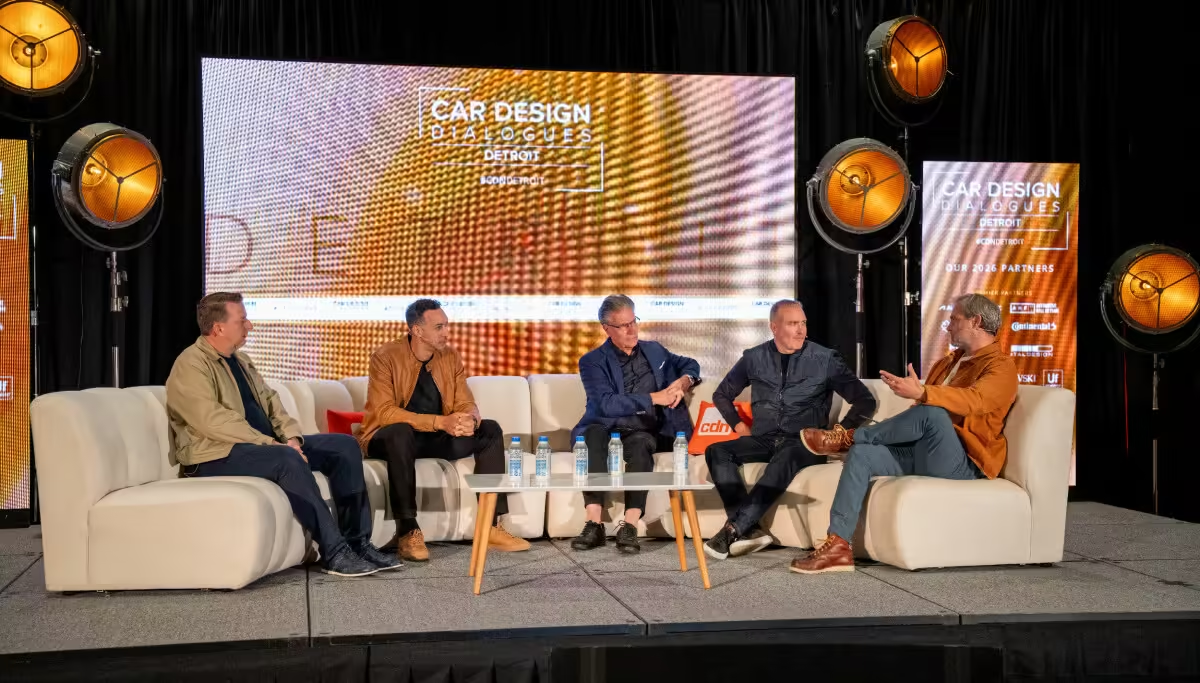
At Car Design Dialogues Detroit 2026, senior design executives from four major automotive manufacturers offered a revealing perspective on what it means to lead a creative team today.
Joining Car Design News were Phil Zak, executive global design director of global exterior design at General Motors; Scott Krugger, senior vice-president and head of North American design at Stellantis; Chris Benjamin, chief design officer at Scout Motors; and Joel Piaskowski, global design director of trucks and commercial vehicles at Ford.
Across a wide-ranging discussion, the four leaders explored the challenge of balancing creative ambition with corporate realities, developing the next generation of designers and creating environments where individuals feel empowered to challenge established thinking.
“A lot of times you’ll see designers that kind of come up, they always don’t want to necessarily put a sketch on the board to start early that’s maybe different than their peers,” he said. “But just try it. If you don’t know, you’ll never move the needle.”
A recurring theme was that successful leadership increasingly depends less on imposing a personal vision and more on enabling others to develop theirs.
Designers as provocateurs
Automotive designers occupy an unusual position within large corporations. While engineering, finance and manufacturing departments are often focused on managing risk and controlling costs, designers are expected to challenge assumptions and propose something different.
For Benjamin, that tension is fundamental to the profession. “We are the trouble children,” he joked when asked about the role of designers within corporate structures.
“We are looked to create the vision, to do new things, to try things that haven’t been done before,” he continued. “I personally have an allergic reaction to doing something that feels too close to something else. And I mean, if that means you break some eggs or you make some waves, that’s just what you do.”
Zak agreed that designers need the confidence to take risks, particularly early in their careers. “A lot of times you’ll see designers that kind of come up, they always don’t want to necessarily put a sketch on the board to start early that’s maybe different than their peers,” he said. “But it’s like, just try it. If you don’t know, you’ll never move the needle.”
However, the challenge for senior design leaders is not simply encouraging provocative thinking. They must also convince the wider organisation that unfamiliar ideas are worth pursuing.
“Customers can’t tell you what they want tomorrow. They only tell you what they want and know now,” he observed.
Krugger described the design chief as an intermediary between creative teams and other areas of the business. “We want to kind of protect the innocence and naivety of the design team to let them create and be provocative and be ultra creative,” he explained.
“But we also have to speak a language to be able to talk to the other disciplines throughout our company to convince them that this is the right solution.”
At GM, Zak described how designers work closely with engineering teams to develop proposals that can be presented to senior executives, helping secure the resources and organisational support required to move projects forward.
For Piaskowski, understanding the customer provides an essential foundation for convincing others to embrace a particular direction. “Customers can’t tell you what they want tomorrow. They only tell you what they want and know now,” he observed.
The designer’s responsibility is therefore to interpret emerging customer needs and technological developments to create something compelling for the future.
Developing creative talent
Another significant theme was recognising that not every talented designer follows the same career path.
At GM, Zak explained that designers are increasingly moved between projects according to their particular strengths and capabilities.
Some excel at generating provocative early concepts, while others are more comfortable developing ideas through detailed engineering and production. “We have some that are very strategic in their thinking, so they’ll be on the advanced side,” he said. “Some designers can do interior, exterior across the board, and some are focused.”
Consequently, career development cannot be approached through a single formula. “There’s not one typical system or typical career growth path. Everything is kind of based on the individual.”
Krugger described a similar approach at Stellantis, where designers are encouraged to contribute ideas across different projects and brands. Sometimes, moving people outside their comfort zones can be equally valuable.
“There are times when you say, you know what, I’m going to take this person and disrupt. I’m going to put them in this studio,” he explained.
“You got to have a point of view because I think that’s the difference between design and style”
That disruption can benefit both the individual and the wider team, exposing designers to unfamiliar challenges and revealing previously untapped abilities.
“I think that discomfort allows them to grow, and they probably didn’t know that until they got in that environment.”
Zak experienced similar moves earlier in his career, which taught him the importance of quickly establishing relationships with unfamiliar teams and collaborating across disciplines.
The importance of being challenged
While much of the discussion focused on how leaders develop their teams, the panel also considered what senior executives can learn from younger designers.
Piaskowski argued that bringing fresh perspectives into established organisations is essential to maintaining creative momentum. “We want them fresh. We want that new perspective. We want them to challenge us as leaders, as an organisation,” he said. “It is a gift to the organisation to be able to get that fresh spark.”
He acknowledged that experienced design leaders must remain conscious of their own assumptions and biases when evaluating unfamiliar ideas.
Krugger made a similar point, arguing that younger designers have an important role in keeping studios connected to wider cultural developments.
But simply offering a different opinion is not enough. Designers must be able to articulate the thinking behind their work. “You got to have a point of view because I think that’s the difference between design and style,” he said. “What are you trying to say? And when you’re saying something in the designs, both visually and even just the story you’re trying to tell, we’ve got to be willing to listen.”
The challenge for leadership is creating an environment where individuals feel sufficiently confident to express those perspectives, even when speaking to senior executives.
Zak described how informal conversations and one-to-one meetings can help break down barriers between junior designers and studio leadership.
“When you create an open, safe environment, people are going to kill it for you.”
Benjamin has taken a more physical approach to accessibility at Scout Motors. His office sits within the design studio rather than alongside the wider executive leadership team, with glass walls allowing designers to see and approach him.
“They know they can walk in anytime, anyone that needs to talk to me,” he explained.
Why humanity matters
Perhaps the most revealing part of the discussion came when Benjamin reflected on how his understanding of leadership had changed throughout his career.
For him, becoming a father had a profound influence on how he manages creative people. “Being a father gave me, taught me patience, taught me understanding,” he said.
He argued that effective leadership requires an appreciation of the individual circumstances of team members, rather than simply treating them as creative resources. “When you create an open, safe environment, people are going to kill it for you.”
That philosophy extends to the relationship between seniority and personal ambition. “The higher up in an organization you get, the lower your ego needs to be,” Benjamin said. “You have to put the team before yourself. You have to sacrifice yourself for the benefit of your team, and that’s how you earn their respect. It’s not by, do what I say.”
It was a striking observation in an industry where design leadership has historically been associated with powerful individual personalities.
“I don’t care if you started tomorrow, or you started 20 years ago. The best design wins”
Piaskowski reinforced the importance of learning from other leaders, arguing that mentorship can come from several different people rather than a single influential figure.
“You may have two or three or four different mentors that do certain things really, really well,” he explained. Over time, those experiences help individuals develop their own approach to managing people, combining creative conviction with empathy and understanding.
Trust, ownership and the best idea
The discussion also highlighted the importance of recognising creative ownership within design studios.
For younger designers, presenting an original idea can be a vulnerable experience, particularly when that work is subsequently developed by more senior colleagues.
Krugger argued that successful studios must establish confidence that good ideas will be recognised regardless of their origin.
“I don’t care if you started tomorrow, or you started 20 years ago. The best design wins,” he said.
“If we’re not having fun in this environment, nobody in the company is having fun. Guaranteed”
While experienced colleagues may be needed to help develop a proposal, he believes designers should remain connected to the ideas they originated. “The trust is in developing the design with the people that birthed it,” he explained.
Zak offered a practical example of encouraging ownership during a design review, describing how he asked a designer to make a decision about the wheels for a particular vehicle.
“What wheel do you want on your car? It’s your car. Where do you want to go with it?” Such moments help establish a culture in which designers feel responsible for their work rather than simply following instructions. Krugger also stressed the importance of maintaining enthusiasm within increasingly demanding working environments.
“If we’re not having fun in this environment, nobody in the company is having fun. Guaranteed,” he said.
Bringing designers closer to customers
The conversation concluded by considering whether automotive designers should have more direct contact with the people who ultimately buy their vehicles.
Benjamin explained that Scout’s community events have created opportunities for designers to interact directly with potential customers and reservation holders.
He recalled inviting children to sit inside a concept vehicle at a recent event, despite such access not normally being permitted. The interaction, he suggested, helps build a more personal relationship between the brand and its audience. “You show the community your warmth and your humanity, and that extends to the brand.”
Zak pointed to similar experiences within the Corvette community, where enthusiasts are particularly interested in meeting the designers and engineers responsible for their cars.
Krugger argued that customer engagement remains equally important for mainstream manufacturers, even if the scale of their operations makes direct interaction more challenging. “You shouldn’t be designing for yourself. You should be designing for the customer,” he said.
A different kind of design chief
Taken together, the discussion suggested that the qualities associated with successful automotive design leadership are evolving.
Creative vision remains essential, as does the confidence to defend unfamiliar ideas against commercial and organisational pressures.
But the four executives also emphasised skills that have not always been celebrated quite so prominently within automotive design: empathy, adaptability, communication and the willingness to give others ownership of their work.
There was little suggestion that the design chief’s authority is disappearing. Rather, the panel described a different way of exercising that authority, one built around developing talent and creating the conditions for creative ideas to succeed.
The challenge is no longer simply to have the strongest creative vision in the room. It is to build a team capable of producing ideas that go beyond what any one individual could achieve.
Source: www.cardesignnews.com