
Article Content
A long-standing collaboration with the San Diego Supercomputer Center (SDSC) at the University of California San Diego has helped provide the computing expertise for the search for high-energy neutrinos from space, work recognized this week with the 2026 Nobel Prize in Physics.
Francis Halzen, the University of Wisconsin–Madison physicist whose vision and leadership helped establish the IceCube Neutrino Observatory, was awarded the prize on October 6 “for decisive contributions to the IceCube Neutrino Observatory and the discovery of high-energy neutrinos of astrophysical origin.” The recognition also marks a moment of celebration for SDSC – a division of the at the Halıcıoğlu School of Data Science and Computing – which has partnered with IceCube for more than a decade to advance the computing infrastructure supporting its science
“IceCube’s discoveries depend not only on the detector at the South Pole, but also on our ability to simulate and interpret what it observes,” Halzen said. “For more than a decade, our partnership with SDSC has brought computing expertise and resources to that challenge, helping us turn observations of elusive particles into new insights about the universe.”
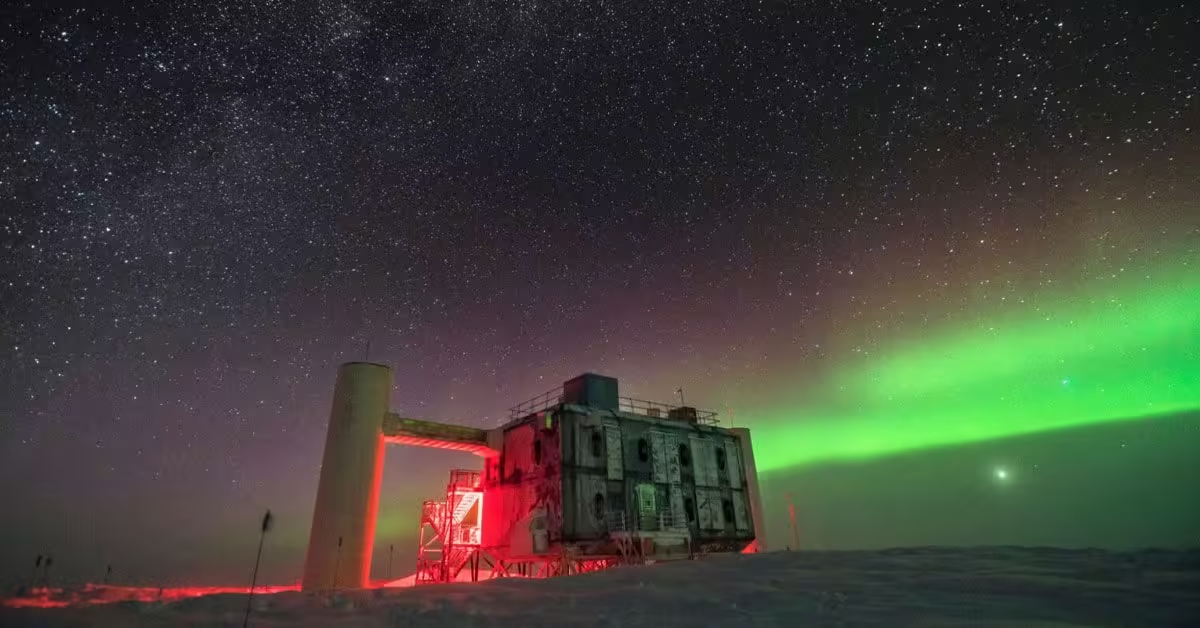
At the South Pole, IceCube uses light sensors embedded in a cubic kilometer of Antarctic ice to detect the rare interactions of neutrinos, which are elusive particles that usually pass through matter unnoticed. Halzen first presented his vision for the observatory in 1988. Completed in 2011, IceCube subsequently detected high-energy neutrinos originating beyond our solar system, helping establish a new field of astronomy. Those observations showed that neutrinos could serve as cosmic messengers, offering scientists a new way to study some of the universe’s most energetic and distant phenomena.
Source: today.ucsd.edu