




Want to bookmark your favourite articles and stories to read or reference later? Start your Independent Membership today.
Already a member?
Log in
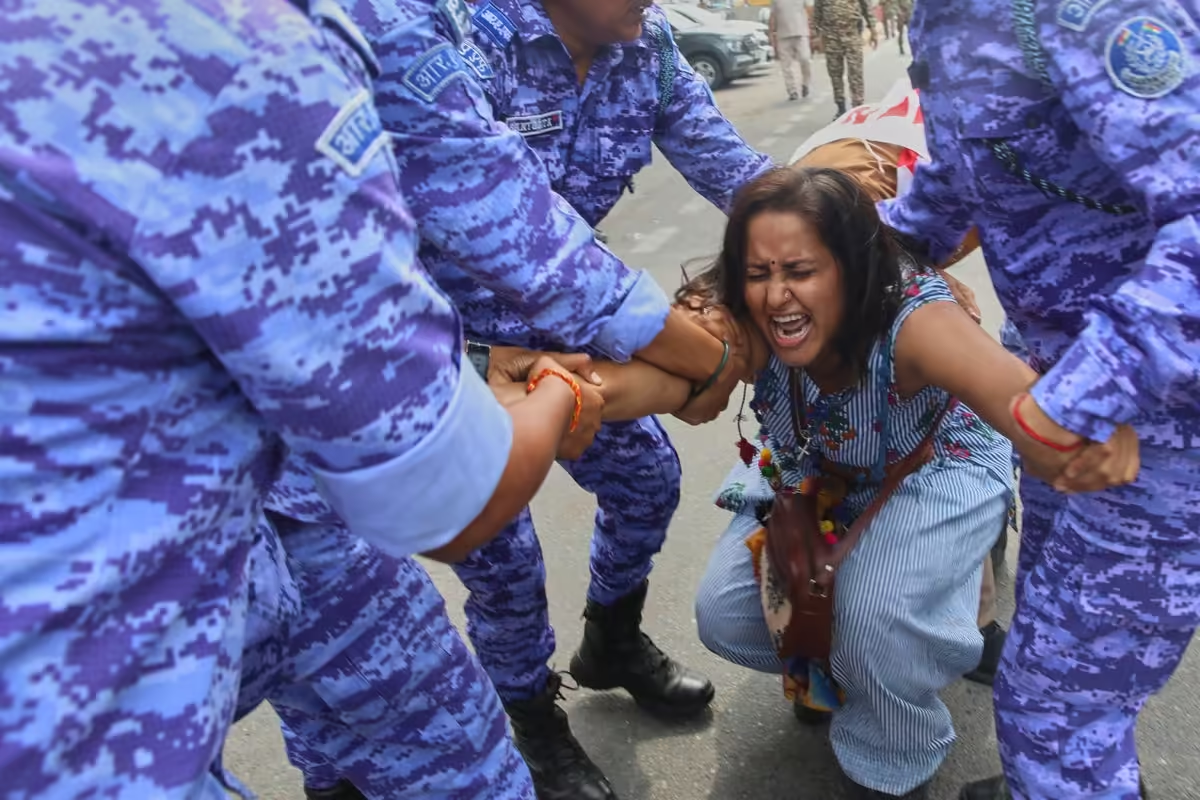
It was a dark day for press freedom in the world’s largest democracy as police manhandled, dragged and arbitrarily detained journalists covering one of India’s biggest anti-government protests in recent years on 10 October.
The Narendra Modi government had turned the capital Delhi into a fortress ahead of the protests, called by youth and student groups demanding the resignation of the nation’s election chief over a controversial revision to voter rolls resulting in the removal of 130 million names.
More than 20,000 police and paramilitary personnel put the city effectively on lockdown and detained thousands of protesters, lawyers, youth leaders, opposition politicians, former chief ministers, and at least 12 journalists, who were forcefully holed up in buses despite prominently displaying their press cards. They also created constant obstructions for many other journalists reporting from the ground, resulting in multiple altercations.
The crackdown on journalists doing their duty was unlike anything I had witnessed as a reporter for almost 10 years in India, all of them under Modi’s rule.
Modi and his ruling BJP party have long faced criticism for their treatment of the free press but this latest attack has set a dangerous precedent. It threatens the safety of journalists working on the ground as protests against the ruling party gain momentum ahead of the 2029 federal elections.
India is ranked 157th out of 180 countries in the latest Press Freedom Index published by Reporters Without Borders.
The unofficial restrictions imposed on journalists on Saturday were manifold, making it a daunting task to even reach the protest venue.
The Cockroach Janta Party, a youth-led pressure group shaping up to be a major challenge to Modi, had called for a protest at Jantar Mantar, an 18th-century observatory which doubles up as the capital’s designated protest site, demanding the resignation of chief election commissioner Gyanesh Kumar. Critics have said the revision of voter lists under his watch had disproportionately benefited Modi’s party.
The protest site was sealed off with barricades, along with roads leading to the area. Police were adamant that even journalists wouldn’t be allowed in.
My taxi was repeatedly diverted away by security personnel as I tried to reach Jantar Mantar, forcing me to navigate the labyrinth of barricades on foot for around 2km. At checkpoints every 100-200 m, I was asked for my press identification despite the card being on display.
Almost an hour into the walk, I was stopped by paramilitary forces from entering one of the roads, triggering an altercation and an unsuccessful attempt to snatch my phone as I began recording the incident. I was allowed to proceed only after I identified myself as a journalist working for foreign media.
My colleague Namita Singh had been at Connaught Place, a central shopping area less than a mile from Jantar Mantar, since morning. On her way there, she faced multiple checkpoints and route diversions. She was repeatedly told by police personnel to step back while recording the detention of protesters. The taxi she had taken booked for the day had its tail light broken while it was parked.
Reporters for independent news organisations like The Quint, The Wire, Scroll, and Newslaundryalong with journalists for Reporter TV, Navbharat Times, and senior independent journalist Paranjoy Guha Thakurta were detained. An editor with Scroll claimed he was detained from a locality in south Delhi while he was waiting for a taxi, miles away from the protest site.
Newslaundry said that the phones of its journalists were snatched and seized. Two women journalists were manhandled and dragged through along a road by police.
Some journalists were released by evening and others taken to police stations. The police in almost all cases refused to state the grounds on which the journalists were detained.
“Everybody claims to be a journalist these days,” police officers said, defending their actions.
A reporter for Boom Live was detained and released after three hours at a faraway location, her editor Jency Jacob said. “She was only doing her job shooting a video,” Jacob said on X. “The cops gave her no reason for detaining her despite being informed that she is a journalist.”
The suspension of mobile internet within a 4km radius of the protest site made it harder for reporters to send information from the ground.
We witnessed police using anti-riot shields to stop reporters from filming the detentions and using whistles in unison to drown out voices.
We also witnessed police imposing a two-tier system for the press, allowing legacy media through while barring independent journalists. Officers turned away multiple journalists and asked most of us to show our accreditation cards issued by the Press Information Bureau.
Press bodies promptly criticised the detention and harassment of journalists, calling it a “blatant attack on the freedom of the press”.
The Committee to Protect Journalists said that a free and independent press was essential to a democracy and urged Indian authorities to respect media workers’ ability to report in the public interest.
“Journalism is not a crime, and neither is protest,” DIGIPUB, an association of digital news outlets and independent journalists, said in a statement.
“If the powerful cannot withstand being watched and challenged, the fault lies in their conduct, not in our cameras or the people’s voices.”
The National Alliance of Journalists said that the attacks were ominous and the situation worse than during the Emergency in the 1970s. The Emergency, imposed by prime minister Indira Gandhi in 1975 and remembered as one of the darkest chapters of modern Indian history, allowed the government to suspend civil liberties, jail the opposition, and censor the press.
“Why not just declare Emergency?” asked Abhijeet Dipke, founder of the cockroach party, which began as an online satire and rapidly evolved into a pressure group.
“The Government of India is at war with its own young citizens,” said Saurav Das, a spokesperson for the group.
The cockroach party emerged as one of the biggest challenges to Modi’s rule after successfully leading protests earlier this year that forced the resignation of his education minister in a rare defeat for the government. The summer protests saw a mass mobilisation of Gen Zfrustrated with unemployment and a dampening economic outlook, and drew comparisons with the demonstrations that had earlier toppled authoritarian governments in Nepal, Bangladesh and Sri Lanka.
The cockroach party’s leaders have often called Modi a “dictator” and accused him of protecting the election body chief, but have stopped short of demanding the prime minister’s resignation.
Attacks on journalists have been a disturbing constant across protests across South Asia, with police opening fire on reporters and protesters burning down media buildings. That shouldn’t be allowed to repeat in India.
Source: www.independent.co.uk

