



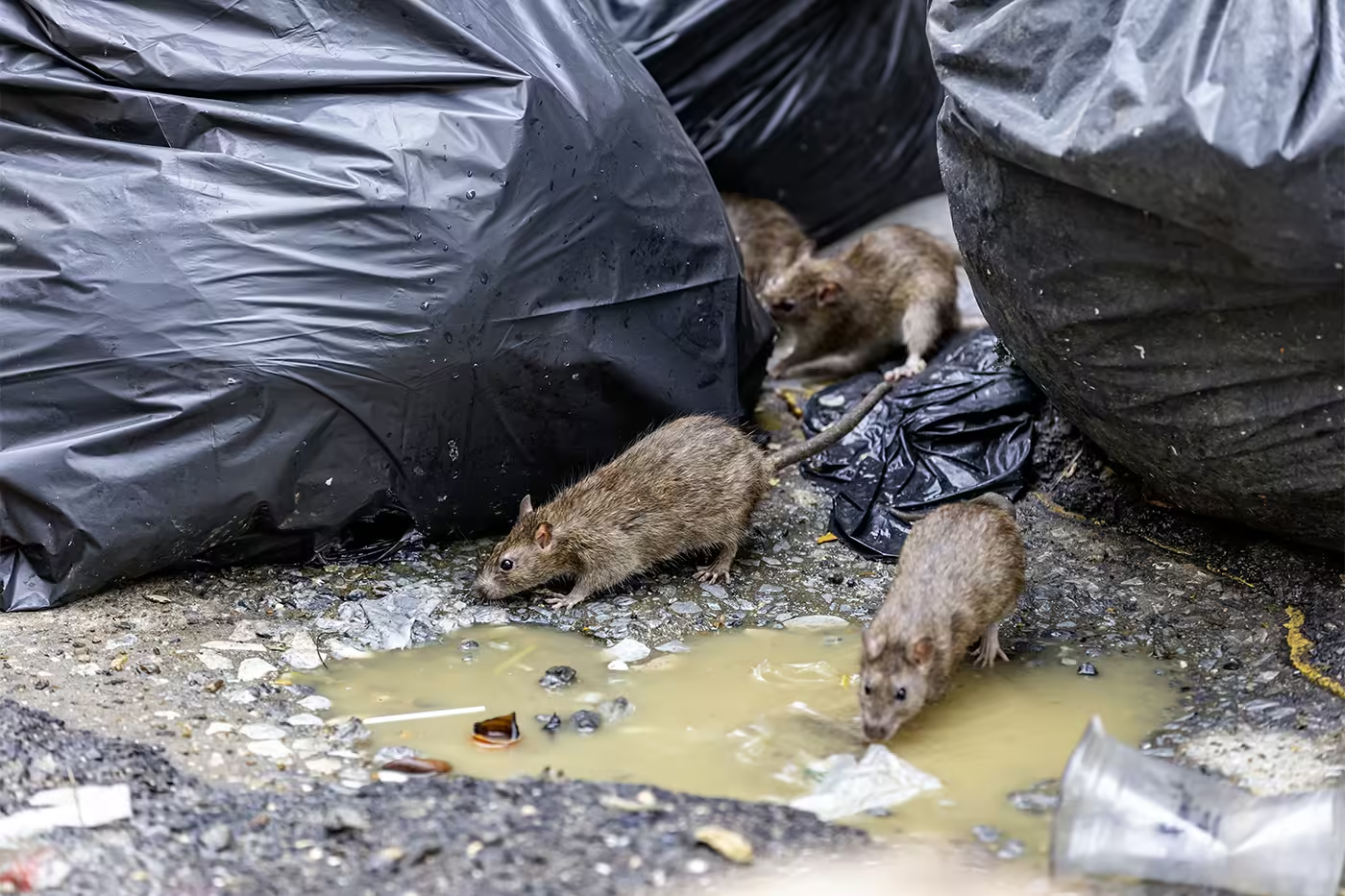

All around Boston at night, tiny hot mics are capturing hours of conversations under the radar. Scientists comb through the recordings, with AI making the job easier.
Rest easy — your secrets aren’t the juicy stuff they’re after.
The scientists are recording the city’s rats. The system detects and removes human speech, leaving the researchers to focus on rodent chatter.
The project is a collaboration between Basisa nonprofit that uses AI to tackle complex problems, and Boston city officials, with assistant commissioner of environmental services John Ulrich and his team at the helm.
By matching recorded rat calls with video of their behavior, the team hopes to uncover how the rodents interact and navigate their surroundings — knowledge that could help the city prevent infestations rather than respond after they take hold.
Linger around Downtown Crossing at night or circle Frog Pond at the edge of Boston Common, and you’ll spot rats peeking under planters or darting across the path to duck into a buttonbush shrub.
In 2021, Beantown even led the nation as the “rattiest” city. Data from the mayor’s office shows that in 2025, the city had responded to 5,957 rodent-related 311 calls by early December.
At the National Urban Rat Summit that Boston hosted this year, experts talked eviction strategy. Instead of swooping in with traps and trained ferrets, one of the ideas was to gather intel on how rats respond to control efforts, using changes in their calls and activity to gauge whether the measures are working.
Northeastern Global News spoke to experts, including animal behavior and urban affair specialists, about Boston’s rat problem.
Why are there rats in Boston, and why does it take special tech to hear them?
“The reason why rats are here is because of us,” said Ulrich, “They’ve evolved next to us for a very long period of time.”
Human trash supplies food, and buildings offer shelter.
“Cities are an ecosystem, and there are lots of species thriving in it,” Daniel O’Briena Northeastern University professor of public policy and urban affairs said.
Thriving — and singing.
There’s a rat chorus all around, but it’s too high-pitched for human ears to pick up, according to rodentologists.
Switch on a specialized microphone, and you realize it’s going on all night, said Ralph Petersonresearch scientist at Basis who studied neuroscience at Northeastern and worked in the lab of Rebecca Shanskya Northeastern psychology professor who studies brain function and behavior in rats.
Rat calls fall between 20 and 100 kilohertz — thousands of sound-wave vibrations per second. Human hearing tops out at the lower end of this range.
Why study rats on their own turf?
Sy Montgomery, acclaimed author and naturalist, said studying rats from inside a lab wasn’t the best measure, because captivity hides much of what makes the lives of animals in the wild so complex. It can’t recreate the full range of their behavior.
“They could be out there making stock trades in the wild and we wouldn’t know it from the lab,” Montgomery joked.
Just imagine, somewhere under a Boston dumpster, a rat yelling “Sell!” at 50 kilohertz.
How do you bug a rat neighborhood, and where does AI come in?
The setup includes two devices, Peterson, the research scientist, explained.
The devices have collected around 200 days’ worth of audio, comprising of around 1.2 million vocalizations, with many calls lasting a tenth of a second.
The researchers used AI to match the rats’ calls with video footage and look for patterns. They also turn recordings into three-dimensional maps that show the rats moving and vocalizing within their virtual neighborhoods.
The team identified three broad categories of calls, each with a distinct purpose and sound signature, putting them together in a “rat dictionary” that maps their connections.
There’s the high-pitched “alarm call.” The “squeak,” which is a lower-frequency, aggressive sound meaning trouble is afoot. And the friendly 50 kilohertz affiliative call — a “Hey babe!” to a potential love interest or banter between pals at play.
One sound resembles whistling — and once you hear it, you might think you’re listening to a bird, Peterson said.
The recordings also reveal family foraging trips and adolescent play — surprisingly human routines, indicating that rats are also intelligent.
They care for their young, feel regret and learn from mistakes, said Ulrich, the environmental services official.
“The more you learn about them, the more you gain a great deal of respect for them,” he explained.
O’Brien suggested the Basis project might inspire empathy and encourage more humane ways to control the critters or live alongside them.
“That’s something that could happen when you get to know a creature better,” he said.
Source: news.northeastern.edu