



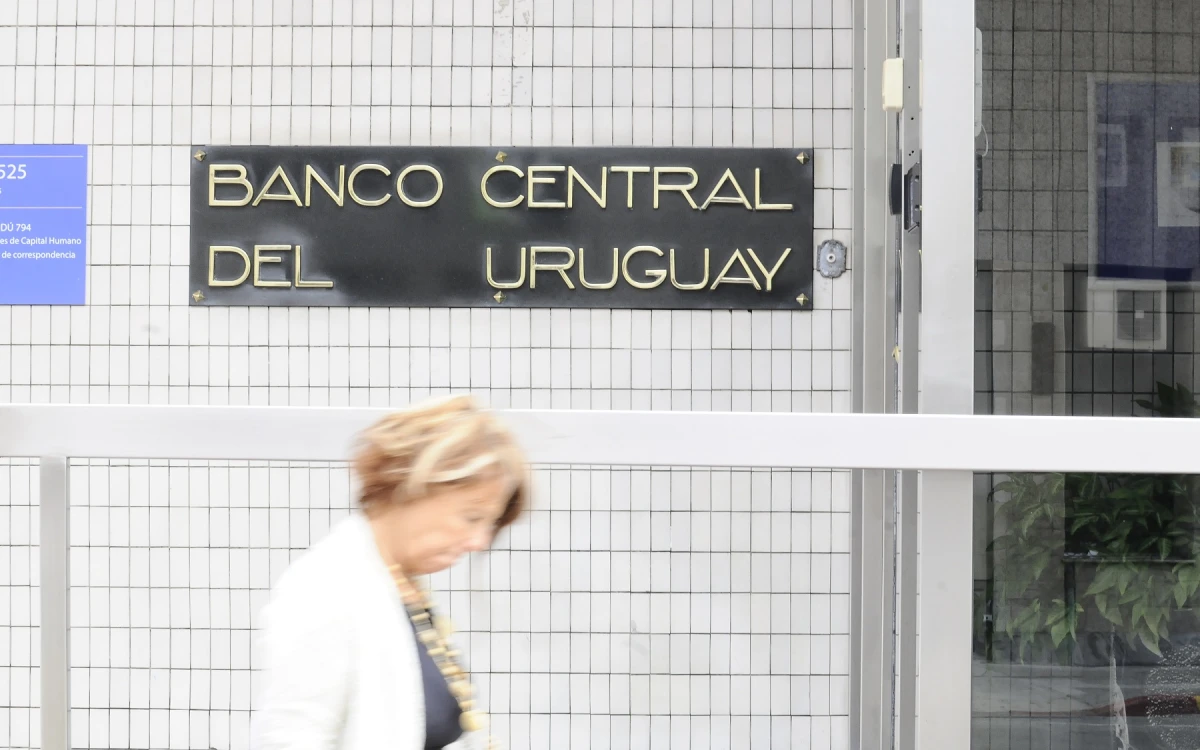

He Central Bank of Uruguay (BCU) decided, unanimously, increase the reference interest rate“the price of money”, from 5,75% a 6%an increase of 25 basis points that ended seven months no changes. The economists consulted by El País considered that the measure was reasonable and preventive, although they differed on the moment of the decision and the possibility of new adjustments in the coming months.
In general terms, a large part of the market and economists they expected this increase of the reference interest rate.
Marcelo Sibillesenior consulting manager at KPMG, considered that the increase was reasonable in a context in which the central banks of the main economies began to raise their interest rates. The United States Federal Reservefor example, raised its rate by 25 basis points in September, to a range of between 3.75% and 4%.
“In a context where the central banks of developed countries began to raise rates, maintaining it at 5.75% could have meant a signal of relaxation with the risk of translating it into a rise in expectations,” he said.
Ignacio Sanchez/El Pais Archive
In his opinion, maintain the 24 month expectations anchored around the goal is “very important”, and the key is in the clarification of the BCU that “the measure does not intend to reverse the direct effect of the higher cost of energy (which is beyond the control of the entity), but rather to act proactively to prevent it from spreading to the remaining prices and expectations (of inflation).”
Ramón Pampínmanager of Economic Consulting at PwC, who also anticipated the decision, pointed out that the increase “responds to a preventive criterion within the framework of an inflation that has gone above the target by a offer shock (fruits, vegetables and fuels), rather than due to generalized pressures.”
Pampín noted that, given that the monetary policy task remains expansive terrainthe effect of the increase would be limited, according to the BCU. However, he considered that it could have an impact on consumer credit, although he clarified that he does not expect a significant effect. In that sense, he warned that private consumption has been the pillar of growth in activity.

PwC projects inflation to be 4.7% in both 2026 and 2027, above the BCU’s 4.5% target, although within the tolerance range. “If external shocks do not subside, we do not rule out a new adjustment of 25 basis points in the first quarter of 2027,” Pampín added.
For its part, Alejandro Vallcorbasenior consultant at Exante, focused on the fact that “the rise is framed in an international context in which the beginning of a contractionary cycle of monetary policy has been observed in other large economies.”
In that sense, he analyzed that the BCU “understands that the increase in inflation responds to supply shocks, without generalized inflationary pressures, and highlighted that expectations They remain anchored around the goal. This diagnosis is consistent with what we have been marking since Exante,” he noted.
In fact, inflation in September rose to 4.7% year-on-year, driven by higher tradable inflation, while non-tradable inflation fell from 5.9% to 5.4%. “The BCU also referred to the fact that it is likely that inflation will be temporarily above the specific target, and that it will then converge to 4.5%, a vision that we also share,” Vallcorba added.
In that sense, Exante does not foresee that the rate increase ordered yesterday by the BCU will begin a cycle of monetary tightening significant.

Vallcorba pointed out that the inflation expectations they remain “quite anchored” and that “the poor performance of economic activity conditions the space for a much greater monetary restriction.” This is especially relevant, he indicated, if external pressures on food prices persist. energy and other raw materials.
The economist José Antonio Licandro noted in
In any case, the economist recognized that the BCU itself had been showing that the expansive instance required some upward adjustment of the monetary policy rate: “Although it is a moderate increase, it was an appropriate signal as a reaction to the rise that prices have been showing in recent months and which, for the second consecutive month, kept the inflation rate somewhat above the target of 4.5%.”

Photo: Leonardo Maine/El País.
According to José Antonio Licandro, this signal reinforces the Central Bank’s commitment “to this goal, at a time when economic activity has been weak, which could generate uncertainty about whether the BCU would stop prioritizing price stability,” he summarized.
Finally, Licandro estimated that the BCU could carry out new marginal adjustments of the monetary policy rate in the November and December meetings, without abandoning the current expansionary stance, but bringing the rate closer to its neutral level.
The reasons given by the Central Bank
In the statement published this Thursday, the BCU explained that the increase in external risks and the possibility that supply shocks persist motivated the decision to raise the monetary policy rate. The objective, he noted, is to preserve the anchoring of inflation expectations and help prices converge to the 4.5% goal over the two-year monetary policy horizon.
The Consumer Price Index (CPI) increased to 4.7% year-on-year in September, associated with the increase in imported goods, fruits, vegetables and fuels. However, the BCU indicated that it does not observe widespread inflationary pressures and highlighted that inflation of non-tradable goods and services has remained stable in recent months.
Inflation expectations remained anchored around the objective for that horizon. According to the statement, analysts’ expectations are at 4.55%, those of financial operators at 4.58% and those of companies at 5%. The average of the surveys reaches 4.71%.

Central Bank of Uruguay.
On the international stage, the organization noted that geopolitical tensions continue to drive energy prices and, indirectly, those of other tradable goods. This situation contributed to an upward revision of inflation expectations. He also indicated that the interest rates of the main central banks and those of the international financial markets have been adjusting upwards.
At the domestic level, the BCU highlighted that the economy shows signs of resilience after facing sectoral and climatic shocks that also temporarily affected activity.
In this framework, the agency’s projections indicate that inflation will temporarily remain above the target, although within the tolerance range, while supply shocks are processed. Subsequently, it will converge to the 4.5% objective in the monetary policy horizon. Regarding activity, he indicated that growth is expected around its trend during that period.
Copom considered that inflation will resume a convergent path towards the target once the transitory effects are absorbed. However, he warned that the proliferation and persistence of geopolitical and climatic shocks constitutes a relevant risk for the evolution of prices and inflation expectations.
Consequently, the Board of Directors unanimously resolved to increase the monetary policy rate by 25 basis points, up to 6%, and maintain the expansive nature of monetary policy. “The measure does not seek to reverse the direct effect of temporary increases in energy and food on prices, but rather to act proactively to limit their persistence and prevent them from being passed on to the rest of the prices and expectations,” he clarified.
Source: www.elpais.com.uy