


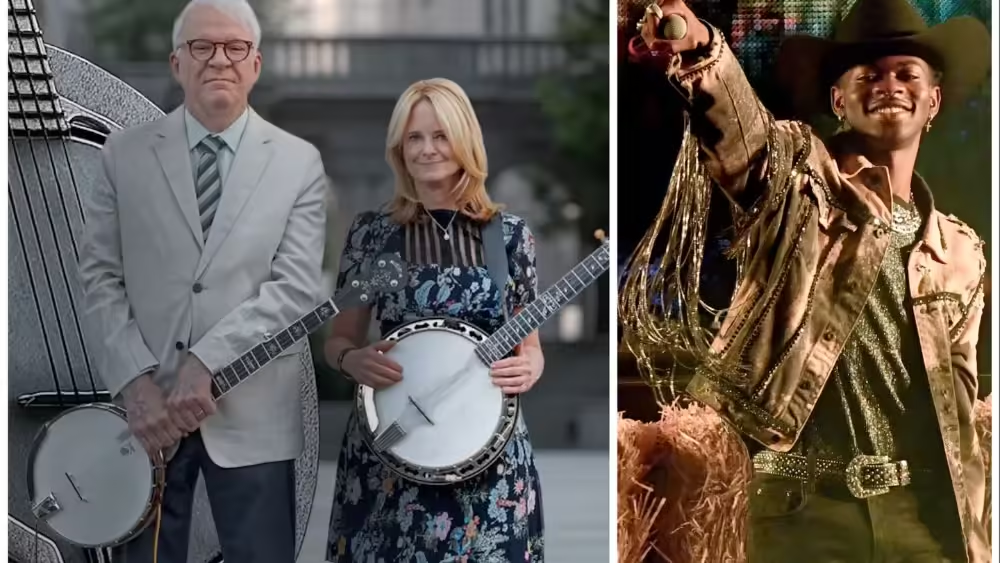

“Old Town Road” is obviously one of the biggest recorded hits of all time, but also probably counts as a guilty pleasure for a lot of people who are in country music — or bluegrass — who go, “I’m not supposed to like this song, but it actually does sound kinda country. Whoever wrote or created it, there’s something in there that kind of feels weirdly authentic,” even though there is also the question, “Oh, is it country cosplay,” or what is it?
Martin: It’s hard to define exactly what their version of the song is. I kinda researched it; I even drew a little map. Because Lil Nas was living in Atlanta, and he was online… Evidently, this is the way things are done: There’s sites where you can buy a track, or a rhythm, and he paid $30 for the beat, I guess. So it went from Holland to Atlanta, and then it ended up in Nashville. Anyway, the artist, Lil Nas, was very generous to us because he allowed us to dabble with the lyrics and sort of rewrite them for bluegrass world…
Brown: But to your point about it sounding kind of country, even though Lil Nas obviously didn’t really come from a country space, or as an artist, one doesn’t think of him that way… To me, it’s the tonality of the melody with the flat seven. And the notes and the scale of the melody, they’re very Appalachian. They’re very much like a song that we did a version of called “Cluck Old Hen” on “Safe, Sensible, and Sane.” That tonality of that modal scale is a very Appalachian kind of sound, so it’s really natural for the banjo to riff off the vibe and the scale of the melody.
Martin: And also what I always thought was gonna be exciting, and it worked out that way, is that when you hear the first 16 bars — that Alison wrote, by the way, very beautifully and very mysteriously — you don’t know what the song is. You can’t even conceive. And then when “Old Town Road” comes in, it’s this weird surprise that it actually works. By the way, this song has a great tempo, and I think we pretty much stuck to that tempo.
So you were looking to sort of set the song up in a more sort of serious or almost misleading way…
Martin: Right. With a very bluegrass opening, or very Appalachian opening, as Alison says, with the modal sound. And Alison wrote this beautiful melody that took me literally a month to learn. Because if you listen to it, it sounds normal, but if you listen again, there’s a lot of strange pushes and pulls and slides and strange things. And I kind of insisted, “Just keep playing that. Don’t riff on that. Just keep playing that,” because that takes a while to get into your head. And when it gets in, you can’t get it out.
Brown: It’s got a little back step here and there, as one might say in this genre. But yeah, Steve was like, “Let’s keep it a secret for the listener.” Like, they should, when they put this on, think it’s some Appalachian tune that they just aren’t familiar with, and keep keep the secret of the song as long as possible.
‘Old Town Road’ single cover
Then you managed, after all the vocal fun, to have a banjo climax toward the end.
Martin: Yeah. Oh my God. Alison, it wasn’t double time, it was quadruple time, right?
Brown: It was only double time. That was enough.
Martin: Yeah. My God. I thought it really lifted the song, as it builds to this big climax. And then, I’m not sure if that going to the major at the end there is in the song or if it’s you guys.
Brown: It’s not in the original version; the original version just stays on the same chords. But putting that bold four chord in there, where it just goes to this four major chord, it just says bluegrass. And then Steve’s idea of changing the lyric right there to say “Bluegrass Road” instead of “Old Town Road” was great, too. It gives you this moment of the shining star of bluegrass music (McCoury) stepping forward.
Source: variety.com