


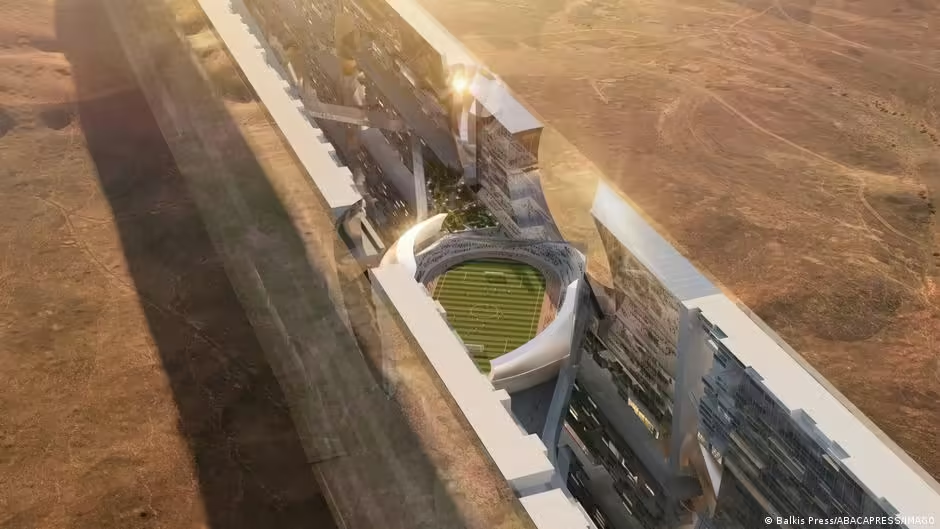

It was billed as “the most unique stadium in the world,” a key pillar of Saudi Arabia’s World Cup 2034 plans. But now Neom Stadium, part of the kingdom’s ambitious aims to build a 170-kilometer-long (111miles) city in the desert known as The Line, looks set to be scrapped, with the broader project scaled back significantly.
A recent Reuters report said the stadium, which according to the country’s bid book was going to be “350 meters (1,148 feet) above ground” and have “stunning vistas, and a roof created from the city itself,” would no longer be built for the tournament, where it was to host a quarterfinal and several other games.
Observers of the gulf country saw this coming.
“When I was in Saudi Arabia in December there were already plenty of signals that the whole Neom project was being put on the back burner, if not abandoned altogether,” F. Gregory Gause III, a regional expert from the Middle East Institute think tank in Washington D.C., told DW.
“I see it as part of a general re-evaluation of their fiscal situation, both in light of the oil market before the current war and in light of the damage that the war is doing. The draw-back from sports commitments is just part of a more general reassessment of priorities in the current, more straitened, situation.”
Priorities changing, with sports losing out
Saudi Arabia’s sports splurge that saw players like Cristiano Ronaldo join the country’s football league and the kingdom invest in all sorts of sports in myriad ways has slowed dramatically. The country pulled funding for the multi-billion dollar LIV Golf as well as events in snooker, tennis and rugby and also withdrew from ambitious plans to host the 2029 Asian Winter Games in Neom.
Sports had formed a key part of Saudi Arabia’s Project 2030which aimed to diversify the country’s economy away from oil and increase its soft power. But Yasir Al-Rumayyan, the governor of the Saudi-government operated Public Investment Fund (PIF), which also owns Premier League football club Newcastle Unitedsaid earlier this year that the PIF was “reassessing its priorities” amid war in the region.
“The impact of the war has not only made the economic rationalization more important, but it’s also accelerated the desire to rethink some of these projects in the sense that Neom is now being repurposed as an industrial center on the Red Sea, which has obviously assumed much greater urgency since the Strait of Hormuz was effectively blocked,” Kristian Coates Ulrichsen, author of “Kingdom of Football: Saudi Arabia and the Remaking of World Soccer,” told DW.
Parallels between Qatar 2022 and Saudi Arabia 2034
There are, Coates Ulrichsen continued, clear parallels with the 2022 World Cup in Qatar, where plans to build 12 stadiums resulted in only eight being used at the tournament. The Arab Spring uprising arrived shortly after the bid was accepted by FIFA and, though it didn’t impact the country directly, it destabilized the region both politically and economically.
Neither Saudi Arabia’s World Cup organizing authority or Sports Ministry nor FIFA have responded to questions from DW about whether we may again see fewer stadiums than the planned 15 for the 2034 World Cup, which could feature 64 teams.
“We’re seeing the same obviously with Saudi Arabia now,” said Coates Ulrichsen, who is also a Fellow for the Middle East at Rice University in the US.
“[FIFA President] Gianni Infantino announced Saudi would be the only bidder on the 4th of October 2023. Three days later was October 7th, so within three days, the region was effectively in flames.”
Since then, there has been the Israel-US war against Iran, while Houthi attacks continue to hit Saudi Arabia as part of the conflict in Yemen, meaning that: “This whole hosting cycle is taking place against a backdrop of considerable uncertainty and kind of real tension.”
World Cup will still matter to Saudi Arabia
But though the scope and cost of it may be reduced, Saudi Arabia’s softening commitment to sport will not likely apply so firmly to the biggest sporting event in the world, said Gause.
“I think it continues to be a major priority, because of its global importance and because the Saudis will want to do at least as well, if not outshine, Qatar’s hosting earlier.“
Relations between Saudi Arabia and Qatar have improved since an agreement in 2021 but the pair remain regional rivals, something Coates Ulrichsen agrees will spur the 2034 hosts on.
As such, the 2034 tournament will still likely be a high-end affair, with Saudi Arabia building most stadiums from scratch. But, said Coates Ulrichsen, it may look somewhat different to what was planned.
Gulf Cup hosting a postivie sign before Asian Cup test
“The fact that at least the Saudis were able to host a big event with 60,000 people in the stadiums, full stadiums without any security concerns [the Gulf Cup football final which they won this week] is a good sign,” he said.
The regional expert thinks more matches could end up being hosted in the two biggest Saudi cities, Riyadh and Jeddah. This may be at the expense of some venues nearer the east coast such as Al Khobar or Al Ahsa. These are separated from Iran by the Persian Gulf, which includes the Strait of Hormuz, and could be reconsidered depending on the state of political affairs.
Saudi Arabia host football’s Asian Cup in January, which Coates Ulrichsen thinks will be an “early test of whether that is viable to have a weeks-long major tournament under these conditions.”
With nearly eight years until the World Cup, the political and economic situation in the country is difficult to predict. While the supposed shelving of Neom Stadium and general Saudi sporting withdrawal poses questions of commitment more broadly, it appears the World Cup show will go on. But probably not quite as billed.
Edited by: Chuck Penfold
Source: www.dw.com