




Five issues Canada must navigate
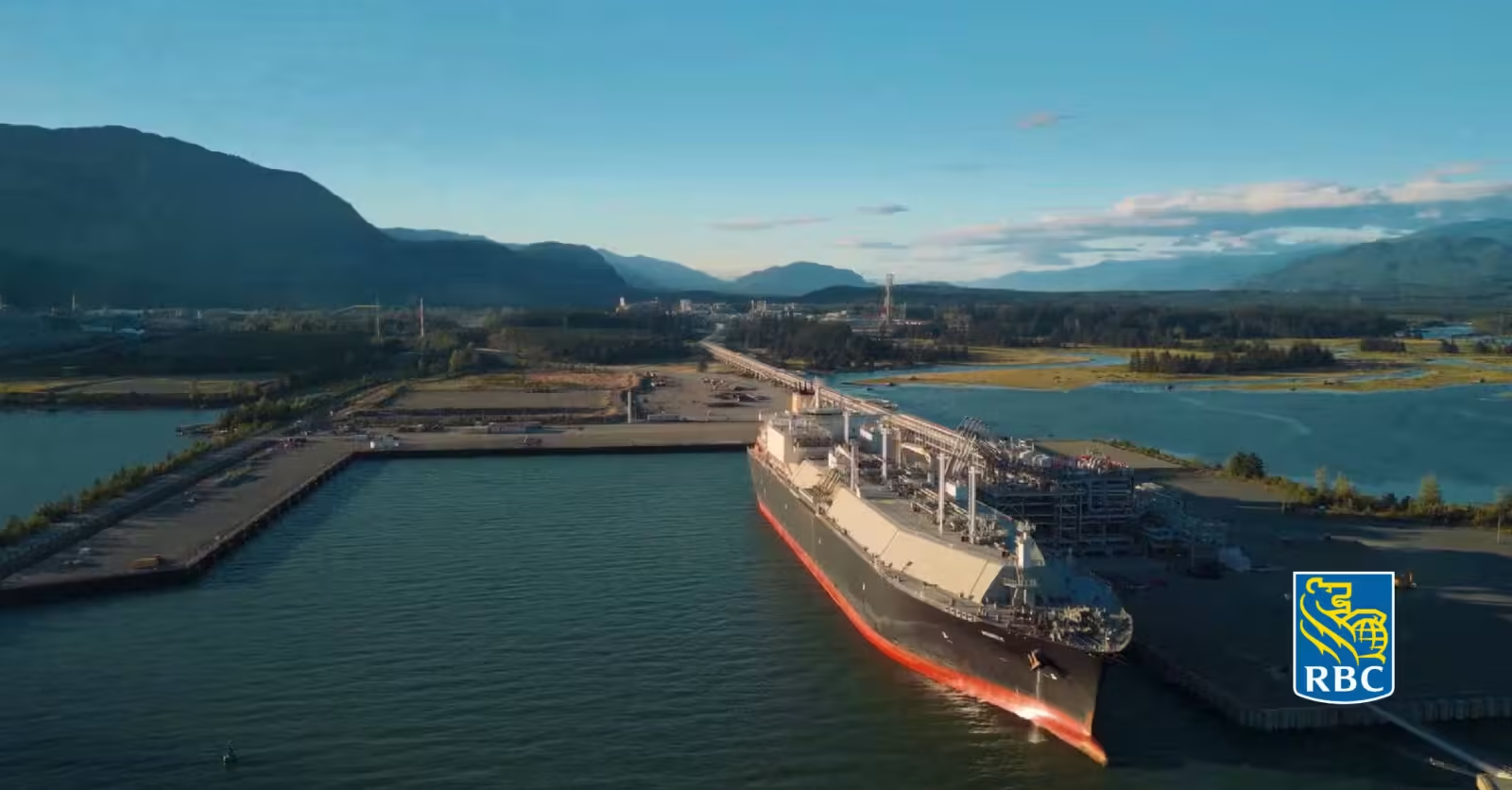
The three Ps depend on five critical elements: investment certainty, labour availability, fabrication of key inputs (steel and equipment), project execution (delivered on time and on budget), and the creation of new markets
1. Investor Certainty: Fiscal terms need permanence
Capital requires certainty. Alberta announced three royalty revisions from 2007 to 2016, essentially all within one growth cycle. B.C. changed its royalty terms in 2022, four years after LNG Canada’s final investment decision (FID), and announced a new price-sensitive gas regime this year, effective January 1 2027.
The moves drew concerns from producers and risks making B.C. a higher-risk jurisdiction.12 Each rule change, delay and permit condition eats into internal rates of return. Investors require certainty for the life of the investment cycle.
The recent federal productivity mega deduction is seen as a template, given its application across industries. Simple and “permanent” is likely a successful recipe for royalties as well.
Proponents are also seeking carbon price stability. Alberta’s Technology Innovation and Emissions Reduction (TIER) system’s headline price rises to $130 a tonne by 2035, but carbon credits still trade around $30 today. The Canada–Alberta agreement set a credit floor rising to $110 by 2040, which Alberta must enact by year-end, and the Pathways deal is non-binding until its definitive agreements are signed.13
Pathways is cheap per barrel at about $2 before public support (cost attributed across all produced barrels, basin-wide), but expensive per tonne captured. Still, its value is more likely in the growth it permits, and not the tonnes it removes.
At today’s emissions per barrel, we estimate about 16 million tonnes of capture is required by 2040 to stay under Alberta’s 100 million tonne (Mt) oil sands limit (assuming no dramatic decreases in upstream emissions intensities). Alberta’s 100Mt oil sands emissions cap was never actually enacted, which can create further regulatory uncertainty especially for foreign investors.14
Permanence is an oft-cited requirement for investors, and arguably one even greater valued in today’s world of heightened geopolitical and energy disruptions, such as the pandemic, Ukraine-Russia war, and the Strait of Hormuz blockade.
2. Labour Availability: Certified trades, headcount and housing
At peak build, the boom will require 130,000 construction workers on site and in the direct supply chain, roughly twice the historical average.15 Alberta is short of certified workers. And nine in 10 of the required construction hires over the next decade will simply replace retirees. Trades wise, gaps cluster in 2027–31 among boilermakers, welders, pipefitters and millwrights. That’s because an apprentice who starts training in 2027 will only be certified in 2030–31 at the earliest, with only about half certifying within six years.16
Alberta imported much of its workforce to solve the labour crunch last time. Out-of-province workers in Alberta doubled between 2004 and 2008, with about 40% of the required labour force from Atlantic Canada. That source is thinner now: Newfoundland and Labrador’s unemployment rate has fallen from 15% in 2006 to 10.1%. And the province is expected to have its own construction peak in 2031 with the $14 billion offshore oil project Bay du Nord $70-billion Churchill Falls hydropower project expansion. It also expects to lose 30% of construction workers to retirement. And that says nothing of the fact that other regions in the country are bidding for the same trades.17
Ontario, where unemployment is higher today than it was in 2006, could be part of the answer. But this could clash with Ontario’s own construction sector’s hiring spree, brought on by growing electrification, mining, and industrial projects.18
While temporary foreign workers could provide an interim solution, importing labour while unemployment among young Canadians is roughly twice the national rate would be a missed opportunity.19 A solution may lie in a national service-style program, “come work for—and build—Canada,” that creates incentives for labour mobility. As our recent report Smarter Immigration notes, the federal government estimates more than 1.4 million new trades workers will be needed by 2033 as a wave of retirements hits, and the report lays out ideas for a nimble and market-driven immigration system to help address the shortage.
Canada will need to manage the labour requirement rollercoaster as it embarks on a spate of transformative projects beyond oil and gas. The Major Projects Office alone oversees 18 projects nationwide valued at $194 billion. That would create jobs for 300,000, requiring housing, roads, schools, and social services. Managing that ebb and flow of labour requirements would require federal agencies, provinces and the private sector to work together and ensure they do not trigger wild fluctuations in the cost of homes, talent and services.
Immigration has to be part of the answer, but it has to be smarter than the last round. This could be achieved by leaving targeted trades streams to the provinces and territories, which know their local shortages, and keep federal Express Entry focused on top scorers instead of piling on categories. Skilled, vetted temporary workers could be the on-ramp to permanent residency, because the work-first, stay-later route produces the best long-term outcomes. Retention matters, too: five-year retention runs from 39% in Prince Edward Island to about 94% in Ontario and Alberta, so jobs, wages and settlement support must keep people in the regions that need them. Pair all of that with a steady population growth target near 1% and real-time labour data, and we can build at scale without repeating the 2022 to 2024 surge that strained housing and services.
3. Fabrication and Procurement: A national plan for a national build
Canada makes few of the large components a build-out of this magnitude requires. It has one large-diameter line-pipe mill, in Regina, and a sole producer of steel plate, Algoma, in Ontario. More than half of steel plate is imported. LNG Canada’s 215 modules came from China and Cedar LNG’s floating hull is being built in South Korea.20 For each Alberta oil and gas construction dollar, only nine cents become GDP in another Canadian province, and 21 cents goes to imports. And the industries that could supply this build domestically (such as steel and aluminum) will likely remain under pressure from U.S. tariffs even over the long-term.
An industrial policy can anchor the construction and manufacturing boom and keep count of capacity such as supply chains, intellectual property and local employment. This can include retooling existing mills, in Ontario for example, toward the plate and line pipe the projects need while placing orders early enough for mills to plan. Ottawa lowered the project value threshold for Canadian content to be used from $25 million to $5 million in 2025 to stimulate the domestic labour market. Project proponents’ workforce commitments could also include apprenticeship ratios and regional training partnerships to build capacity.
The trade-off will be whether this contributes to cost inflation beyond a threshold that proponents would then deem as uncompetitive. Balancing this against the benefit of expanding the GDP add beyond just a mere nine cents per committed dollar of construction could be, on paper, a more timely discussion amongst policy makers given current heightened industrial policy and activity.
4. New Markets: Finding a second customer needs a fulsome strategy beyond laying pipe
Asia is Canadian energy’s largely untapped frontier. Cementing Canadian heavy oil barrels in Asia’s growing mega-refinery complexes for jet fuel and petrochemicals can secure the longevity of Canadian fossil fuels over time.
But the benefits could extend far beyond that. Efforts to boost trade ties with ASEAN nations, including Japan, South Korea, Vietnam, and Canada’s 40-country Indo-Pacific Strategy targeting 65% of the world’s population and 50% of global GDP by 2040, could help diversify Canada’s energy and wider exports. Oil and gas exports could prove to be the tip of the export spear that creates an opening for other goods and services, from canola to climate-tech.
The benefits of energy exports to Asia will show up in Canada’s current account, which ran a $30 billion deficit in 2025. But it can be further leveraged. At a minimum, this could be increasing trade marketing for Canadian LNG and crude in Asia—a region expected to be the largest source of economic growth this century—to further new agreements with customer nations to expand Canadian trade, generally.
A greater economic relationship likely generates greater cross-border investments, both for consumers/producers to secure and enhance their value in upstream/downstream supply chains. Ports and marine terminals are part of the build, and an opportunity to attract Asian foreign direct investment (FDI) for Canada. Many Asian sovereign wealth funds, pension managers and institutional investors are looking to reduce their exposure to the U.S. and seeking to park a portion their funds in stable and promising jurisdictions.
5. Project Execution: From approvals to a clearing house
Permitting processes in the past were gummed up in layers of approvals and permits from various forms of governments that frustrated proponents, added to the costs, and discouraged new capital. All eight Western Canada megaprojects of the last two cycles ran over budget and behind schedule: Trans Mountain’s investment costs quadrupled to $34 billion, and Coastal GasLink costs (LNG Canada’s feeder pipe) more than doubled.
This time around, sequencing could prove to be the most impactful determining factor. Governments cannot fund everything at once, and no entity is yet mandated to rank projects against what host regions and suppliers can absorb. Alberta once had such a function, when it created an oilsands secretariat after the 2006 Radke Report and produced regional infrastructure plans for two of the three oilsands regions. However, the secretariat was dissolved in 2016.
The new Major Projects Office compresses approvals and coordinates financing, and the 2025–26 federal–provincial agreements carry fiscal terms, carbon terms and timelines, but nothing on host capacity.4 But many view the role of Major Projects Office as a bridge to trust, rather than a permanent solution. The sequencing challenge today could arise when proponents set their own priorities leaving small and mid-sized projects feeling excluded.
A clearing house could help. A standing Ottawa–B.C.–Alberta table could put sequencing and permitting in one room: a tight-knit group of senior figures from each government, including Indigenous representation, weekly, to raise complaints that stall projects in a coordinated fashion. A similar set up was used for the Trans Mountain expansion, successfully. That included commitments to 129 Indigenous communities to explore economic participation, procurement and contracting opportunities, environmental monitoring and employment and training opportunities.
The trade-off is speed against thoroughness. Consultation and monitoring exist for reasons, and governments cannot reasonably be co-investors in everything. Defining the “national interest” and a framework in how to rank projects allows governments to allocate and prioritize competing demands accordingly. Early visible wins, such as data centres that bring their own power, can show a community a benefit as demonstrated in Alberta with key major announcements this year.
Source: www.rbc.com