



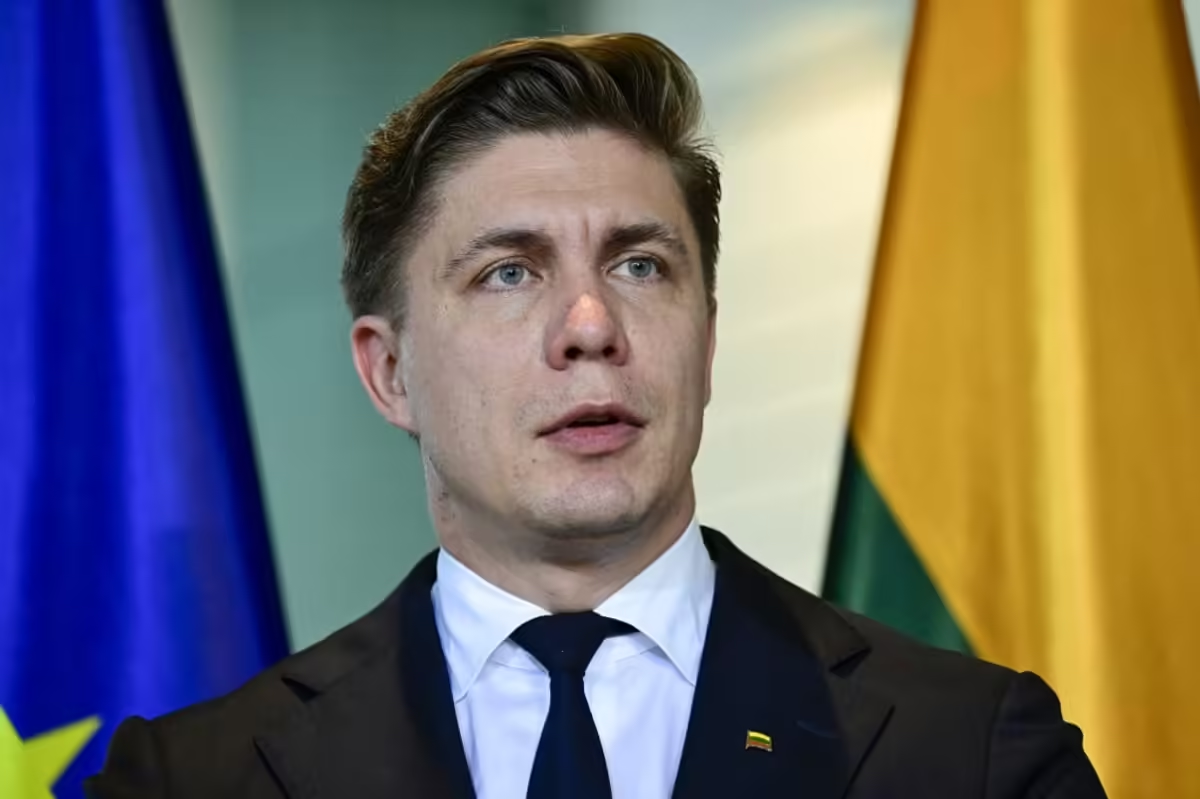

Lithuanian Prime Minister Mindaugas Sinkevičius warned Europe against growing tired of the war in Ukraine, saying Ukrainians are fighting for peace across the continent, while a Russian victory could push Moscow to seek “other directions.”
“We cannot have war fatigue. We are not the ones at war. They are, and they are fighting for Europe’s peace,” Sinkevičius said, according to Politico.
JOIN US ON TELEGRAM
Follow our coverage of the war on the @Kyivpost_official.
“The rest of Europe is coming to the point of acknowledging that we cannot ignore what is happening in Leipzig, Denmark, and elsewhere,” Sinkevičius told Germany’s WELT in comments on Monday, Oct. 5.
The Lithuanian leader said Russian activities once viewed primarily as a threat to NATO’s eastern members were now spreading across the continent.
“It is not a question of proximity,” he said, pointing to drone incursions, GPS interference, sabotage attacks, and Russia’s weaponization of migration through Belarus.
Concrete NATO response
Sinkevičius argued that political condemnation alone is insufficient as Russia increasingly employs operations that remain below the threshold of conventional war.
“NATO is trying to address it politically. What we need is a concrete plan for how the Alliance reacts,” he said, adding that he hoped such a plan would emerge soon.
He did not publicly specify what should automatically trigger a NATO response or what form retaliation should take.
Lithuania has previously called for greater joint investment in air and missile defenses, cybersecurity, border surveillance, and the protection of critical infrastructure.
Other Topics of Interest
Russia Strikes Kryvyi Rih Hospital, 3 Wounded
Two women underwent surgery after Russia attacked the city center with two Banderol loitering munitions.
The government in Vilnius describes Russian hybrid operations as a systematic campaign against NATO rather than a series of unrelated incidents.
Recent cases include the attempted explosive-drone attack at Germany’s Leipzig-Halle Airport, which Berlin formally attributed to Russia, as well as drone incursions and suspected sabotage across Europe.
European intelligence assessments also indicate that Moscow has ordered an intensification of hybrid operations targeting military facilities, transport networks, communications infrastructure, and other strategic sites.
Russia has repeatedly denied conducting sabotage or preparing attacks against NATO members.
Article 5 threshold
Hybrid operations create a particular problem for NATO because they are designed to cause damage while maintaining uncertainty over who was responsible and whether the incident qualifies as an armed attack.
NATO Secretary General Mark Rutte has said the alliance deliberately avoids announcing the precise threshold for activating Article 5, its collective-defense clause, so adversaries cannot calculate how far they can escalate without triggering a joint response.
Since 2016, the alliance has maintained that a sufficiently serious hybrid operation could lead NATO members to invoke Article 5, although any decision would be made collectively and depend on the circumstances.
Rutte recently described the term “hybrid attack” as too mild for operations involving drones, sabotage, and cyberattacks. He said NATO possesses both public and undisclosed response options and does not necessarily have to retaliate in kind.
NATO is also developing broader plans to confront a possible Russian attack by combining conventional forces with drones, artificial intelligence, and integrated battlefield systems.
Lithuania’s warning
Sinkevičius warned that a Russian victory in Ukraine could encourage Moscow to search for “other directions” for expansion or pressure.
He urged European governments not to become fatigued by the war, stressing that Ukrainians were fighting not only for their country but also for peace across Europe.
The Lithuanian prime minister also said Russian President Vladimir Putin had successfully subordinated much of Russia’s economy to the war, making the Kremlin more difficult to predict despite its internal economic problems.
Source: www.kyivpost.com