

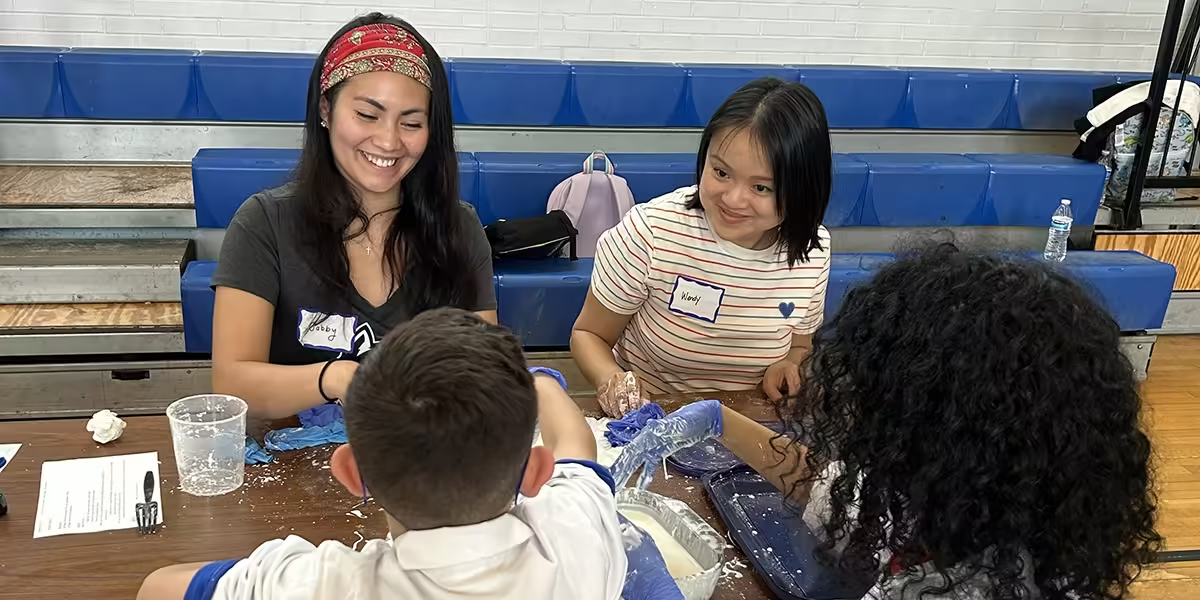

At a family science event in Hartford, a volunteer used salt-dough bones and modeling clay to show how cartilage protects joints. When she removed the “cartilage” and ground the bones together to simulate arthritis, one elementary school student exclaimed, “It’s like my grandpa!”
Courtesy of Patricia Hare
Graduate students and Cena y Ciencias leaders Gabriela Soriano and Wendy Mok work with Burns Latino Elementary School students to create oobleck, a cornstarch-and-water mixture that resembles cartilage, at the 2025 outreach event, “Cartilage: Your Skeleton’s Best Friend!”
That moment of connection captured what I wanted science outreach to be: not an abstract lecture, but a connection between science and everyday life.
During my Ph.D. training at UConn Health, I saw many opportunities to volunteer in science outreach. But those programs often served affluent school districts with established science, technology, engineering and mathematics, or STEM, resources. Just a few miles away in Hartford, students did not always have the same opportunities. I wanted to help close that gap.
At a conference, I met a student from the University of Illinois Urbana-Champaign who told me about Cena y Ciencias, or Dinner and Science. The program brings Latino families together with graduate scientists, using a shared meal to open conversations about science. I was drawn to its focus on the whole family. Children may be curious about science, but families also shape whether they see research as a possible career.
What if families could meet scientists as people rather than distant geniuses? What if they could see a place for their children in science?
I approached my lab mate, Juliet González, about creating a similar program for Hartford’s predominantly Spanish-speaking public schools. We founded CyC CT in late 2024 to create a welcoming space where families could explore science together.
With support from grants, including the American Society for Biochemistry and Molecular Biology Science Outreach and Communication Grant, we bought digital microscopes, lab coats and other equipment and designed hands-on activities.
At our first event, elementary school students learned about DNA and the central dogma of molecular biology through a paper puzzle. They matched shapes to “transcribe” RNA from DNA and translated the sequence into letters spelling “Curiosidad” or “Yo <3 STEM.” They took home friendship bracelets bearing the phrases.
The most rewarding feedback has come from families. Parents often tell us, “I learned something new!” At one event, we even had three generations of family members working on paper flowers to learn about capillary action in plant stems. Children are encouraged to teach the lessons back to volunteers and parents, showing us how they have connected our science lessons to their everyday lives (or their grandparents’ knees!).
Since our first event in February 2025, we have led more than 10 programs for students and families at Burns Latino and María Sánchez Elementary Schools. The children are years away from choosing a college or career, and we do not know whether our program will measurably change diversity in science.
For now, that is not the point. The goal is to show up for Hartford’s Latino families, invest in young learners and make room for families to explore science together. When children see researchers who look like them and speak their language, they can understand that science belongs to them, too.
Source: www.asbmb.org