



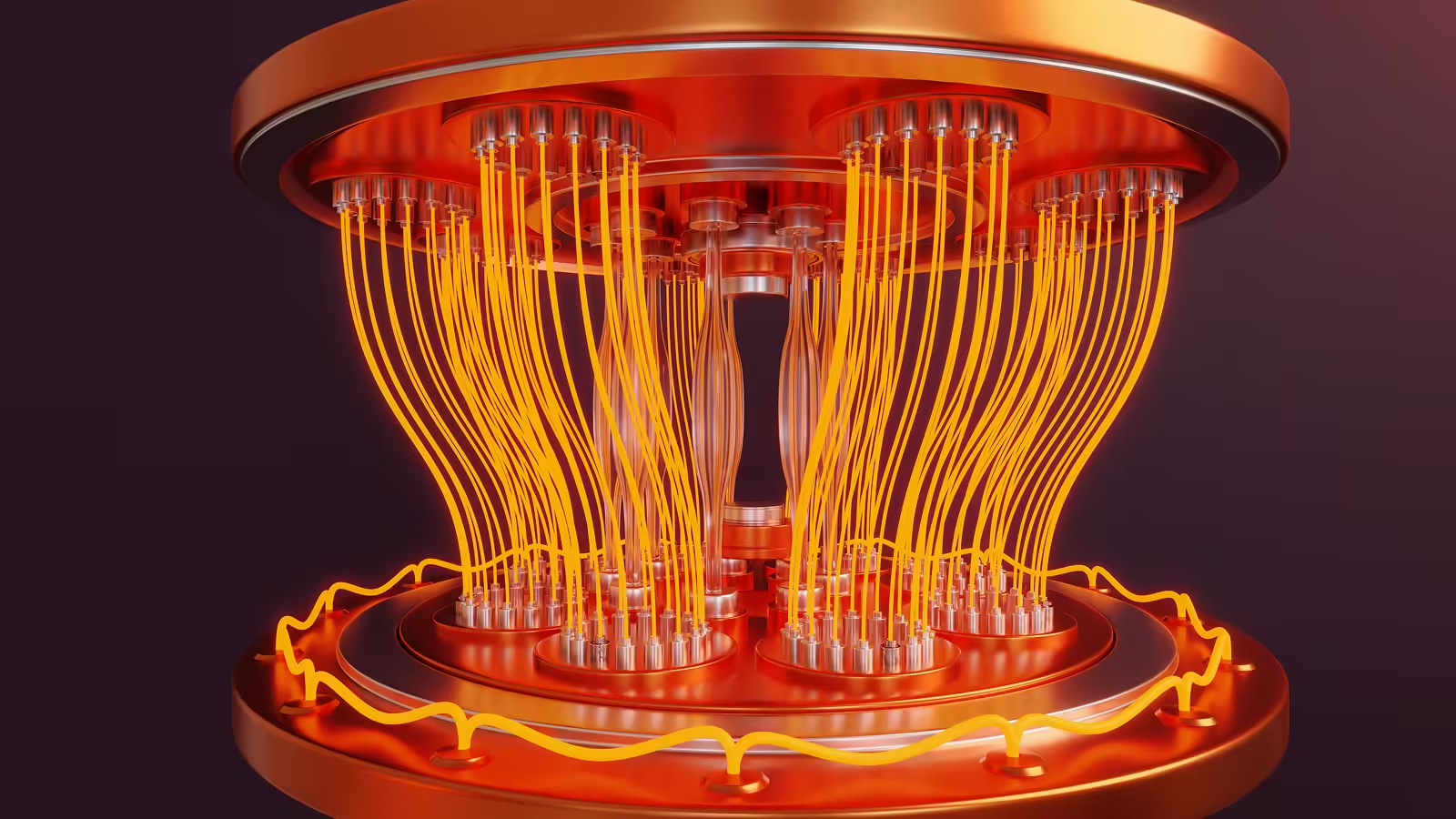

Researchers have developed a new type of interconnected architecture for quantum computing chips, and it could pave the way for machines capable of large-scale processing, including those with over a million qubits.
In a study published June 15 in the journal APL Quantumscientists aimed to resolve a huge problem with the leading quantum processing units (QPUs): Qubits struggle to communicate and share quantum information with each other if they aren’t immediate neighbors.
That’s why the scientists pioneered Quantum Phononic Links (QPLs) — an approach for long-range coupling between qubits that leans on phonons — quasiparticles that carry vibration energy — to convey information. By contrast, conventional methods, like surface acoustic waves — high-frequency sound vibrations — demand complex designs and extra hardware.
Latest Videos FromLive Science
“One of the key challenges in quantum computing is long-range qubit connectivity,” Maksym Myronovan associate professor of semiconductor materials and devices at the University of Warwick in the U.K. and first author of the study, said in a statement. “Our work introduces a new concept in which phonons act as a quantum bus, enabling distant qubits to exchange quantum information while remaining fully compatible with semiconductor technology.”
In the study, the scientists said the most promising way to achieve a quantum computer that’s capable of large-scale processing and takes advantage of QPLs would be a qubit modality known as “semiconductor hole spin qubits.”
A “hole” here refers to the absence of an electron in a material, but it can act like a particle and have a spin state — a property used to encode quantum information — where the 1s and 0s of data would be represented by the direction of the particle’s spin state.
To demonstrate this technology, they created a prototype QPU consisting of silicon with a thin germanium crystal layer, a specialized material they called compressively strained germanium on silicon (cs-GoS). Germanium is an especially useful material for quantum computing, the scientists said, as it has natural properties that reduce decoherence — the loss of quantum information due to external interference.
Get the world’s most fascinating discoveries delivered straight to your inbox.
Hole spin qubits combine long quantum coherence times — how long they can retain quantum information — with the ability to communicate using electron impulses in control systems. But they struggle to form bonds and share quantum information with qubits they don’t directly neighbor. In any large-scale system, for instance, enabling this “quantum coupling” between distant qubits is essential for quantum error correction techniques to work effectively across the breadth of a massive system, the scientists said.
Other proposed long-range communications approaches, such as “charge shunting” — redirecting capacitors to reduce sensitivity to charge noise, or surface acoustic waves — have fundamental limitations regarding scalability, both in terms of their size and in maintaining coherence. That’s where QPLs come in.
QPLs are engineered phononic waveguides and cavities that both confine and guide acoustic modes within a compressively strained germanium “quantum well,” where a quantum well is an ultrathin layer that acts as a guide.
In the study, the researchers focused on qubits using valence-band holes — the absence of electrons at absolute zero — hosted using cs-GoS. With QPLs, the scientists sent sound-like vibrations through the specialized material to carry quantum information between the distant qubits.
Spin states in this material are highly sensitive to lattice deformations, which enable precise control and the coupling of spin states with vibrational energy. Essentially, this allows the spin state to be distinguishable from its electron counterpart, enabling the phononic coupling strategies. The technique they adopted permitted direct coupling between the phonons and the hole spins.
By using a slow wave velocity (the speed of a quantum particle) and a short wavelength for acoustic excitations, the scientists used QPLs to link qubits separated by less than a micrometer (one-thousandth of a millimeter) and those up to 300 mm (11.8 inches) apart.
QPLs are not only promising for quantum computing, the scientists pointed out in the study. By utilizing phonons as the connections, this technique offers a versatile interface for hybrid quantum systems — conventional computers with quantum computing functionality. This could enable coherent interconnection of semiconductor spin qubits with other quantum platforms, such as cloud-based quantum computing.
The combination of phononic engineering and hole-spin physics makes cs-GoS a promising platform for next-generation quantum architectures, they added, since it could achieve both long-range coherent coupling and large-scale integration.
Myronov, M., Yonjali, Y. K., Mnaymneh, K., & Studenikin, S. (2026). Quantum phononic links for on-chip long-range coupling of hole spin qubits in compressively strained germanium on silicon. APL Quantum, 3(2). https://doi.org/10.1063/5.0332643
Can you match these ancient devices to their pictures? Find out with our computing quiz!
Source: www.livescience.com