



China has opened a new military training and logistics facility in Laosextending Beijing’s security presence deeper into mainland Southeast Asia and potentially giving the Chinese air force its first dedicated foothold overseas.
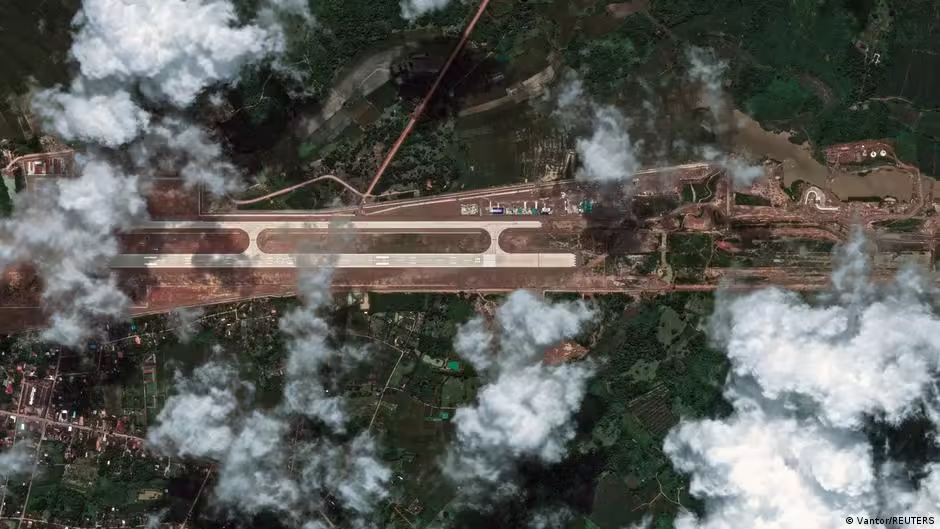
The China-Laos Joint Support and Training Center at Ban Keun Airport, north of the capital Vientiane, formally began operations late last month alongside the new China-Laos Friendship Aviation Academy.
Beijing says the center will primarily help train Lao air force pilots and will be jointly maintained and operated by the two countries.
The opening adds to China’s still relatively small network of overseas military facilities.
Beijing established its first foreign military base in Djibouti in the Horn of Africa in 2017. A Chinese-funded expansion of Cambodia’s Ream Naval Base was formally inaugurated last year, giving Chinese forces access to a facility strategically positioned near the South China Sea.
Laos and Cambodia are widely regarded as China’s closest political partners in Southeast Asia, and military cooperation with both has expanded substantially in recent years.
“The two institutions … are not directed against any third party and aim to help further deepen practical cooperation between the two militaries and contribute to maintaining peace and stability in the region,” said the Chinese Defense Ministry in a public statement.
Could Ban Keun become a permanent Chinese base?
The facility’s infrastructure gives Beijing the option of expanding its military use in the future, Hunter Marston, director of the Southeast Asia Program at Australia’s Lowy Institute, told DW.
“The focus may well be on joint training, but it has the potential to become a more permanent base. Should Beijing choose to use it as such, it has ample political leverage over Vientiane to demand exclusive access in the future,” he added.
Laos has become heavily dependent on Chinese investment and financing during the past two decades. Critics have frequently accused Beijing of engaging in “debt-trap diplomacy.”
The International Monetary Fund estimates Laos’ public debt at around 81% of GDP last year, with China by far the largest bilateral creditor.
In 2020, China’s state-owned China Southern Power Grid acquired a reported 90% stake in Electricite du Laos Transmission Company, which operates much of Laos’ electricity transmission network.
A more durable Chinese military presence in Laos would also add another dimension to the strategic competition between Beijing and Washington in Southeast Asia.
The United States still enjoys far more extensive military access across the wider Indo-Pacific, particularly through alliances with the Philippines, Japan and Australia.
Beijing has historically lacked comparable overseas facilities. But Ban Keun, alongside Ream, could gradually reduce that disadvantage by giving the Chinese military additional locations from which to train, maintain equipment and potentially preposition supplies.
It is a particularly ominous development for VietnamEuan Graham, a senior fellow at the Australian Strategic Policy Institute, told DW.
Hanoi and Beijing retain close party-to-party and economic relations, but they remain rivals in the South China Seawhere their competing territorial claims have repeatedly generated tensions.
Vietnam has also traditionally viewed Laos and Cambodia as strategically important buffers along its western flank and has worked for decades to maintain considerable political and military influence in both countries.
“Hanoi has always perceived the Indochinese peninsula as within its sphere of influence, offering a buffer against external aggressors, especially given Vietnam’s narrow midriff,” said Graham. “Now, it faces an alarming possibility of strategic encirclement by China. The new air base in Laos will certainly complicate Vietnam’s defense planning.”
Strategic importance should not be overstated
Other analysts caution, however, that geography places clear limits on Ban Keun’s military value.
Collin Koh, a senior fellow at the S. Rajaratnam School of International Studies at Singapore’s Nanyang Technological University, told DW that China could gradually expand its presence at the facility.
Beijing could deploy more personnel, particularly advisers and instructors, as well as trainer aircraft and eventually more advanced aircraft, while also using the site to preposition equipment and supplies, he said.
But the “operational usefulness for the PLA’s projection of military power in Southeast Asia is constrained by the landlocked nature of Laos.”
Unlike Ream, Ban Keun provides no sea access, while Chinese military aircraft already operate from substantially larger and better-equipped bases in southern China.
While Vietnam will closely monitor Ban Keun for its potential role in any future South China Sea conflict, the site’s geography doesn’t give the Chinese military a significant operational advantage, said Koh.
Simon Creak, an associate professor at Singapore’s National Institute of Education and a historian of Laos, noted that Vientiane has maintained a policy of non-alignment since adopting its current foreign policy in 1986.
“It has not had similar joint facilities in the past despite boasting close political and military relations with Vietnam, as well as China and Russia … and any mention of foreign bases in Laos typically recalls the CIA’s bases during the Indochina Wars,” Creak said.
Still, he believes it’s “highly unlikely” that Laos will adjust its formal foreign policy settings or its longstanding effort to balance relations with Vietnam, Thailand and China.
Edited by: Keith Walker
Source: www.dw.com